The break
S&P 500 1,356.56 · −83.95 · −5.83%
The mania's obituary was written not by disillusion but by arithmetic: borrowed conviction, running in reverse, on a Friday.
The day's protagonist
The margin clerk — no symbol.
Move: The calls went out Thursday night
The morning's core CPI came in hot — 0.4 percent against expectations — and rates fear met a market already five weeks into puncture. Margin debt had doubled in a year: buying stocks with the stocks as collateral. It ran in reverse into a Friday. The Nasdaq's 9.67 percent fall was its worst day ever to that point, capping its worst week ever, and this time the selling took the S&P and the Dow with it — all thirty Dow stocks down, the broad index down 5.83. The weekend's famous question — meet the call, or sell? — had already been answered by the machinery.
The deeper account
Trigger: core CPI +0.4% against expectations — a rates scare landing on a market that had already lost its floor of new believers.
Margin debt had roughly doubled in the year to March 2000; April's unwind was the textbook epilogue, and the Fed's margin-requirement debate that spring came too late to matter.
The composite closed 34% below the five-week-old peak. It would rally through the summer, fooling nearly everyone, before the long grind to 1,114.
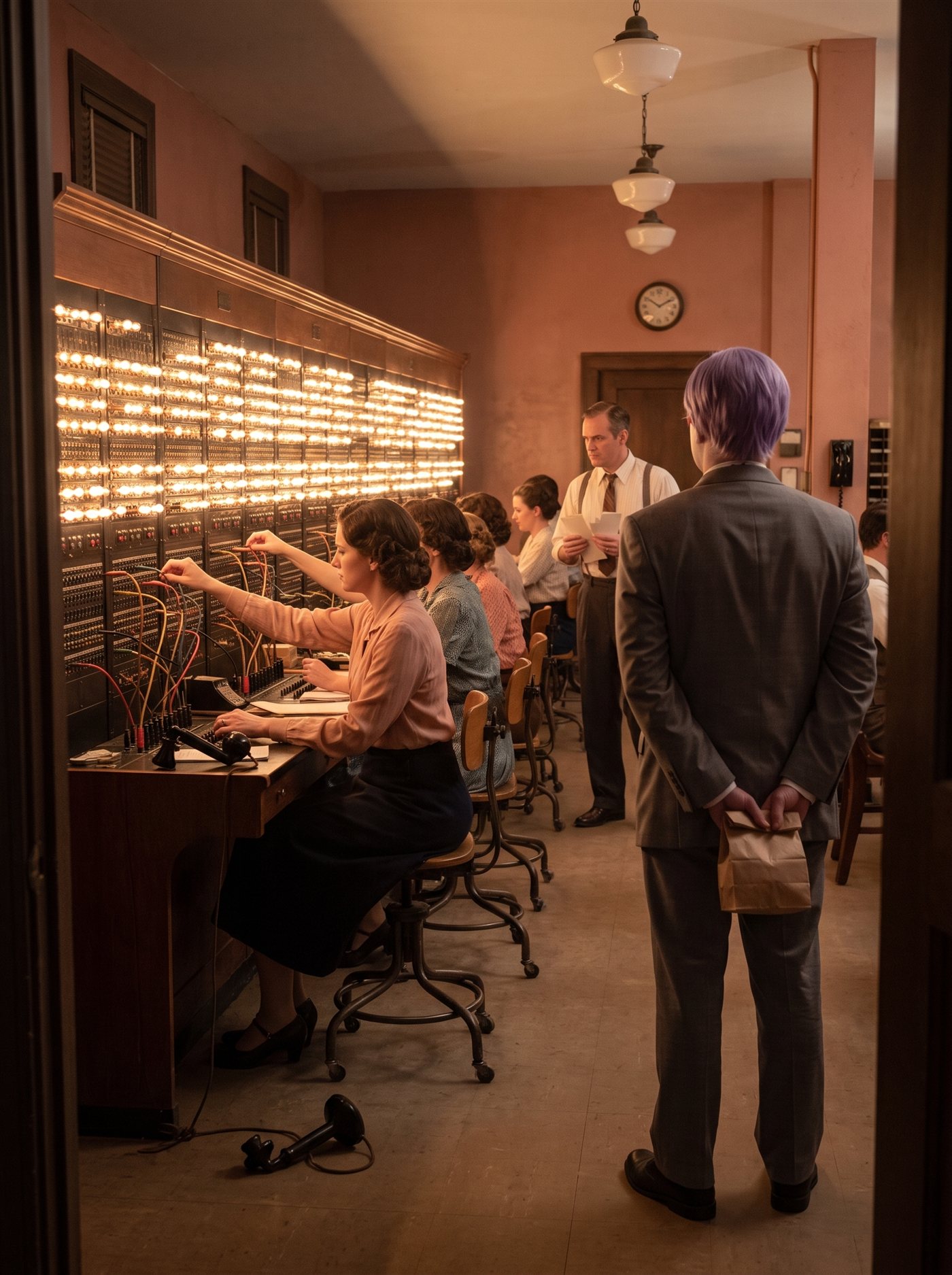
In the photograph of this day every lamp on the board is lit at once and the operators cannot seat the cords fast enough. He stands at the end of the aisle with his bag; retail's own line was ringing somewhere on that wall, and he knew it.
Between this page and the wing's next stands a different world: the towers fell seventeen months later.
The artifact
The form's two printed lines hold the whole mechanism: the deposit was due before the open, and the collateral was the very thing being sold. A year of doubling margin debt ran in reverse in one Friday — the fast index's worst day and worst week to that point, every one of the old names down with it. The famous weekend question arrived pre-answered, which is what the stamp means.
Read the notice
Printed text is shown plain; the night clerk's entries are shown in script.
THE EXCHANGE · THURSDAY NIGHT, APR 13 · BY WIRE · NOTICE OF MARGIN CALL
- deposit required: before the open. collateral held: the shares themselves. DOUBLED IN A YEAR. BOUGHT WITH WHAT THEY BOUGHT.
- the question on the form: meet, or sell? answered by the machinery, before morning.
- CALLED
- NIGHT CLERK'S TALLY, FRIDAY AT THE BELL: the fast index: −9.67%. its worst day yet. the week: −25.3. its worst ever. all thirty of the old names: down.
- BORROWED CONVICTION, RUNNING IN REVERSE · THE OBITUARY WAS WRITTEN BY ARITHMETIC, NOT DISILLUSION
On Friday, April 14, 2000, a hot core CPI print met a market five weeks past the Nasdaq's peak, and a year's doubling of margin debt unwound at once: the Nasdaq fell 9.67 percent — its worst day to that point, ending its worst week ever at −25.3 percent — while the S&P 500 fell 5.83 percent to 1,356.56 and all thirty Dow stocks closed down, the Dow off 617.78 points. The composite closed 34 percent below its five-week-old peak.
The ledger — what actually happened
| Measure | Close | Change | Marginalia |
|---|---|---|---|
| S&P 500 | 1,356.56 | −83.95 · −5.83% | the sell-off leaves tech and takes everything |
| Nasdaq Composite | 3,321.29 | −355.49 · −9.67% | its worst single day to that point — 34% below the peak, five weeks on |
| Nasdaq, that week | −25.3% | the worst week in its history | |
| Dow Jones | 10,305.77 | −617.78 · −5.66% | all thirty stocks down |
Sources
- TIME — Top 10 Dow Jones Drops: April 14, 2000 — https://content.time.com/time/specials/packages/article/0,28804,1845523_1845619_1845554,00.html
- EBSCO Research Starters — NASDAQ Dive Prompts Dot-Com Crash — https://www.ebsco.com/research-starters/economics/nasdaq-dive-prompts-dot-com-crash
- Johansen & Sornette — The Nasdaq crash of April 2000 (European Physical Journal B)