The barrel and the gallon
S&P 500 7,656.98 · +65.28 · +0.86%
The S&P 500 rose 65.28 points to 7,656.98 on Friday, eighty-six hundredths of one percent, its best session of the week and the end of a four-day slide, because crude oil fell about three percent in the course of an afternoon. The same morning, the Bureau of Labor Statistics published August consumer prices — four tenths on the month, with gasoline alone, up 3.9 percent, accounting for more than a third of the whole increase. The same day, AAA put the national average price of a gallon of diesel at six dollars and six cents: above six dollars for the first time in the country's history, up twenty-one cents in a week, a third record inside seven days, and about sixty-three percent higher than a year ago. And the same day, at ten o'clock, the University of Michigan published its preliminary September reading of how Americans feel about their own finances. It was 47.8, the second-lowest figure in a survey that has been asking since November 1952. The market trades the barrel. The country buys the gallon. On Friday they went opposite ways, and the market was the one that got the good news.
The day's protagonist
Diesel — no symbol.
Move: $6.06 a gallon — the first national average above six dollars ever recorded, up 21 cents in a week and about 63 percent in a year
There is no company in this day either. The protagonist is a grade of fuel. On Friday AAA reported the American national average for a gallon of diesel at six dollars and six cents — the first print above six dollars there has ever been, twenty-one cents dearer than a week earlier, the third record inside seven days, and roughly sixty-three percent above the three dollars seventy of a year ago. California was at seven ninety-eight. Since the war with Iran began in late February the national figure has risen about sixty percent. The important thing about that number is that it did not come from the barrel, and it will not be fixed by the barrel. Crude fell around three percent on Friday, on a report that Iran will sit down with the Gulf states in Oman on Monday, and the stock market took the afternoon off on the strength of it. Diesel went up anyway, because the constraint is not what comes out of the ground, it is what comes out of a refinery, and refineries in the Middle East and Russia have been damaged while Russia has capped its own exports to keep its home market supplied. A barrel that nobody can crack is not fuel. And diesel is the grade that matters most and gets talked about least: it moves freight, works farmland and runs construction plant, which is the belt that carries an energy shock into the price of everything that has to be driven somewhere. The August consumer price index, published the same morning, is what that belt looks like after four weeks of it — gasoline up 3.9 percent on the month and 27.4 on the year, accounting on its own for more than a third of the whole rise in the cost of living; the energy index up 16.3 percent over twelve months against 3.4 for all items and 2.7 for food. Inflation in America in August was, to a first approximation, one line. And the third number of the morning was the one nobody trades: 47.8 on the University of Michigan's preliminary September sentiment index, down from 51.7, against 51.0 expected, the second-lowest reading in a survey that has been asking the same question since November 1952. Only this May, at 44.8, has ever been lower. Consumers now expect prices to rise 4.6 percent over the coming year, up from 4.0 in August; the survey's director pointed at fuel and said people anticipate greater pressures on their pocketbooks to come. So the eleventh of September gave three readings of the same commodity — a barrel that fell, a gallon that made history, and a mood that has been worse exactly once — and the stock market rose eighty-six hundredths of one percent.
The deeper account
The index opened at 7,636.75, forty-five and five hundredths of a point above Thursday's close, and that opening print turned out to be the lowest price of the day — it never went back. It gained 30.97 points in the first ten minutes of trading, so that by twenty to ten it already stood 10.74 points above where it would eventually finish. The high, 7,677.02, arrived thirty minutes after the bell and was never beaten; the twenty-past-one bar came within seventy-nine hundredths of it and stopped. Everything after that was a slow give-back of about twenty points into the close. Bell to bell the session was worth 20.23 points and the gap it opened on was worth 45.05, which is sixty-nine percent of the day. The whole range, 40.27 points, was smaller than the gap. Thursday had done precisely the same thing in the other direction — a 41.62-point gap down into a 32.80-point range — and the two together make the only pair of their kind this year. Across all 174 sessions of 2026, sixteen have opened on a gap larger than the day they then had; 10 September and 11 September are the only two of the sixteen that landed on consecutive days, and they point opposite ways. Put them end to end and the two overnight gaps very nearly cancel, −41.62 against +45.05 for a net of three and a half points, while the two sessions themselves add seventeen. The index finished twenty and sixty-two hundredths above where Wednesday left it, and sixty-one and sixty-two hundredths below where the week began.
Three numbers were published on Friday morning and they describe the same commodity from three distances. At half past eight the Bureau of Labor Statistics said August consumer prices rose four tenths of a percent, the fastest month in three and exactly what was expected, with the annual rate held at 3.4. The detail is where the day is. The Bureau's own sentence reads: the index for gasoline rose 3.9 percent in August, accounting for over one third of the monthly all items increase. One line item, more than a third of the cost of living. Over twelve months gasoline is up 27.4 percent and the whole energy index 16.3, against 3.4 for all items, 2.7 for food and 2.4 for core. Core was the one miss — three tenths on the month against two expected, the fastest since April, concentrated in services that are not housing, which rose half a percent. Then at ten o'clock the University of Michigan published its preliminary September sentiment reading: 47.8, down from 51.7, against 51.0 expected, the second-lowest figure in a survey that has been asking Americans the same question since November 1952. Only 44.8, this May, has ever been lower. One-year inflation expectations went from 4.0 percent to 4.6, and the survey's director named fuel costs.
And the third number, which is not a statistic but a price: AAA reported the national average for a gallon of diesel at six dollars and six cents, the first time it has ever been above six dollars. Twenty-one cents in a week. The third record inside seven days. About sixty-three percent above where it sat a year ago, and about sixty percent above where it sat in February. What makes that number resistant to good news is that it is not really about crude. Crude fell on Friday — around three percent, on a report that Iran will meet the Gulf states in Oman on Monday, in Salalah, the first such meeting since the war began more than six months ago — and the stock market rose on exactly that. Diesel rose anyway, because the constraint is refining rather than extraction: refineries in the Middle East and in Russia have been damaged, and Russia has capped its own exports to keep its home market supplied. A barrel nobody can crack is not fuel. The market can trade the barrel intraday; the country has to buy the gallon, and on Friday the two went opposite ways. The tape shows the split cleanly enough. United rose 3.14 percent, Delta 2.13, Southwest 1.42, American 1.17 — companies that buy fuel by the tanker, having a good afternoon. The energy sector rose 0.30 on a day the crude fund fell 2.24, the mirror image of Thursday, when energy fell on a day crude rose five and a half. Two sessions running, the sector did the opposite of the barrel.
What actually led the rally was none of this. Oracle had reported after Thursday's close — cloud infrastructure revenue up 121 percent to $7.4bn, remaining performance obligations of $664bn, and capital expenditure guided to between ninety and ninety-five billion dollars for the year — and on Friday Oracle's own shares fell 1.76 percent while the companies that will be paid out of that money went up in double digits. Hewlett Packard Enterprise rose 12.42 percent, Dell 11.95 on the same read-through plus an RBC initiation at outperform with a $640 target, Vicor 10.98, Super Micro 7.28, Flex 7.18, Skyworks 5.15. Technology finished best of eleven sectors at +1.33, the semiconductor fund +1.46, nine sectors green, utilities and health care the only two red. A capital expenditure is somebody else's revenue line, and Friday priced both halves of that sentence inside one session: the spender fell, the suppliers ripped. Elsewhere Copart agreed to buy ACV Auctions for $10.50 a share in cash and ACV rose 44.20 percent on ninety-four million shares against a four-million average, while Copart itself fell 2.63. And underneath all of it the rate meeting moved: the implied odds of a quarter-point increase on the fifteenth and sixteenth went from 72 percent on Thursday to 87 on Friday, the two-year yield to its highest since the middle of 2024, the ten-year to its highest since October 2023, and the thirty-year to a level last printed in May 2007 — while the long-Treasury fund barely moved, because the whole adjustment happened at the front end, where the meeting is.
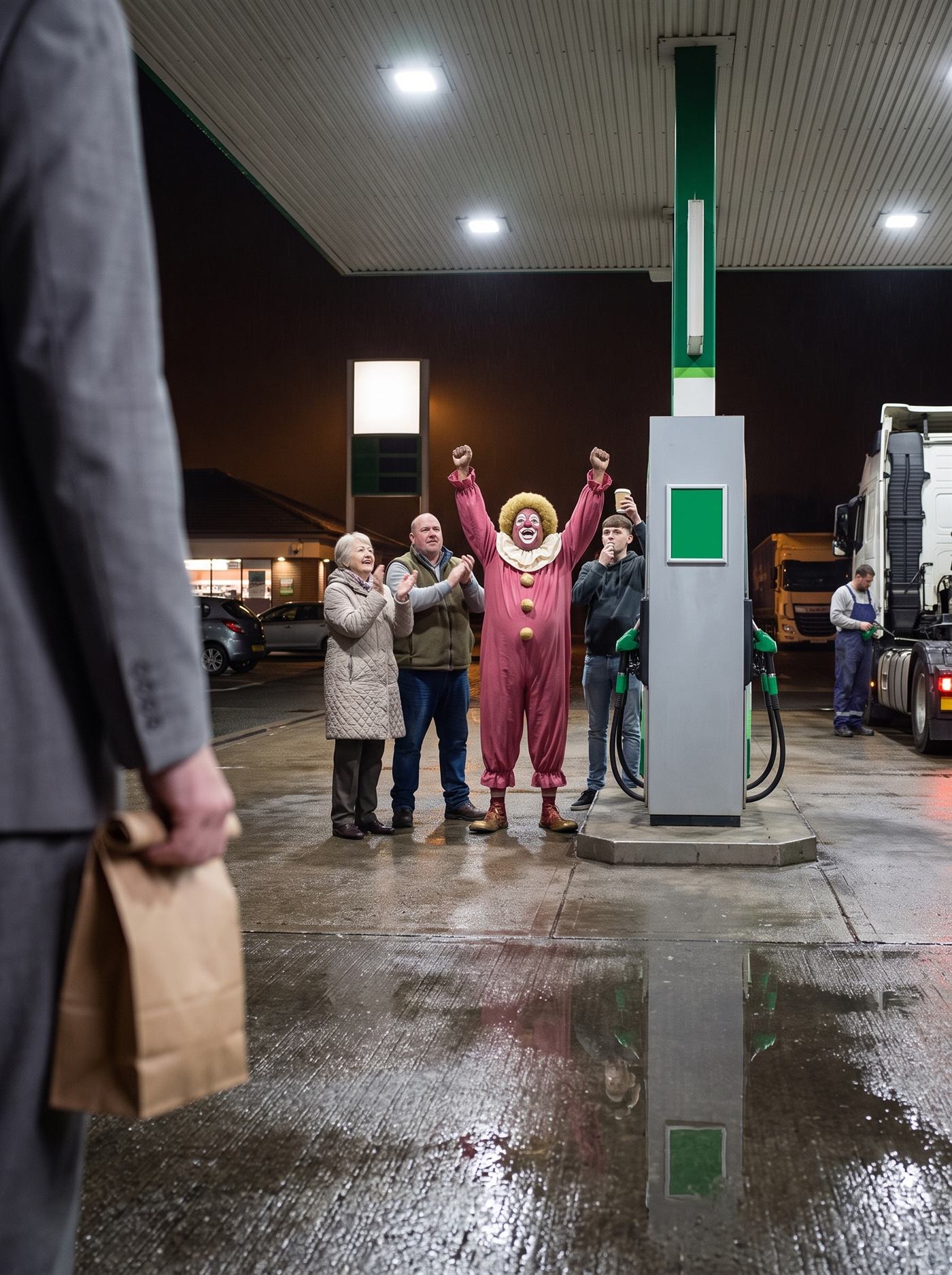
The artifact is a receipt from a diesel pump — one ordinary fill of a tractor unit's saddle tanks, a hundred and eighteen gallons and four tenths, at Friday's national average printed the way a pump prints it. Seven hundred and eighteen dollars fifty-seven. The same fill a year ago was four hundred and thirty-nine fifteen, so the year has added two hundred and seventy-nine dollars and forty-two cents to filling one truck once. And at the foot of it the machine asks how it did, and prints five empty boxes for the answer. Nobody ticked any of them; nobody ever does. The photograph is the same joke told the other way round. On a wet forecourt under a canopy at one in the morning, a large clown called Breakout stands at the pump with both fists above his head at the top of a cheer, and a few ordinary travellers applaud the fuel pump with him — because for one afternoon the thing got cheaper. Nobody is looking at the camera and nobody is looking to the left. At the left, closest to the lens, is a man in a grey suit half a size too big, and he is so close to the camera that the top of the frame cuts him off at the chest: his head, his face and his painted spectacles are not in the picture at all. All that is in it is one sleeve, one fist, and a small brown paper bag held shut. His dossier has said for a year that on the great days he is always just outside the celebration's frame, holding the bag. This is the first time the camera has taken him at his word.
The artifact
The price on this receipt is Friday’s national average, printed the way a pump prints it — six dollars and six cents, rendered to the tenth. It is the first time the American average for a gallon of diesel has been reported above six dollars, it is twenty-one cents higher than it was a week ago, it is the third record inside seven days, and it is about sixty-three percent above the three dollars seventy of a year ago. A hundred and eighteen gallons is one ordinary fill of a tractor unit’s saddle tanks; the difference between the two totals, two hundred and seventy-nine dollars and forty-two cents, is what a year has added to filling it once. Multiply it by the number of trucks on the interstate at eleven o’clock at night and you have the reason the word “transitory” has not been used in public since February. And then, at the foot, where every receipt printed in this country carries the same line, the machine asks how it did. Five boxes, nothing ticked. On the same Friday morning a different survey put the same question to the country — it has been asking since November 1952, in the same words, about how people are getting along financially these days — and the answer came back 47.8, the second-lowest figure it has ever been given, beaten only by this May. The stock market, reading the same morning’s paperwork, rose eighty-six hundredths of one percent.
Read the receipt
ISLAND 3 · PUMP 07
SEP 11 2026 · 22:41
- PRODUCT · DIESEL №2
- GALLONS · 118.400
- PRICE/GAL · $6.069
- TOTAL · $718.57
The same fill, one year ago:
- PRICE/GAL · $3.709
- TOTAL · $439.15
- DIFFERENCE · $279.42
HOW ARE WE DOING? · RATE YOUR VISIT
Thank you — drive safe.
The ledger — what actually happened
| Measure | Close | Change | Marginalia |
|---|---|---|---|
| S&P 500 | 7,656.98 | +65.28 · +0.86% | opened 7,636.75, which was also the day's low — the index never traded below its opening print. High 7,677.02 in the 10:00 bar, range 40.27. The first rise in five sessions, and the 23rd-largest gain of the year's 174 |
| The gap, before the bell | +45.05 | the distance between Thursday's close and Friday's open, carrying 69.01 percent of the day's gain. August consumer prices landed at 8:30, an hour before the exchange opened, and crude was already falling on the Oman headline | |
| The session, bell to bell | +20.23 | 7,636.75 at half past nine to 7,656.98 at four. Thirty and ninety-seven hundredths of it was made in the first ten minutes: by twenty to ten the index stood 10.74 points above where it would close, and the remaining six hours and twenty minutes were spent inside a 26-point band | |
| The gap, and the range | 45.05 / 40.27 | the gap was bigger than the whole day. Sixteen of 2026's 174 sessions have done that — and 10 September and 11 September are the ONLY two of the sixteen to land back to back, in opposite directions, −41.62 then +45.05. Two consecutive days decided while the market was shut | |
| Diesel, national average | $6.06 | AAA, Friday. The first American national average above six dollars a gallon ever recorded; +21 cents on the week, the third record inside seven days, about +63 percent on the year, about +60 percent since the war began in late February. California $7.98. Regular gasoline $4.29, +15 cents on the week | |
| Gasoline, in the August index | +3.9% m/m | the Bureau's own sentence: the gasoline index rose 3.9 percent in August, "accounting for over one third of the monthly all items increase." Up 27.4 percent over twelve months. One line item, more than a third of the cost of living | |
| August consumer prices | +0.4% / 3.4% | the fastest month in three, matching consensus, with the annual rate held at 3.4 as expected. Core was the miss: +0.3 on the month against 0.2 forecast, the fastest since April, though the annual core eased to 2.4 from 2.5. Supercore — core services less housing — rose 0.5, its largest month in four | |
| Energy, over twelve months | +16.3% | against all items at 3.4 percent, food at 2.7 and core at 2.4. The energy index rose 2.1 percent in August alone. This is the number the Federal Reserve is being asked to raise rates against, and it is not a demand problem | |
| Consumer sentiment | 47.8 | the University of Michigan's preliminary September index, from 51.7 in August against 51.0 expected — the second-lowest reading in a survey conducted since November 1952, behind only 44.8 this May. One-year inflation expectations went to 4.6 percent from 4.0; the five-year to 3.4 | |
| Crude | −2.24% | the feed's crude fund, 158.38 to 154.84, after Iranian state media said Tehran will meet the Gulf states in Oman — Salalah, Monday, the first such meeting since the war began over six months ago. Both benchmarks still finished the week up about eight and a half percent, a second straight weekly rise. The press quoted Friday's settles at six different levels and this page prints none of them | |
| Technology | +1.33% | the best of eleven sectors, ahead of industrials +1.07 and communication services +0.98. Nine of eleven green; utilities −0.33 and health care −0.18 the only fallers; spread 1.66. Energy rose 0.30 on a day crude fell 2.24 — the mirror of Thursday, when energy fell 0.58 on a day crude rose 5.61 | |
| Hewlett Packard Enterprise | 62.08 | +12.42% | with Dell +11.95, on Oracle's capital expenditure guidance of $90bn to $95bn for the year, published after Thursday's close. Dell also had an RBC initiation at outperform with a $640 target and was the second-biggest gain in the index. Vicor +10.98, Flex +7.18, Super Micro +7.28, Skyworks +5.15, the semiconductor fund +1.46 |
| Oracle | 150.26 | −1.76% | the company whose bill lifted them all fell. Cloud infrastructure revenue up 121 percent to $7.4bn, remaining performance obligations $664bn, and ninety to ninety-five billion dollars of capital expenditure guided for the year. A capital expenditure is somebody else's revenue line, and Friday priced both halves of that sentence in one session |
| ACV Auctions | 10.41 | +44.2% | Copart said late Thursday it will buy the company for $10.50 a share in cash, about $1.9bn. ACV traded 94.1 million shares against a 3.9 million average; Copart fell 2.63, among the worst in the index. Also on the board: Oklo −9.10 on a billion-dollar share sale agreement, Chewy −3.01 on a downgrade, Kroger +2.65 on earnings |
| The airlines | +3.14 / +2.13 / +1.42 / +1.17 | United, Delta, Southwest and American, on jet fuel relief from the same barrel that made the inflation print hot. The people who buy fuel by the tanker had a good afternoon; the ones who buy it by the gallon set a record | |
| The meeting | 87% | the implied probability of a quarter-point rise on 15–16 September, up from 72 percent on Thursday on the CME's tool as quoted by MT Newswires; other venues rounded it to about ninety. A week ago it was a coin flip. The two-year yield rose seven and a half to nine and a half basis points to about 4.63 percent, its highest since mid-2024, the ten-year to about 4.97, its highest since October 2023, and the thirty-year touched about 5.35, last seen in May 2007 — while the feed's long-Treasury fund rose 0.11 percent. The move was at the front end, where the meeting is | |
| The week | −0.80% | 7,718.60 to 7,656.98 across a holiday-shortened four sessions, −61.62. The Dow lost 1.6 percent on the week and the Russell 2000 2.4, and Friday recovered 41.8 percent of a four-day slide that had run 156.01 points from 3 September | |
| The other indexes | +0.98 / +0.96 / +0.45 | the Dow +509.19 to 52,573.29, the Nasdaq Composite +251.31 to 26,333.04, the Russell 2000 +13.00 to 2,903.94. The VIX closed 15.84, down 11.2 percent against Thursday's 17.84. CORRECTED 16 September 2026: this page first published 15.75, a press level that reconciled against Thursday at the time. The feed's own VIX index series, which this site gained access to on 15 September, puts the close at 15.84, and a second press figure agrees with it. The feed is the arbiter everywhere else on this site and is the arbiter here |
Sources
- Robinhood market-data feed — SPX 10-minute bars for 2026-09-11 and day bars across 2026 for the gap-and-range study; 9/10 official closes against 9/11 last trades for the eleven sector SPDRs and for DELL, HPE, ORCL, ADBE, ACVA, CPRT, NVDA, AAPL, MSFT, AVGO, SMCI, SWKS, VICR, FLEX, OKLO, CHWY, KR, UAL, DAL, LUV, AAL, XOM, CVX, COP, SLB, OXY, MPC, VLO, PSX, DVN, APA, USO, GLD, TLT, DIA, QQQ, IWM and SMH
- Bureau of Labor Statistics — "Consumer Price Index Summary — 2026 M08 Results" — https://www.bls.gov/news.release/cpi.nr0.htm
- MT Newswires — "Update: Wall Street Rises at End of Losing Week Amid Inflation Worries" (4:53 PM, 11 September 2026)
- MT Newswires — "Update: Communication Services, Technology Lift US Equity Indexes After August Inflation Print Triggers Rally in Shorter-Maturity Treasury Yields" (3:05 PM)
- Benzinga — "Rate Hike Odds Jump to 90% as Record Diesel Lifts Inflation: This Week on Wall Street" — https://www.benzinga.com/markets/economic-data/26/09/61736703/august-inflation-report-2026
- Benzinga — "S&P 500 Snaps 4-Day Decline as Oil Cools, Dell Jumps 11%: Stock Market Today"
- Associated Press via LancasterOnline — "How major US stock indexes fared Friday 9/11/2026" — https://lancasteronline.com/business/stock_market/how-major-us-stock-indexes-fared-friday-9-11-2026/article_a0e04fe1-f2af-57b7-9f1e-9c7336075c8e.html
- NBC News — "Diesel hits all-time high of $6 per gallon, and just about everything will cost more" — https://www.nbcnews.com/business/energy/diesel-record-price-trump-inflation-rcna596843
- CNN Business — "Diesel costs more than $6 a gallon for the first time. Here's how that affects you" — https://www.cnn.com/2026/09/11/business/6-dollar-diesel-effects
- Scotsman Guide — "Consumer sentiment falls to second-lowest level on record as inflation expectations rise" — https://www.scotsmanguide.com/news/consumer-sentiment-falls-to-second-lowest-level-on-record-as-inflation-expectations-rise/
- CNBC — "Oil prices fall Friday, but post sharp weekly gains as tensions in the Middle East rise" — https://www.cnbc.com/2026/09/11/oil-price-today-iran-brent-wti-trump.html
- CNBC — "CPI inflation report August 2026" — https://www.cnbc.com/2026/09/11/cpi-inflation-report-august-2026.html