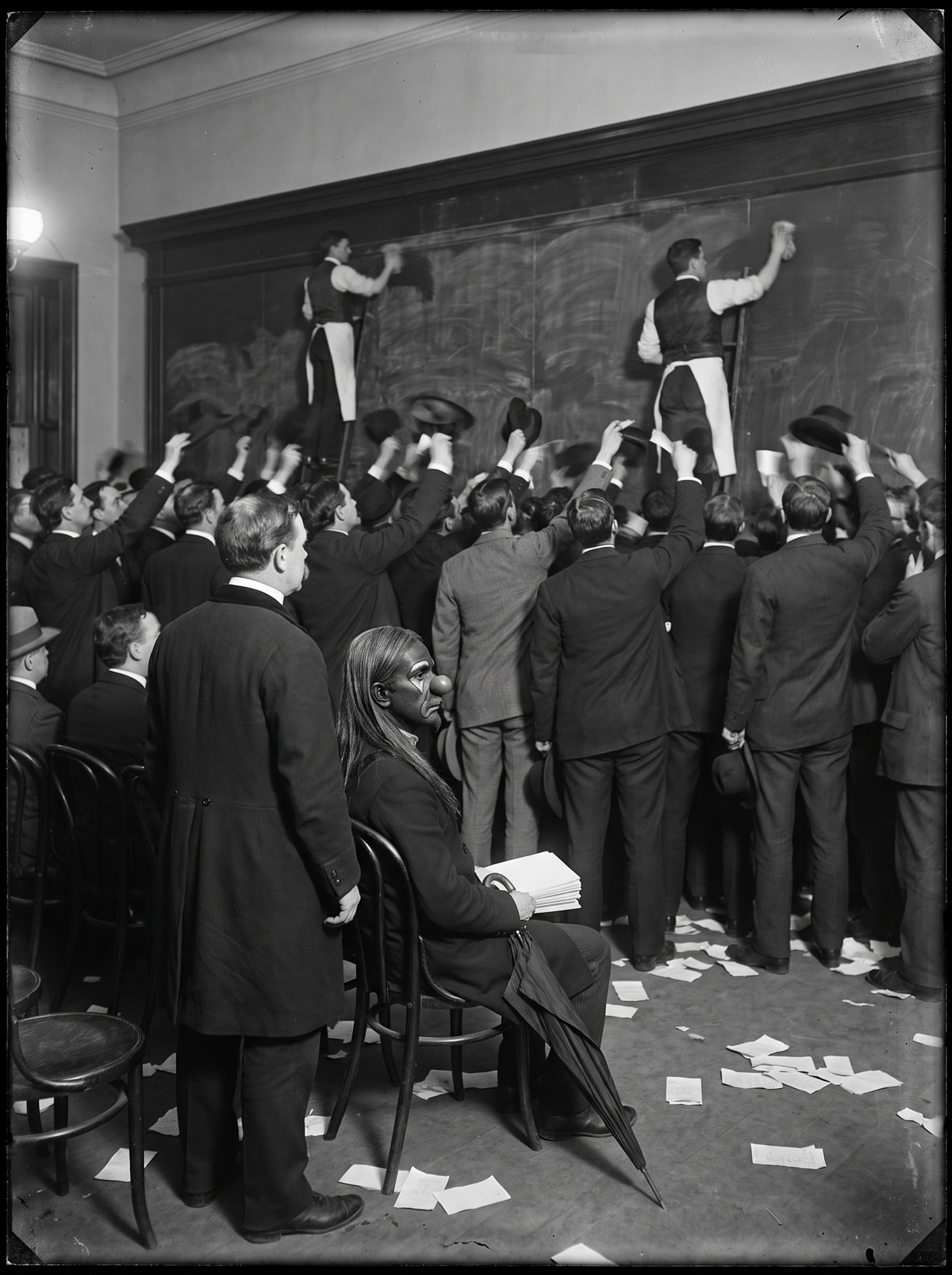
Sold to cover
DOW JONES 49.36 · −3.18 · −6.05% · one railroad took the rest with it
Nobody set out to break the market. Two groups of very serious men wanted the same railroad and each bought it in secret, and between them they came to own rather more of Northern Pacific than had ever been issued. That left the men who had sold it short holding a promise they could not keep at any price — Northern Pacific went from a hundred and ten dollars to a thousand inside seventeen hours of trading — and there was only one way to raise money that fast, which was to sell everything else. So the shares of companies with nothing whatever to do with a northern railroad were thrown overboard all afternoon by people who had no wish to sell them.
The day's protagonist
Northern Pacific NP
Move: $110 → $1,000 — in seventeen hours of trading
Edward Harriman of the Union Pacific and James Hill of the Great Northern both wanted the Chicago, Burlington and Quincy, and the way to it ran through Northern Pacific. Harriman, financed by Jacob Schiff of Kuhn, Loeb, bought Northern Pacific quietly; Hill, financed by J. P. Morgan, bought it quietly as well. Neither side knew the size of the other, and the market did not know about either, so speculators went on selling Northern Pacific short into what they took for an ordinary run-up. When the two syndicates finished, they held between them more stock than had been issued, and the shorts were required to deliver shares that no longer existed to be bought. The price went from a hundred and ten dollars to a thousand. To find the money, the shorts sold whatever else they held, and the rest of the market — sugar, steel, copper, everything — went down with it. The two sides then made peace, released the shorts at a figure they fixed between them, and folded their railroads into a holding company called Northern Securities. The Supreme Court ordered it dissolved three years later.
The deeper account
The mechanism is the whole story and it recurs: a position that cannot be closed forces the sale of positions that are perfectly sound. The archive keeps the same machinery running in 1998 at Long-Term Capital, in 2021 in GameStop, and in 2024 in the yen carry trade — different instruments, one arithmetic.
The break is usually dated to the afternoon of May 8, when the selling began; the larger fall printed on the 9th, which is the day this page keeps.
This is commonly called the first crash on the New York Stock Exchange. It is better described as the first crash caused entirely inside the market, by its own plumbing, with no war, no bank failure and no harvest behind it.
Neither Harriman nor Hill lost. The people ruined were the ones who had taken the other side of a trade between two men who were not trading against each other at all.
The artifact
A short seller borrows stock and owes it back. That is normally an inconvenience; on this afternoon it was an impossibility, because the Harriman and Hill syndicates between them had bought more Northern Pacific than existed, and neither had told the other. There was nothing to deliver. Northern Pacific went from about a hundred and ten dollars to a thousand in seventeen hours of trading, and the men who owed it raised the money the only way anyone can raise money that fast — by selling everything else they held. That is why sugar and steel and copper fell on a day whose entire cause was one railroad. The Dow lost 6.05 percent. The two sides then settled with the shorts at a figure they fixed between them and folded their railroads into Northern Securities, which the Supreme Court ordered dissolved in 1904.
Read the notice
Printed text is shown plain; the clerk's entries are shown in script.
NOTICE OF FAILURE TO DELIVER · UNDER THE RULES OF THE EXCHANGE — New York, Thursday, May 9, 1901
- You have failed to deliver 100 shares · Northern Pacific common, contracted for delivery this day. The security will be bought in for your account, at the market.
- sold short at 110 · bought in at —
- last sale on the floor: 1,000 · position: NOT CLOSED
- CLERK'S HAND: there is no stock. none is to be had at any price. he has sold everything else he owns to pay for this.
- THE TWO BUYERS WERE NOT BIDDING AGAINST EACH OTHER. THEY DID NOT KNOW.
The corner in Northern Pacific was an accident of two secret accumulations: Edward Harriman with Kuhn, Loeb on one side, James Hill with J. P. Morgan on the other, both after the Chicago, Burlington and Quincy. The forced covering broke the whole market on May 8 and 9, 1901; the Dow closed May 9 at 49.36, down 6.05 percent. The share prices quoted on this form are illustrative of the corner rather than a specific transaction record.
The ledger — what actually happened
| Measure | Close | Change | Marginalia |
|---|---|---|---|
| Dow Jones | 49.36 | −3.18 · −6.05% | the second day of the break; the afternoon of May 8 began it |
| Northern Pacific | $110 → $1,000 | the corner's climax — a price that reflects no opinion about a railroad | |
| What the shorts owed | more than exists | the two syndicates together held more of the company than had been issued | |
| What it became | Northern Securities | the truce built a holding company; the Supreme Court dissolved it in 1904 |
Sources
- MeasuringWorth — Daily Closing Values of the Dow Jones Average (May 6–15, 1901, queried directly) — https://www.measuringworth.com/datasets/DJA/
- Panic of 1901 — the Harriman/Schiff and Hill/Morgan contest for Northern Pacific, the corner, and the ruin of the short sellers — https://en.wikipedia.org/wiki/Panic_of_1901
- Northern Securities Company and Northern Securities Co. v. United States (1904) — the holding company formed by the truce and its dissolution — https://en.wikipedia.org/wiki/Northern_Securities_Company