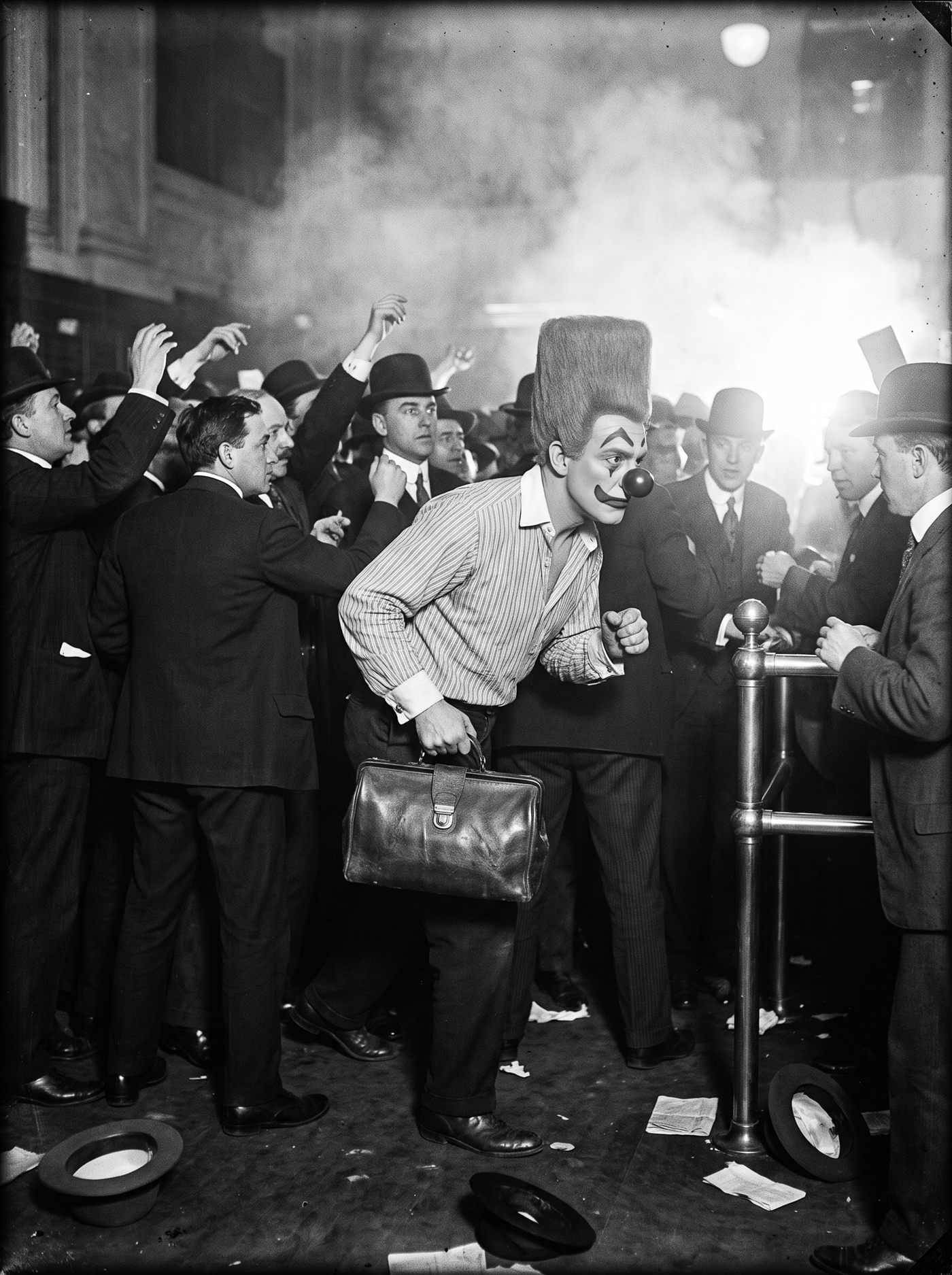
Nothing in the number
DOW JONES 42.62 · −0.02 · −0.05% · the rescue is not in the number
The tape that afternoon records a market that did essentially nothing, and behind it is one of the closest approaches to a total stop the American financial system has ever made. Brokers could not borrow against stock they already owned; the rate on call money went past a hundred percent and then the rate stopped mattering, because there was no money at the post to lend at any price. The Exchange was minutes from shutting its doors, which would have made every loan on the street unsecurable at once. What prevented it was one man in a room raising a fund by telephone. The index does not know any of this happened.
The day's protagonist
Twenty-five million dollars — no symbol.
Move: raised in minutes, spent in an afternoon
Call loans financed the stock market day by day, and by Thursday of that week there were none to be had. Ransom Thomas, president of the Exchange, crossed to J. P. Morgan's office to tell him the floor would have to close before the closing bell, which everyone in the room understood to mean that every broker's collateral would become unsaleable simultaneously. Morgan summoned the presidents of the major banks and had roughly twenty-five million dollars subscribed within minutes; the money went to the money post and was lent at ten percent to brokers who had been bidding a hundred and getting nothing. The floor is said to have cheered. It was not enough: another pool was needed the following day, about ten million of it from the Morgan group, two million from First National, half a million from Kuhn, Loeb. The panic ran on into November, when Morgan locked the trust presidents in his library overnight until they agreed to fund the weakest of their own.
The deeper account
The panic began in a failed attempt to corner the shares of a copper company, spread to the trust companies that had financed it, and became a general run. The Knickerbocker Trust suspended on October 22; the Trust Company of America was in line for the same treatment when Morgan intervened.
The whole apparatus of the rescue was private. There was no lender of last resort in the United States in 1907, so the function was performed by a seventy-year-old banker with a telephone and a reputation. The Federal Reserve Act followed in 1913, in large part because the country had noticed how that felt.
The archive keeps this day beside 1929-03-26, twenty-two years later, when call money hit twenty percent and Charles Mitchell pledged the same sum — twenty-five million dollars — to break the same kind of squeeze. Both closes are almost perfectly flat. A rescue that works leaves no mark on the tape, which is why the tape is a poor record of how close a thing was.
The pigment on that later page is this one's brass, tarnished.
The artifact
Call money financed the stock market one day at a time, and the card records the hour it ran out. A rate of a hundred percent is a crisis; no bid at all is a different thing entirely, because it means the price has stopped being the obstacle. Ransom Thomas, president of the Exchange, walked to J. P. Morgan's office to say the floor would have to close early — which would have made every broker's collateral unsaleable at once. Morgan called in the bank presidents and had roughly twenty-five million dollars subscribed within minutes; it went to the post and was lent at ten percent. Another pool was needed the next day. The industrials closed at 42.62, down two hundredths of a point, and nothing in that number records any of it.
Read the card
Printed text is shown plain; the loan clerk's entries are shown in script.
CALL MONEY · RATES RULING AT THE POST — Thursday, October 24, 1907
- 10.00 — 60% · 11.00 — 70% · 12.00 — 100%
- 1.00 — NO BID · 1.30 — NO MONEY AT THE POST
- 2.15 — 10% · money delivered · $25,000,000 subscribed
- CLERK'S HAND: mr morgan sent it over. the floor cheered. we are open at three.
- the industrials closed at 42.62 — DOWN TWO HUNDREDTHS OF A POINT.
Call money rose above a hundred percent on October 24, 1907 and then became unobtainable at any rate. Morgan assembled roughly $25 million from the major banks in a matter of minutes and sent it to the money post, where it was lent at ten percent; a second pool followed on the 25th, about $10m from the Morgan group, $2m from First National and $500,000 from Kuhn, Loeb. The hourly rates on this card are illustrative of the afternoon's collapse rather than a surviving ledger. The United States had no central bank; the Federal Reserve Act followed in 1913.
The ledger — what actually happened
| Measure | Close | Change | Marginalia |
|---|---|---|---|
| Dow Jones | 42.62 | −0.02 · −0.05% | two hundredths of a point, on the day the money market stopped functioning |
| Call money | over 100% | and then unobtainable at any rate — the rate had ceased to be the problem | |
| The fund | $25,000,000 | subscribed by the bank presidents in a matter of minutes and lent at ten percent | |
| The next day | another pool | about $10m from the Morgan group, $2m from First National, $500,000 from Kuhn, Loeb | |
| There was no | central bank | the Federal Reserve was six years away, and this panic is the reason it exists |
Sources
- MeasuringWorth — Daily Closing Values of the Dow Jones Average (October 21–26, 1907, queried directly) — https://www.measuringworth.com/datasets/DJA/
- Federal Reserve History — The Panic of 1907: the trust company runs, Morgan's pools, and the Act that followed — https://www.federalreservehistory.org/essays/panic-of-1907
- EH.net encyclopedia — The Panic of 1907: call money above 100 percent, the October 24 fund, and the October 25 second pool with its per-house contributions — https://eh.net/encyclopedia/the-panic-of-1907/