Twenty-five basis points
S&P 500 469.81 · −10.90 · −2.27% · the first cut
The smallest move the Fed could make, after seventeen months of not making one — announced, for the first time in the Committee's history, the same day it was decided, so that nobody could misunderstand. Everybody understood immediately. The quarter point was nothing; the positions built on three percent money forever were everything, and they began coming undone by the afternoon and kept coming undone until November.
The day's protagonist
The carry trade — no symbol.
Move: borrowed at 3, long at 6 — condemned by a quarter point
Seventeen months of three percent money — negative in real terms — had taught the Street a trade: borrow short, own long bonds at six and better, and lever the difference. By late 1993 the Treasury primary dealers alone carried nearly two hundred billion dollars of borrowed positions, with banks, hedge funds and brand-new mortgage-derivative books stacked behind them. On the fourth of February the Fed moved the smallest amount it could move, and — for the first time in its history — said so publicly the same day, so that no one could misunderstand. No one did: the S&P fell 2.27 percent from within a percent of its record, the long bond began a climb from 6.31 to 8.16 by November, and the unwind fed on itself for nine months. Fortune counted six hundred billion dollars off American bonds and named the year the Great Bond Massacre. Askin Capital went in the spring, Orange County in December, and the peso by New Year's.
The deeper account
Greenspan had told Congress days earlier that short rates would have to rise "at some point." The point arrived Friday at the end of a two-day meeting, around eleven in the morning, and the market fell through the afternoon to close near its low.
The announcement itself is the day's monument. The minutes record the Chairman deciding "to announce this action immediately so as to avoid any misunderstanding" — with the express caveat that it set no precedent. Every policy change since has been announced: the era of the Fed as a silence to be decoded ended here.
The wreckage arrived on a nine-month fuse: Askin Capital in the spring, Orange County's bankruptcy in December, Mexico's peso at the year's edge. Merton Miller: "I'll never understand why they call bonds 'fixed' income." A veteran trader, to Fortune: "A move in the long bond that used to take six weeks now happens in six days."
Monday stabilized; the regime didn't revert. The Dow's late-January record stood for a year, and 1994 finished as the worst year for American bonds in decades.
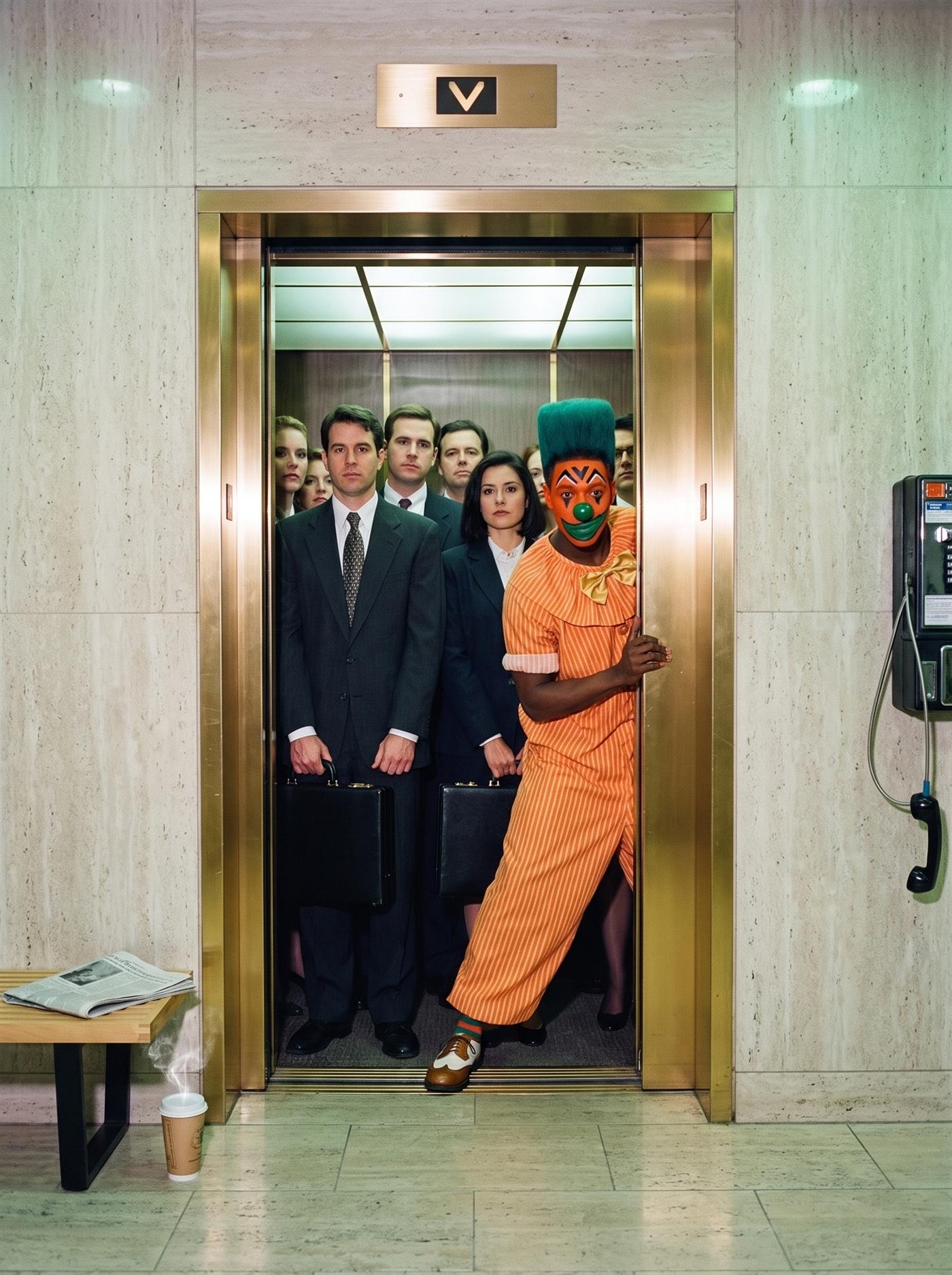
In the photograph of this day the bad friend squeezes last into a full elevator going down, bow tie already undone, while the lobby behind him holds everything the crowd abandoned to catch this exact ride — a phone off its hook, coffee still steaming. The doors are an instant from meeting.
The ground is wire-room charcoal; the pigment is carmine — the first cut of the year the bond market bled.
The artifact
The words are the Committee's own, from the first same-day public announcement of a policy change the Federal Reserve ever made — issued, the minutes explain, "to avoid any misunderstanding," and expressly not as a precedent. It became the precedent: every policy change since has been announced. The quarter point itself was almost nothing; what it detonated was two years of borrowed carry — near two hundred billion dollars of leveraged positions among the Treasury dealers alone — built on the assumption that three percent money was permanent. The long bond moved six basis points that day and a hundred and eighty-five more by November. Fortune counted six hundred billion dollars off the value of American bonds by then and named the year: the Great Bond Massacre.
Read the wire
Wire text is shown plain; the desk's entries are shown in script.
WIRE COPY · FRIDAY, FEBRUARY 4, 1994 · LATE MORNING
- "The Federal Open Market Committee decided to increase slightly the degree of pressure on reserve positions... to move toward a less accommodative stance... to sustain and enhance the economic expansion." — Chairman Greenspan, for the Committee: the first same-day announcement it has ever made.
- the funds rate: 3 → 3¼ — first firming since 1989. the index: down 2.27 percent by the close.
- the long bond: 6.31 → 6.37. by november: 8.16. the year's name would be a massacre.
- DESK HAND: a quarter point. the positions were the problem, not the point.
- EVERY POLICY CHANGE SINCE HAS BEEN ANNOUNCED. THE PRECEDENT IT DIDN'T SET, IT SET.
On Friday, February 4, 1994, the Federal Reserve raised its funds target a quarter point to 3.25 percent — the first tightening since 1989 and the first policy change the FOMC ever announced publicly the same day. The S&P 500 fell 2.27 percent to 469.81 and the Dow 96.24 from within a percent of its record. Six more hikes followed by November; the thirty-year yield ran from 6.17 in January to 8.16; and the unwinding of the great carry trade took down Askin Capital, Orange County, and, at the year's far end, the Mexican peso.
The ledger — what actually happened
| Measure | Close | Change | Marginalia |
|---|---|---|---|
| S&P 500 | 469.81 | −10.90 · −2.27% | 480.71 → 469.81 — the worst day of the young year; the Dow stood within a percent of its record that morning |
| The action | 3% → 3.25% | the first tightening since 1989 — and the first policy change the Committee ever announced publicly, same day | |
| The long bond | 6.31% → 6.37% | six basis points that day; 8.16% by November 4 — the massacre ran nine months | |
| The leverage | ≈$200 billion | borrowed positions among the Treasury primary dealers alone by late 1993 (Fortune) — the trade the quarter point condemned | |
| The year | six hikes, +250 bp | to 5.50% by November 15; more than $600 billion off U.S. bond values (Fortune) |
Sources
- Federal Reserve — FOMC statement, February 4, 1994 (the first same-day announcement) — https://www.federalreserve.gov/fomc/19940204default.htm
- Federal Reserve — FOMC minutes, February 3–4, 1994 ("to avoid any misunderstanding"; the no-precedent caveat) — https://www.federalreserve.gov/fomc/minutes/1994/19940204min.htm
- Fortune — "The Great Bond Massacre" (1994): the dealer leverage, the $600 billion, the quotes — https://fortune.com/article/the-great-bond-massacre-fortune-1994
- FRED / H.15 — the 30-year constant-maturity series (6.31 → 6.37 → 8.16)
- SEC EDGAR daily-close tables and Yahoo daily series — the index closes