The fear was in the waiting
S&P 500 327.97 · +11.80 · +3.73% · a war rally
The bombs fell the evening before, live on television — the first war the whole world watched start. By morning the thing that collapsed wasn't the market but the premium on not knowing: oil lost a third of its price, gold gave back its hiding, and stocks threw one of the strongest rallies in their history on the first morning of a war. Five and a half months of dread, sold by lunch.
The day's protagonist
The uncertainty premium — no symbol.
Move: five months of dread, unwound in one session
Since Iraq took Kuwait on the second of August the market had priced a war that might go badly: stocks down thirteen and a half percent, oil in the thirties, gold near four hundred. The air campaign that opened the night of the sixteenth — massive, one-sided, met by almost nothing, leaving the Gulf's oil untouched — deleted the worst case before New York opened. So the first morning of the war produced the opposite of a panic: crude fell $10.56, the largest one-day drop ever recorded to that point; gold gave back about thirty dollars; and the Dow gained 114.60, the second-biggest point day it had ever had, on volume two and a half times the day before. Tokyo had shown the way hours earlier, falling three hundred points on the news and finishing up a thousand. The fear was in the waiting, not the fighting.
The deeper account
The overnight sequence: first bombs on Baghdad shortly before 7 p.m. New York time, reported live by CNN's crew at the al-Rashid — "the skies over Baghdad have been illuminated" — and at about 7:05 the White House's Fitzwater: "The liberation of Kuwait has begun." Tokyo fell three hundred points at the open and reversed to plus a thousand as the reports arrived.
It was the first war whose opening night the world watched live, which compressed the usual fog-of-war discount into a few hours of television. By the New York open there was nothing left to dread that hadn't already been repriced.
The rally that began this day carried the Dow past 3,000 for the first time that April, and 1991 into the record books.
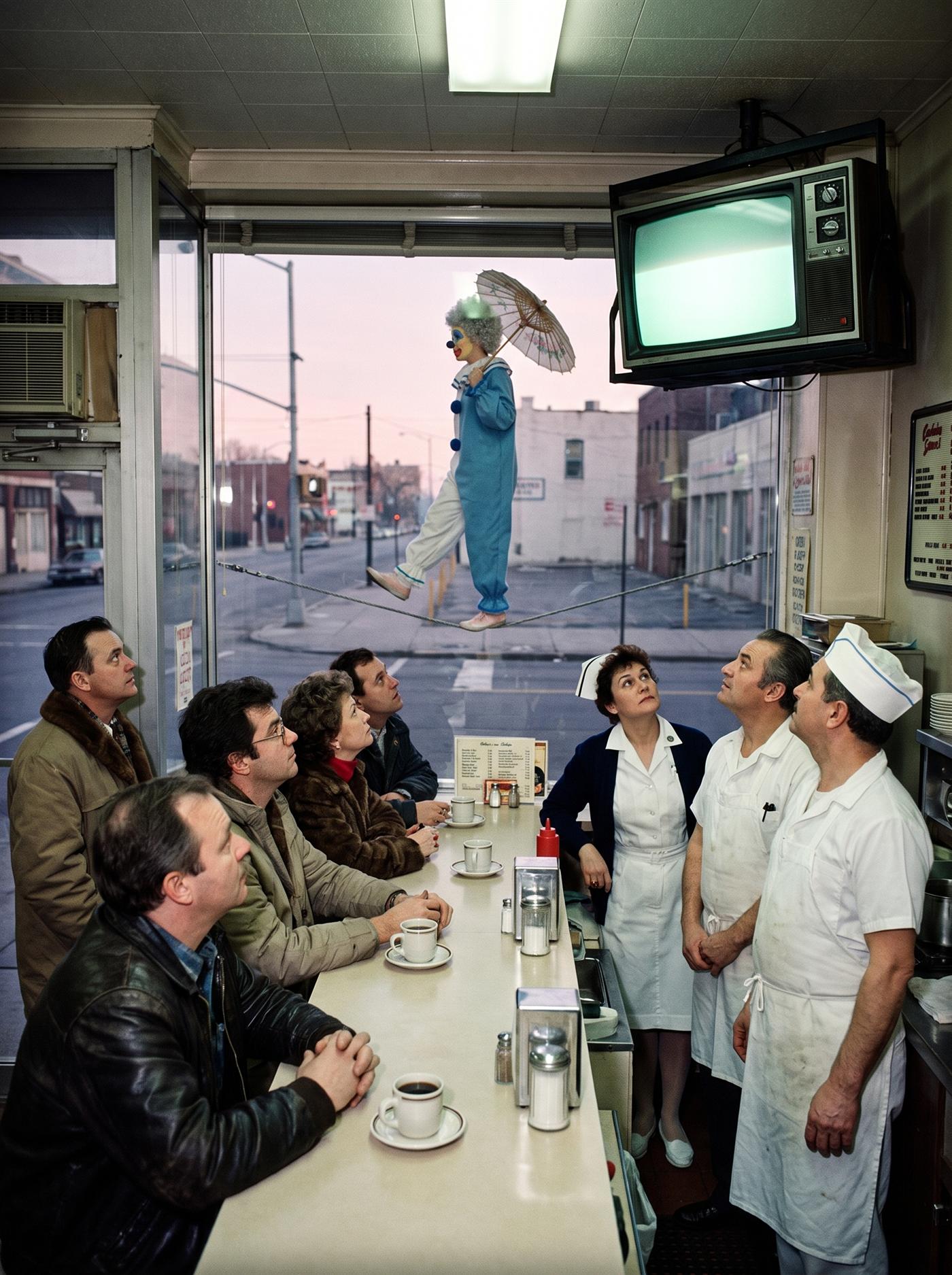
In the photograph of this day every face in the diner is aimed at the green glow of the corner television — and above the street outside the window, unnoticed, risk itself crosses the morning on a wire, parasol open, foot not yet down.
The ground is the desert dark; the pigment is night-lens green — the color the war arrived in. The archive's terminal green stays with 2021; this is the other green.
The artifact
The bombing had started around seven the evening before, live on television — the first war whose opening night the whole world watched as it happened. What collapsed in the morning wasn't the market; it was the premium on not knowing. Crude oil fell $10.56, then the largest one-day drop ever recorded, a third of its price gone as the worst case — burning Gulf fields, a long ugly war — was deleted overnight by the one-sidedness of the opening hours. Gold gave back about thirty dollars of hiding. And equities threw one of the strongest rallies in their history on the first morning of a war, because the fear had been in the waiting, all five and a half months of it, and the waiting was over.
Read the check
Printed text is shown plain; the counterman's entries are shown in script.
COUNTER CHECK · THURSDAY, JANUARY 17, 1991 · COFFEE, FOUR REFILLS — on the house. nobody left till noon.
- crude oil: −$10.56 · the largest one-day fall ever recorded — a third of the price of oil, gone between breakfasts.
- the index: +3.73 percent — the industrials' second-biggest point day there had ever been. gold: down about thirty dollars.
- five and a half months of waiting, priced out in a session: volume two and a half times the day before.
- COUNTERMAN'S HAND: the television stayed on. the fear went out all at once, like a tide.
- THE FEAR WAS IN THE WAITING. FIVE MONTHS OF IT, SOLD BY LUNCH.
On Thursday, January 17, 1991 — the first trading day after Operation Desert Storm began — the S&P 500 rose 3.73 percent to 327.97 and the Dow gained 114.60, its second-biggest point day to that date, while WTI crude suffered the largest one-day drop in its exchange-traded history, from $32.25 toward $21.48. The market had fallen roughly 13.5 percent between the invasion of Kuwait and the war's start; the rally that began this day carried the Dow past 3,000 for the first time that April.
The ledger — what actually happened
| Measure | Close | Change | Marginalia |
|---|---|---|---|
| S&P 500 | 327.97 | +11.80 · +3.73% | 316.17 → 327.97 — five and a half months of war-fear sold in a session |
| Dow Jones | 2,623.51 | +114.60 · +4.57% | the second-biggest point gain the index had ever had — behind only October 21, 1987 |
| Crude oil | −33% | $32.25 → $21.48 — the largest one-day fall in crude's exchange-traded history, the Gulf's fields untouched and reserves released | |
| Gold | ≈−$30 | the war-hedge, unwound by lunch (per the wire reports) | |
| Volume | 319 million shares | two and a half times the day before |
Sources
- SEC EDGAR — daily close tables for the DJIA and S&P 500 (the primary series for the week) — https://www.sec.gov/Archives/edgar/data/357298/000035729801500016/dowjones.html
- The Washington Post, January 18, 1991 — "Dow Soars 115 in Second-Biggest Rally"
- FRED, DCOILWTICO — WTI spot $32.25 → $21.48
- UPI, January 17, 1991 — "Stocks surge on Gulf war" (the Tokyo reversal; the Asian session)
- AP wire coverage, January 18, 1991 — the crude contract's record drop; gold's ≈$30 fall
- Benzinga / Yahoo Finance — "This Day in Market History: Operation Desert Storm" (the setup: −13.5% invasion-to-war)