The price of leaving
S&P 500 334.43 · −10.43 · −3.02% · the worst since the mini-crash
The invasion had come five days earlier, in the middle of the New York night, and Thursday's session took only a percent off the index — the shock lived in the oil pit, where a man told the wires it was a panic and he hadn't seen its like since the early days of the last Gulf war. It took the weekend and the embargo to finish the argument: with Iraqi and Kuwaiti crude suddenly unsellable, September oil settled up three dollars and fifty-six cents at $28.05 — a five-year high, fourteen and a half percent in a session — and the stock market suffered its worst loss since the October 1989 mini-crash, which happens to be the previous page of this shelf. The airlines bled worst; jet fuel is the price of leaving, and leaving had just repriced.
The day's protagonist
The embargo — no symbol.
Move: crude +14.5% in a session — and the market's worst day since the mini-crash
Iraq crossed into Kuwait about two in the morning local time on August 2 — evening of the 1st in New York — and Kuwait City fell within hours. The first market to trade it was Tokyo's; New York's Thursday cost only 1.14 percent, with the real violence in oil, gold and the long bond. Friday slid another 1.88. Then the weekend did its work: Resolution 661, the worldwide embargo, adopted Monday — and with Iraqi and Kuwaiti barrels suddenly unsellable, September crude settled at $28.05, up fourteen and a half percent, the highest price since December 1985 and seventy percent above a month earlier. The S&P gave up 3.02 percent, the Dow 93 points — the worst session for both since October 13, 1989, the mini-crash that sits one page back on this shelf. UAL, already dragging a leveraged buyout's financing doubts, lost another $12.50 — down $53 in six sessions — with AMR and Delta behind it. Tuesday the tape went flat and Washington announced the troops: the panic phase was over in three sessions. The bear was not: the index was already three weeks past its July 16 top, the recession by the official dating had already begun in July, and the grind ran to 295.46 by October 11 — off 19.9 percent, close to close. The resolution of all of it hangs one page ahead, in night-lens green.
The deeper account
The invasion session itself is the misdirection this page exists to correct: Thursday cost one percent. Money "poured into oil and gold issues but fled from others," and a Goldman vice chairman offered the wires the era's most careful sentence — intense nervousness, by no means a panic. The panic took the weekend to become law.
Three sessions, and done: Thursday −1.14, Friday −1.88, Monday −3.02, Tuesday flat. The shock priced in seventy-two market hours; the bear then ground on for two more months on the recession nobody had dated yet.
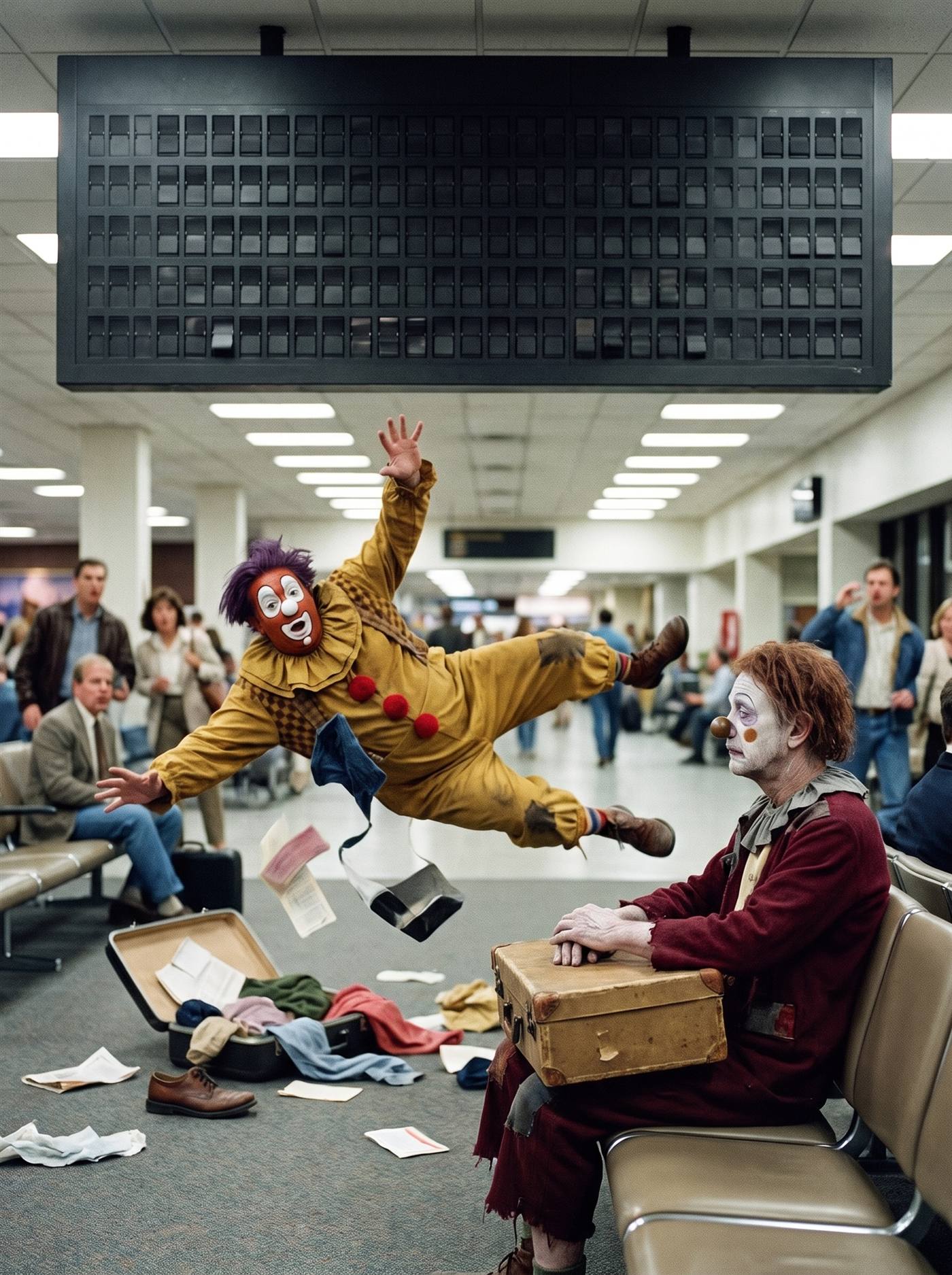
In the photograph of this day the fall is professional — horizontal, magnificent, the suitcase's contents still airborne — and the only one not surprised is the old clown on the near bench, who has seen every landing there is. The one who falls a step later, retail, is not in the frame. His day at the pump is two pages back, seventeen years earlier; his decade was different but the fuel was the same.
The ground is tarmac dark; the pigment is kerosene straw — jet fuel, the price of leaving, which had just gone up first.
The artifact
The invasion was five days old and had cost the index barely one percent; the shock had lived in the oil pit. Monday the embargo made it law — Iraqi and Kuwaiti crude unsellable anywhere — and September oil settled up fourteen and a half percent at a five-year high. The stock market's 3.02 percent was its worst loss since the October 1989 mini-crash, one page back on this shelf; the airlines, whose whole business is priced in kerosene, bled worst, UAL down fifty-three dollars in six sessions with a leveraged buyout's financing dying alongside. The clerk's line is the day entire: by the settle, leaving cost more than staying.
Read the notice
Printed text is shown plain; the handwritten entries are shown in script.
NOTICE · MONDAY, AUGUST 6, 1990 — FARE ADJUSTMENT — effective immediately · a fuel surcharge applies to all itineraries · we regret the necessity.
- crude: $28.05 · up 14.5 percent in one session — a five-year high. the embargo made the barrels unsellable.
- the five hundred: 344.86 → 334.43 · down 3.02 percent — the worst since the thirteenth of october.
- our own shares: down 12.50 today. fifty-three dollars in six sessions.
- COUNTER CLERK'S HAND: the embargo passed at the u.n. this morning. by the settle, leaving cost more than staying.
- THE PRICE OF LEAVING WENT UP FIRST.
On Monday, August 6, 1990 — the day UN Security Council Resolution 661 imposed the worldwide embargo on Iraq — September crude settled at $28.05, up 14.5 percent, the highest since December 1985, and the S&P 500 fell 3.02 percent to 334.43, its worst loss since October 13, 1989. The panic phase ended the next day; the bear ran to October 11 at −19.9 percent from the July top. Desert Storm — the next page — resolved it in January.
The ledger — what actually happened
| Measure | Close | Change | Marginalia |
|---|---|---|---|
| S&P 500 | 334.43 | −10.43 · −3.02% | "the stock market suffering its worst loss since Oct. 13" — the 1989 mini-crash, the previous page of this archive; per the official series |
| Dow Jones | 2,716.34 · −3.32% | −93.31; per the daily record, matching the day's press | |
| Crude | $28.05 · +14.5% | September settle, +$3.56 — highest since December 6, 1985, and 70% above a month earlier; the embargo made the barrels unsellable | |
| UAL | 110 · −12.50 | −$53 in six sessions: jet fuel plus the buyout financing's doubts; AMR −4.37, Delta −3.37 behind it | |
| The arc | −19.9% by Oct 11 | close-to-close from the July 16 top of 368.95 — three weeks old when the tanks moved; the recession had already begun in July, by the official dating, and nobody knew |
Sources
- S&P 500 daily series (official) — the closes, Aug 1–7 and the July 16 / October 11 arc
- MeasuringWorth — Daily DJA (the Dow closes; Aug 2 and 6 double-checked against the day's press) — https://www.measuringworth.com/datasets/DJA/
- Chicago Tribune, Aug 7, 1990 — the oil settle ($28.05, highest since Dec 6, 1985), the "worst loss since Oct. 13", the airline tape (UAL, AMR, Delta)
- UPI, Aug 2, 1990 — "Invasion of Kuwait churns international markets": the Hormats and Fiedler quotes, the first day's shape
- FRED — daily WTI and Brent spot; NBER business-cycle dates (peak July 1990)