The lights, asked for
DOW JONES 824.95 · −29.05 · −3.40% · the Sunday speech, priced Monday
The President spoke from the Oval Office at seven on Sunday evening: gasoline deliveries cut fifteen percent, filling stations asked to go dark from Saturday night to Sunday midnight, fifty miles an hour proposed for every road in the country, the ornamental lighting of Christmas curtailed. Monday the market gave its answer — down 29.05 points, 3.40 percent, the fifth-greatest one-day decline in the index's history to that date, per the wires. The war that started it all was seven weeks old and had cost the tape nothing. It was the arithmetic of the barrel that finally arrived: $3.01 in September, $5.12 by mid-October, and a number nobody would print aloud coming at Christmas.
The day's protagonist
The barrel — no symbol.
Move: $3.01 → $5.12, and the embargo behind it — the war's arithmetic, arriving late
The Yom Kippur War began October 6 and the market shrugged for seven weeks — rallied, in fact, fifteen percent off the August low to a 987.06 peak on October 26, leaning bullish into the worst of it. The arithmetic took its time: on October 16 the Gulf six met in Kuwait City and raised the posted price of oil unilaterally — the first time — from $3.01 to $5.12; the embargo on American shipments followed within days of Washington's $2.2 billion aid request for Israel. Belief, once it arrived, arrived completely: twenty-seven sessions nearly without relief, the Dow under 900 by mid-November, and the two great Monday breaks — the nineteenth, 3.22 percent, and this day, 3.40, the hardest single day of the slide, the morning after the President asked the country for its lights, its Sundays and its speed. The low came December 5 at 788.31, a fifth off the October peak, a quarter off January's top. Two days before Christmas, Tehran announced $11.65 — the quadrupling complete in ten weeks. And the far worse year was 1974, which this archive keeps one page ahead, in an emptied theater.
The deeper account
The market's seven-week shrug is the page's quiet lesson: the war itself cost the tape nothing. It was the barrel's arithmetic — and the Sunday address that made the shortage domestic, personal, and visible from every driveway — that it finally believed, all at once.
Period truth, kept precisely: in November 1973 there were no gas lines and no odd-even plates — those belong to the winter ahead. What there was: Sunday closings beginning December 1, a proposed fifty, truckers' protests gathering, and Christmas lighting going dark on request. The lines are another page's grief.
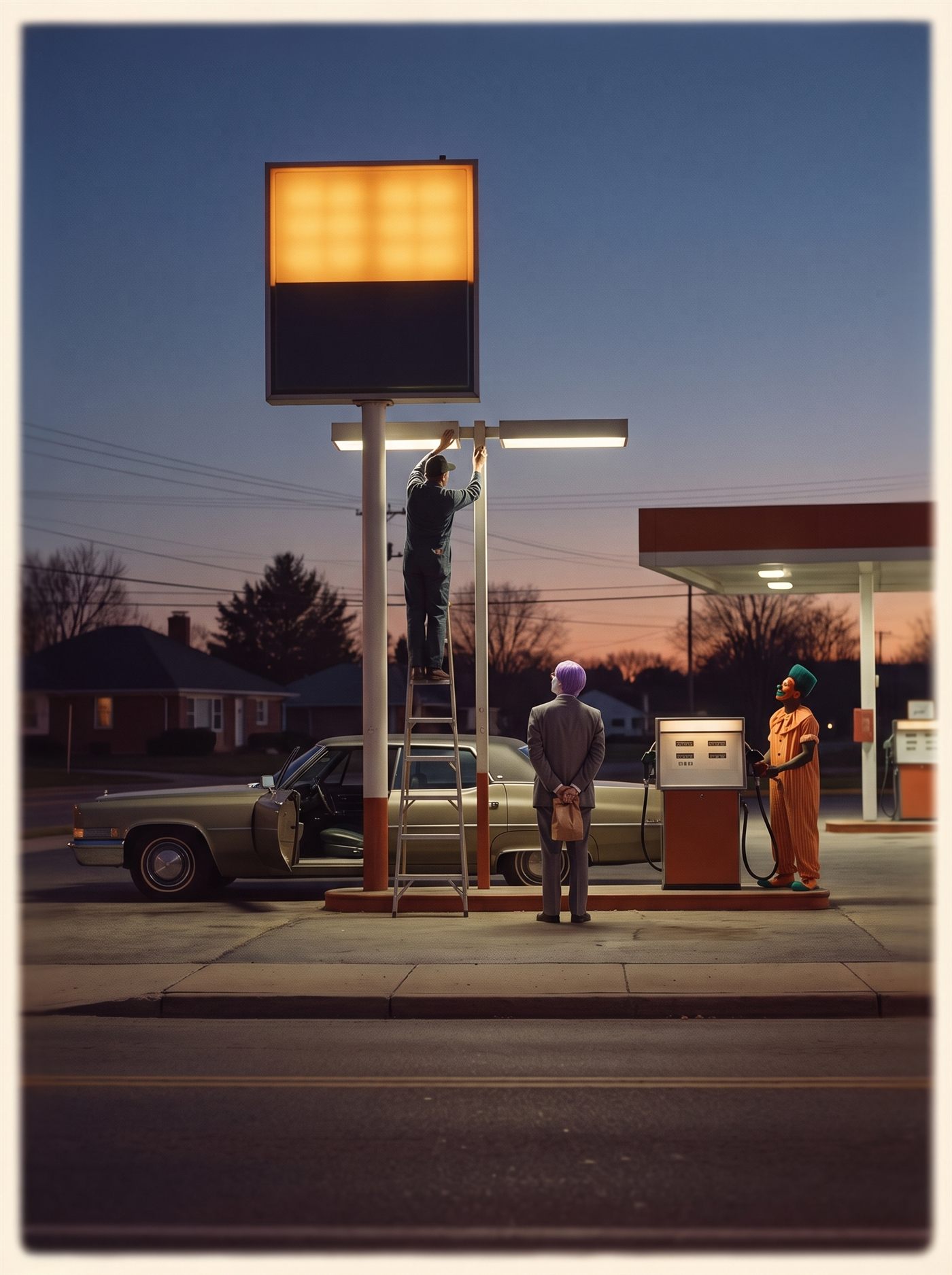
In the photograph of this day a man stands on a ladder putting a sign out, lamp by lamp, and everyone watches — even the one at the far pump with the nozzle forgotten in his hand, who talked half the county into the cars that need it. retail stands on the island in the middle, hands behind his back, holding his bag. His decade of waiting in lines has not started yet. It starts in about five weeks.
The ground is the brown-black of a sign already asked to stop; the pigment is the amber of the half that hasn't yet.
The artifact
The Sunday-night address asked the country for its lights, its Sundays and its speed — deliveries cut fifteen percent, stations dark from Saturday night, fifty miles an hour proposed for every road. Monday the market answered with 29.05 points, 3.40 percent, the fifth-greatest one-day decline in the index's history to that date. The card keeps the period honestly: closings and dimmed signs, not gas lines — the lines and the odd-even plates belong to the winter ahead, and this archive will not misdate a grief. The barrel had gone from $3.01 to $5.12 in October; the number that came at Christmas was $11.65.
Read the card
Printed text is shown plain; the handwritten entries are shown in script.
NOTICE TO OUR CUSTOMERS · NOVEMBER 1973 — CLOSED SUNDAYS — beginning december first, at the president's request. lights out at nine · fifty is plenty
- the industrials: 854.00 → 824.95 · down 3.40 percent — the fifth greatest one-day decline in the book, said the wires.
- the barrel: $3.01 → $5.12 since the middle of october. a worse number is coming for christmas.
- the slide: twenty percent in twenty-seven sessions — from a market that had rallied into october, believing none of it.
- PUMP CLERK'S HAND: he asked for the lights and the sundays. the tape threw in monday for free.
- THE SIGN WENT DARK AT NINE. THE TAPE BY FOUR.
On Monday, November 26, 1973 — the first session after Nixon's energy address — the Dow fell 29.05 points, 3.40 percent, to 824.95, the hardest day of the embargo slide that ran from 987.06 on October 26 to 788.31 on December 5. Tehran announced $11.65 oil on December 22–23. The 1974 collapse that followed is the next page but one.
The ledger — what actually happened
| Measure | Close | Change | Marginalia |
|---|---|---|---|
| Dow Jones | 824.95 | −29.05 · −3.40% | the fifth-greatest one-day decline in the index's history to that date, per the wires; the hardest day of the embargo slide; per the daily record |
| S&P 500 | 96.58 · −2.88% | per the official series | |
| The address | Sunday, 7 p.m. | deliveries −15%, stations asked dark Saturday night to Sunday midnight from Dec 1, fifty miles an hour proposed, the Christmas lights curtailed | |
| The barrel | $3.01 → $5.12 | posted price, announced Oct 16 in Kuwait City — the first unilateral rise; $11.65 announced Dec 22–23, effective New Year's Day | |
| The slide | −20.1% in 27 sessions | close-to-close, the Oct 26 peak (987.06) to the Dec 5 low (788.31); from January's all-time top, −21.6% |
Sources
- MeasuringWorth — Daily Closing Values of the Dow Jones Average (every close: the Oct 26 peak, both Monday breaks, the Dec 5 low) — https://www.measuringworth.com/datasets/DJA/
- UPI wire, Nov 27, 1973 (via the Michigan Daily) — 824.95, −29.05, the fifth-greatest ranking, the heavy selling
- Richard Nixon, Address to the Nation About National Energy Policy, Nov 25, 1973 (American Presidency Project) — the measures, verbatim record
- S&P 500 daily series (official back-history) — 96.58, −2.88%
- Basosi & Garavini; GeoExpro; Davis (1976) — the posted-price record: $3.01 → $5.12 (Oct 16), $11.65 (Dec 22–23)