The last step down
S&P 500 65.01 · −1.12 · −1.69% · the floor
The second-worst bear market in American history ended on a Friday that made no sound: down another point and a half, the lowest close in twelve years, the cheapest market in a generation, and no buyers to notice. The papers recorded a dreary session. Nobody rang a bell, because nobody rings a bell at the bottom — the falling simply stopped, and the house lights came up on an empty theater.
The day's protagonist
The exhausted shareholder — no symbol.
Move: −45% in 23 months — and then it simply stopped
From 1,051.70 in January 1973 — weeks after the first close above a thousand — the Dow fell through the dollar's unmooring, quadrupled crude, double-digit inflation and a President's resignation to 577.60: the lowest close since the Cuban Missile Crisis, at roughly 6.2 times earnings, one of the cheapest markets ever recorded. That Friday the news gave no quarter — unemployment up to 6.5 percent while the Fed eased a quarter point at the discount window — and the market gave up another point and a half to an empty room. That evening Louis Rukeyser told his viewers that buyers had become rarer than scarlet tanagers in New York. On Monday the recovery began. Nobody had rung anything.
The deeper account
The wreckage behind the number: the end of Bretton Woods and the dollar's devaluations, the October 1973 oil embargo and quadrupled crude, inflation running double-digit, and the resignation of a President in August — all priced into twenty-three falling months.
The two averages bottomed apart: the S&P 500's closing low came October 3 at 62.28; the Dow ground on into December. December 6 is the bear's end-date because the thirty industrials were the last to stop.
That evening on Wall $treet Week, Louis Rukeyser observed that buyers had become "rarer than scarlet tanagers in New York." A month earlier Buffett had told Forbes how being liquid felt amid the carnage: "like an oversexed guy in a harem. Now is the time to invest and get rich." Almost no one did.
From Monday the market rose — roughly 48 percent by May 1975 — and 577.60 was never seen again. The recognition that this Friday was the floor is entirely retrospective; at the time it was a dreary session in a dreary December.
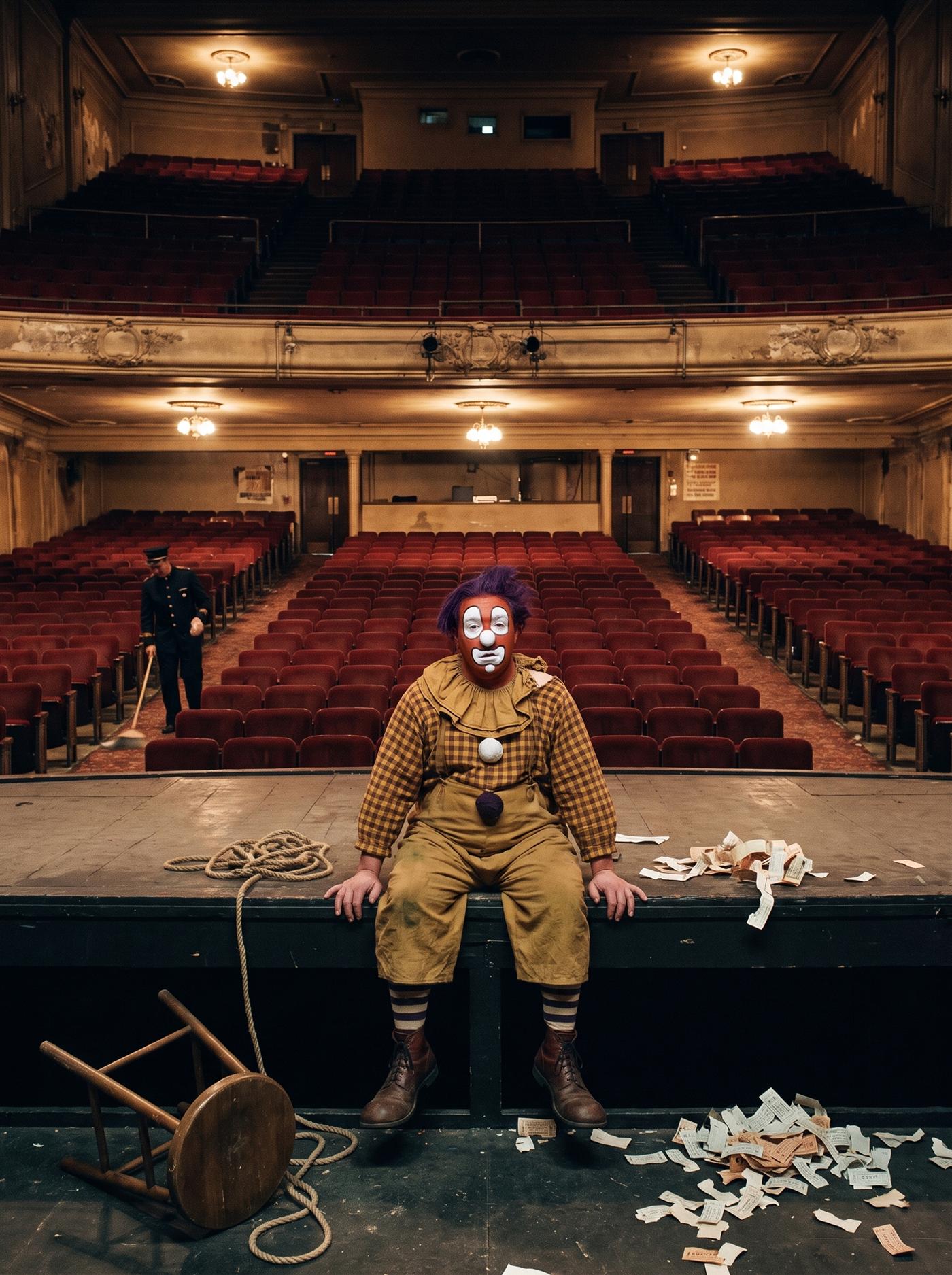
In the photograph of this day the faller has landed and the house lights are up: Tumbles on the stage lip of an emptied theater, the debris of a twenty-three-month run swept around him, his weight already shifting forward onto his hands. The usher keeps sweeping.
The ground is emptied-theater velvet; the pigment is the dim brass of house lights — the quiet register, for a floor nobody noticed.
The artifact
The scarlet tanagers were Louis Rukeyser's, said on television that very evening: buyers had become rarer than the bird. The multiple was real — around 6.2 times earnings, among the cheapest closes ever recorded, printed in the next morning's paper to no particular effect. The bell was real too, in its absence: no one rang one. The Dow's 577.60 was its lowest close since the Cuban Missile Crisis, forty-five percent below January 1973, and on Monday — with the lights on and nobody watching — the longest recovery of the postwar era quietly let itself in.
Read the statement
Printed text is shown plain; the usher's entries are shown in script.
HOUSE STATEMENT · FRIDAY, DECEMBER 6, 1974 · TONIGHT'S HOUSE: THIN — buyers rarer than scarlet tanagers
- the run: 1,051.70 — january 11, 1973 → 577.60 tonight · down forty-five percent. twenty-three months. the longest run down since the thirties.
- price of admission: 6.2 times earnings. the cheapest seat in a generation. still empty.
- USHER'S HAND: swept the aisles. found nothing anybody wanted. monday we open again.
- NOBODY RANG A BELL. THE PAPERS CALLED IT ANOTHER DREARY FRIDAY. IT WAS THE FLOOR.
On Friday, December 6, 1974, the Dow Jones Industrial Average closed at 577.60 — down 45 percent from its January 1973 peak, its lowest close since October 1962, at roughly 6.2 times earnings. The S&P 500 closed at 65.01. That evening Louis Rukeyser told his television audience that buyers were "rarer than scarlet tanagers in New York." No one called it the bottom. It was the bottom: the Dow never closed lower again, and by May 1975 it had recovered forty-eight percent.
The ledger — what actually happened
| Measure | Close | Change | Marginalia |
|---|---|---|---|
| S&P 500 | 65.01 | −1.12 · −1.69% | 66.13 → 65.01; the S&P had touched its own closing low, 62.28, back on October 3 — the Dow was the last to stop falling |
| Dow Jones | 577.60 | −9.46 · −1.61% | the lowest close since October 1962 — per the daily record |
| The bear | −45% in 23 months | 1,051.70 on January 11, 1973 → 577.60 tonight; the S&P's own peak-to-trough ran −48.2% | |
| The multiple | ≈6.2× earnings | among the cheapest closes ever recorded — the New York Times, the next morning | |
| The day's news | 6.5% unemployed | and the discount rate cut to 7.75% — recession deepening while the Fed eased |
Sources
- Forbes (Brian Domitrovic) — "50 Years Ago, The Stock Market Bottomed": the close, the twelve-year low, Rukeyser's scarlet tanagers — https://www.forbes.com/sites/briandomitrovic/2024/12/06/
- Benzinga / Yahoo Finance — "This Day in Market History: The 1974 Bear Market Bottom", citing The New York Times of December 7, 1974 (the 6.2 multiple, unemployment, the discount-rate cut)
- Yardeni Research bull & bear tables — S&P 500 120.24 (1/11/73) → 62.28 (10/3/74), −48.2%
- Wikipedia — 1973–1974 stock market crash (1,051.70 → 577.60, −45%)
- Daily closes: Yahoo ^GSPC daily series and the StatMuse daily record