Six years at the door
DOW JONES 1,003.16 · +6.09 · +0.61% · the thousand, crossed
The number had been standing at the door since January 1966, when the hourly ticks first brushed 1000.50 and the papers set their headlines in type they never got to use. Six years, nine months and twenty-seven days of almost. Then a Tuesday with every wind at once — the President a week re-elected in forty-nine states, peace declared at hand by the highest authority short of the fact — and the close printed 1,003.16. The specialists cheered and threw confetti; corks went up in the brokerage offices. It was, by the record, a ribbon and not a summit: the true top came eight weeks later, four point eight four percent higher, and the bear that followed it kept the number out of reach for a decade. But that is the next page's grief. This page keeps the confetti.
The day's protagonist
The round number — no symbol.
Move: 1,000 — waited for since January 1966, held for eight weeks, repossessed for a decade
Round numbers do no work and mean everything, and this was the roundest the American market had ever stalked. The hourly computations first crossed it on January 18, 1966 — 1000.50, three more kisses that winter, never a close — and then the sixteen-year sideways began and the number stood at the door like a guest nobody could seat. The week it finally sat down had tailwinds stacked to the ceiling: Nixon re-elected in a forty-nine-state landslide with the Exchange closed for the day, and Kissinger's October declaration — we believe that peace is at hand — still governing the tape's imagination of the war's end. The old 1966 record fell quietly on Friday the tenth, by eleven cents. Tuesday the close printed 1,003.16 on twenty million shares, and the floor did what floors do at ribbons: cheered, threw confetti, opened bottles in the upstairs offices. The retrospectives preserved the era's tell — in 1972, people really did say that now it was through the thousand it was never going to stop. It stopped at 1,051.70 on January 11, eight weeks later. The bear that followed — the first oil shock's, whose hardest Monday this archive keeps two pages on — took 45.08 percent from the top, and the Dow did not hold four figures again until the end of 1982. The peace, for the record, was not at hand either; the talks broke down in December. The confetti was real, though. The archive has decided that counts for something.
The deeper account
This page and the previous one are a matched pair six years apart: the needle that stopped one tick short, and the morning it finally crossed. The archive notes what fell between them — nothing. The Dow spent the whole wait inside a fifty-point corridor around the number, which is why the floor threw confetti at a Tuesday.
The next page along the shelf is the war batch's embargo Monday, one year and twelve days later, with the Dow at 824.95 and falling. The room past the ribbon was the same room.
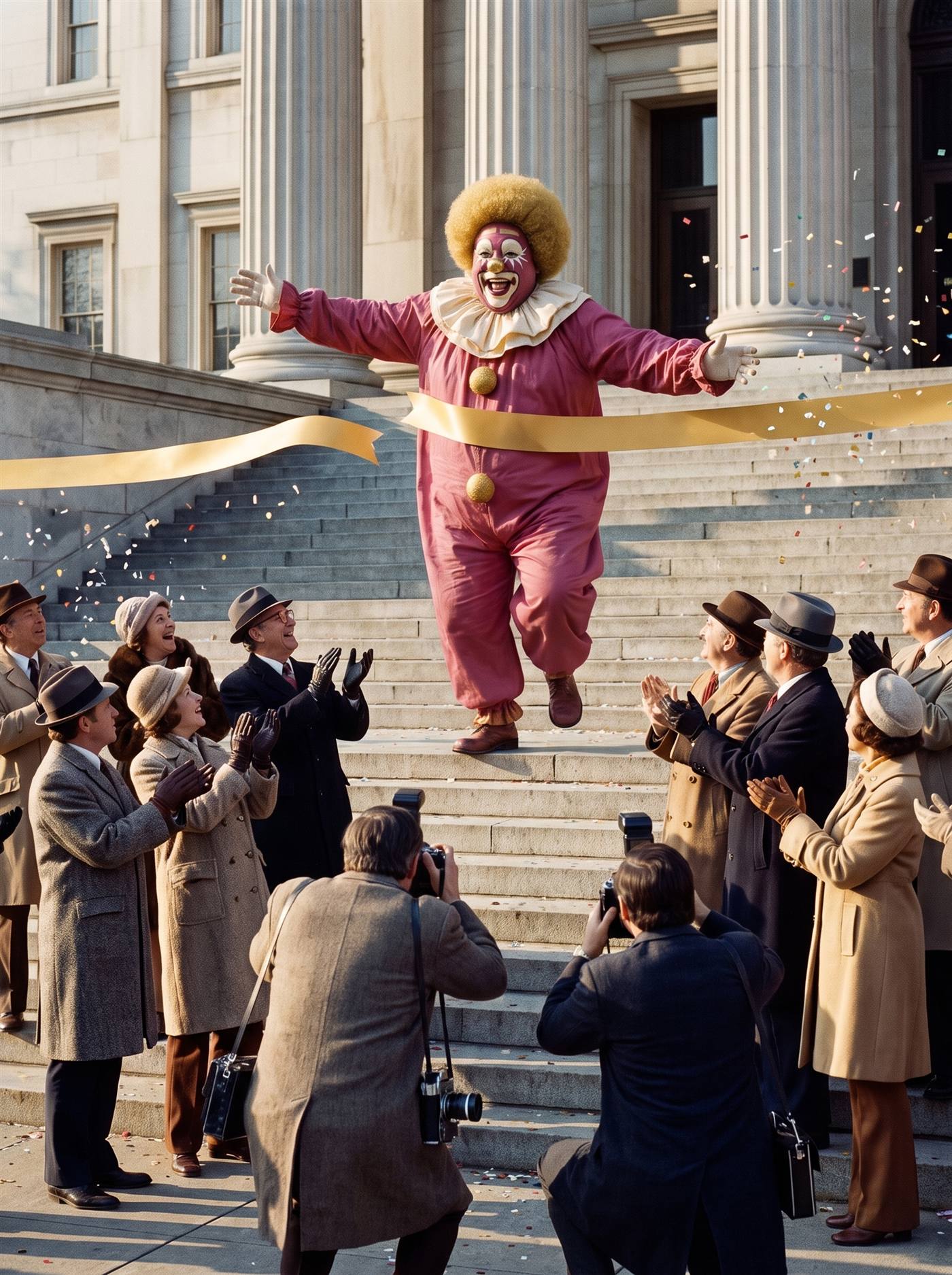
In the photograph of this day the press photographers aim up at him from the steps — the only frame in the archive where cameras inside the picture point at a clown. For one morning, the burst was the assignment. He is mid-laugh, mid-stride, trailing the ribbon from both shoulders, and none of it is false: the pressure was real, the six years were real, the crossing was real. The falseness was scheduled for January.
The ground is November's cold dark; the pigment is the gold of the cut ribbon — the only instrument the day required.
The artifact
Somebody always keeps a piece of the ribbon. This one waited at the door six years, nine months and twenty-seven days — from the January morning in 1966 when the hourly ticks first brushed 1000.50 to the November Tuesday the close finally printed 1,003.16, the first four-figure number in the index's seventy-six years. The floor cheered and threw confetti; the offices upstairs opened bottles; the wires preserved the era's tell, which was that in 1972 people genuinely said it would never stop now. The clerk's line is the one the next pages prove: the room past the ribbon was the same room, and January found its ceiling at 1,051.70. The oil-shock Monday two pages on, the emptied theater of 1974 three pages on — both happen in that room. The number wasn't durably held until December 1982.
Read the card
Printed text is shown plain; the clerk's entries are shown in script.
NOVEMBER 14, 1972 — A PIECE OF THE RIBBON
- stretched across the door january 18, 1966, at 1000.50 — the ticks' first kiss.
- cut november 14, 1972, at 1,003.16 — the first four-figure close in the index's 76 years. six years, nine months, twenty-seven days at the door.
- the president re-elected in forty-nine states, the week before. peace declared at hand, october 26. confetti on the floor; corks upstairs.
- MARGIN CLERK'S HAND: the room past the ribbon was the same room. january found the ceiling of it.
- THE TOP: 1,051.70, EIGHT WEEKS LATER. NOT DURABLY HELD UNTIL DECEMBER 1982.
On Tuesday, November 14, 1972, the Dow closed at 1,003.16 — its first close above 1,000, on 20.2 million shares, six years after the hourly ticks first crossed the mark. The bull topped at 1,051.70 on January 11, 1973; the 1973–74 bear took 45.08 percent from that top to December 6, 1974 — the archive's page — and the Dow did not hold four figures durably until December 1982.
The ledger — what actually happened
| Measure | Close | Change | Marginalia |
|---|---|---|---|
| Dow Jones | 1,003.16 | +6.09 · +0.61% | THE FIRST four-figure close in the index's 76-year history; per the daily record |
| S&P 500 | 114.95 · +0.92% | per the official series | |
| The wait | 6y 9m 27d | from the first intraday kiss (1000.50, Jan 18, 1966) to the close; the 1966 closing record had fallen two sessions earlier, by eleven cents | |
| The wind | 49 states · "peace is at hand" | the landslide a week old (the Exchange closed for it); Kissinger's Oct 26 declaration still aloft — the talks broke down in December | |
| The trap | 1,051.70 · Jan 11 | the true top, +4.84% and eight weeks on; then −45.08% to Dec 6, 1974 — the archive's emptied-theater page — and no durable four figures until late 1982 |
Sources
- MeasuringWorth — Daily Closing Values of the Dow Jones Average (the crossing week, the Jan 11, 1973 top, the Dec 6, 1974 bottom, the 1982 sequence — queried directly) — https://www.measuringworth.com/datasets/DJA/
- UPI, "Dow-1,000: Its meaning then and now?" (Nov 19, 1980) — the confetti, the champagne, and the era's 'never going to stop' tell (single-source retrospective, so labeled)
- Foreign Relations of the United States, 1969–76 vol. IX — Kissinger's October 26, 1972 statement and the December breakdown
- The official S&P daily series — 114.95; Zweig/WSJ for the January 1966 origin of the wait