Certainty, outbidding peace
S&P 500 862.79 · +29.52 · +3.54% · the best day of the year, before a shot
Sunday at the Azores the diplomacy was declared over; Monday the second resolution was withdrawn, the inspectors were ordered out of Iraq, the terror alert went to orange — and the market rose three and a half percent, its best day of the entire year, closing at its exact session high before the President had said a word of the eight o'clock ultimatum everyone knew was coming. "The old cliche is that the market hates uncertainty," a strategist told the wires. "So this removes the uncertainty." The archive has heard this before: in September 1939 the declarations, not the invasion, were what the tape bought. Sixty-four years of progress, and certainty still outbids peace.
The day's protagonist
The ultimatum — no symbol.
Move: +3.54% — the year's best day, priced before it was spoken
The rally was already four days old — it had started Thursday the thirteenth with a 3.45 percent day, as the low held its retest three percent above October's bear bottom — and Monday was its crescendo. The Azores summit had declared Sunday that diplomacy had one day left; by Monday afternoon the second UN resolution was withdrawn, Kofi Annan had ordered the weapons inspectors out of Iraq, and the terror alert had gone to orange. War was now certain, and the market rose on the certainty all session: up 3.54 percent to 862.79, its largest daily gain of all 2003, closing on its exact session high. Treasuries dumped; the dollar rallied; the war premium began draining out of crude — twenty-eight percent of it by Friday. At about eight the President gave Saddam Hussein and his sons forty-eight hours to leave Iraq. The tape had voted four hours earlier. The invasion began Wednesday evening and added almost nothing; Friday capped the Dow's best week since October 1982. The following Monday, when the quick-war narrative wobbled, gave back three and a half percent — but that is a different day, and this page keeps this one: the day certainty outbid peace, again.
The deeper account
The bottom was five months old and nobody had believed it: the October 9 page of this archive closed at 776.76, and March's low held three percent above it. Belief arrived only when the war became certain — the rally's whole engine was the removal of the question.
The mirror trade tells it cleanest: crude lost twenty-eight percent in eight sessions as the war premium drained, steepest the day after this one. The commodity priced the war ending before it began; the invasion itself, Wednesday evening, barely moved either market.
The war babies page of September 1939 sits nine pages back on this shelf and is this day's direct ancestor: then too the market rose not on the invasion but on the declarations. Sixty-four years apart, the same trade — certainty, outbidding peace.
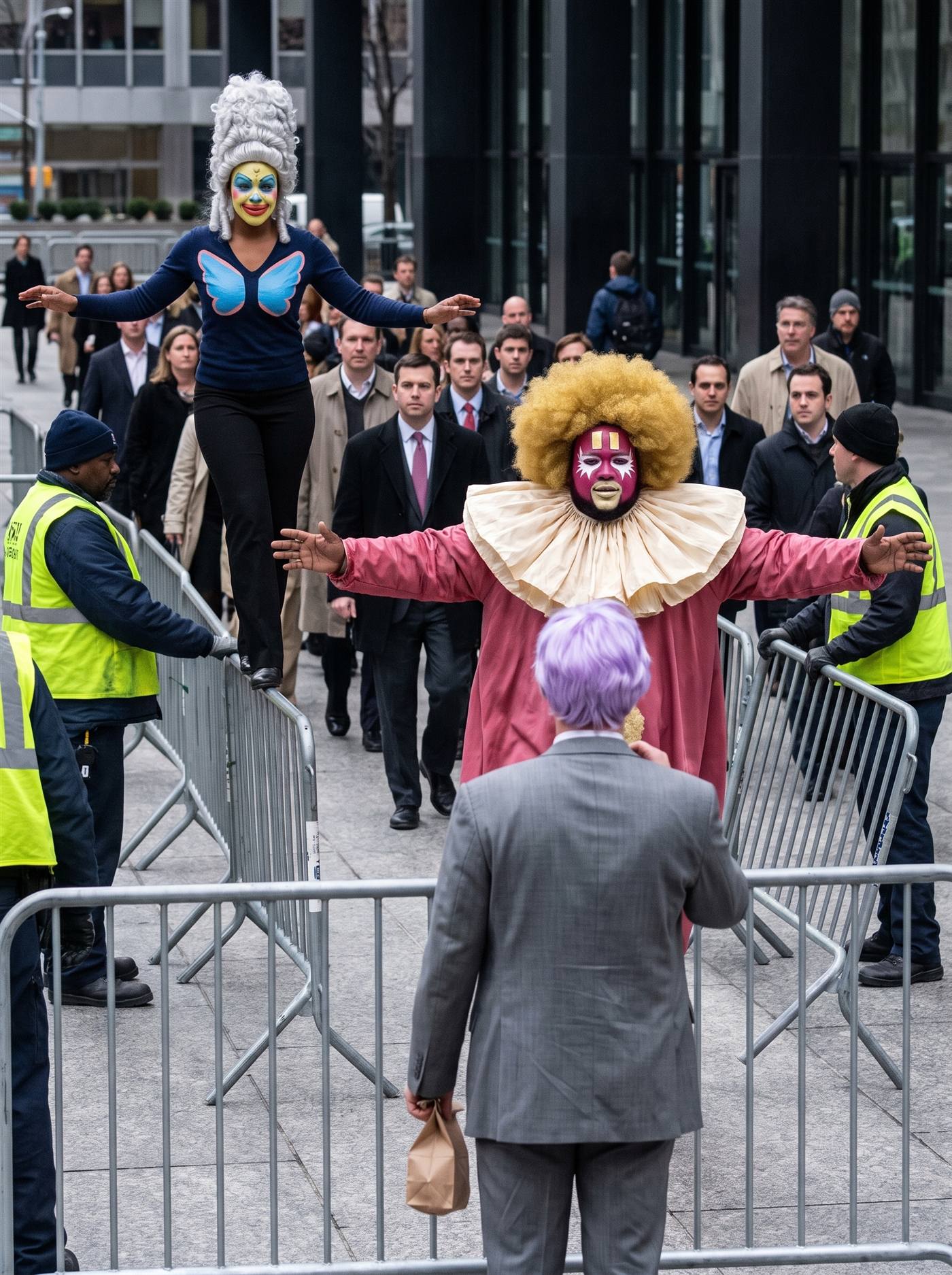
In the photograph of this day the barriers that penned the plaza for weeks are being carried away, the big one comes through the first gap mid-laugh, and the one made of balance walks the rail above it all. The man with the paper bag stands behind the section not yet removed — just outside the celebration's frame, as ever, glowing anyway.
The ground is dial-dark; the pigment is countdown brass — the metal of deadlines, polished by everyone checking the clock.
The artifact
The archive keeps a television-listings card from October 1962, its seven o'clock struck through for a presidential address about a war — and here is the form again, forty-one years on. The order reversed: in 1962 the address came after the close and the market sold the morning after; in 2003 the market rallied all day INTO the address — up 3.54 percent, the year's best day, closed on its exact session high at four o'clock, four hours before the eight o'clock ultimatum everyone had spent the session pricing. The clerk's verdict is the honest one available: progress, of a kind. The invasion came Wednesday evening and barely moved the tape; the war premium drained out of crude all week.
Read the card
Printed text is shown plain; the clerk's entries are shown in script.
TELEVISION · MONDAY EVENING, MARCH 17, 2003
- 7:30 — [printed program]
- 8:00 — [struck through] all networks — the president. forty-eight hours.
- 8:15 — regular programming will resume.
- the five hundred: 833.27 → 862.79 · up 3.54 percent — the best day of the year. closed on the exact high, four hours before he spoke.
- MARGIN CLERK'S HAND: in '62 the address came first, and we sold the morning after. this time we rallied first. progress, of a kind.
- CERTAINTY, OUTBIDDING PEACE. AGAIN.
On Monday, March 17, 2003 — the day the second UN resolution was withdrawn and the inspectors were ordered out of Iraq — the S&P 500 rose 3.54 percent to 862.79, its largest daily gain of 2003, closing at its session high before the 8 p.m. ultimatum. The invasion began the evening of March 19 and added little; the Dow's March 17–21 week was its best since October 1982. The rally's four-day-old base, the March 11 close of 800.73, held three percent above the October 2002 bear low this archive already keeps.
The ledger — what actually happened
| Measure | Close | Change | Marginalia |
|---|---|---|---|
| S&P 500 | 862.79 | +29.52 · +3.54% | the largest daily gain of all 2003, closed at the exact session high; per the feed and the official record, to the cent |
| Dow Jones | 8,141.92 · +3.59% | +282.21 — "best gains of the year"; the week that followed was its best since October 1982 | |
| Nasdaq | 1,392.27 · +3.88% | per the record | |
| The address | 8 p.m. — 48 hours | the market closed on its high four hours before the ultimatum it had spent the day pricing | |
| The October low | 776.76 — held | March's retest stopped at 800.73, three percent above the bear bottom this archive already keeps; the war premium left crude at −28% in a week |
Sources
- Market-data feed + the official daily record — 862.79, +29.52, +3.54%, close = session high; the full-year 2003 ranking computed from the daily series
- CNN/Money, "Prewar rally" (Alexandra Twin, March 17, 2003, 8:24 p.m. ET) — the day's wrap, the George and Selkin quotes, the ultimatum's timing
- FRED — daily WTI spot: the −28% war-premium unwind, March 12–21
- RBC Wealth Management / NBC retrospectives — the Dow's best week since October 1982