The only thing burning
S&P 500 6,477.16 · −114.74 · −1.74%
There was, on paper, good news. The president had announced a ten-day pause on strikes against Iranian energy infrastructure and talks were under way, which is the closest thing to de-escalation the month had produced. The market opened on it, put on forty points in the first forty minutes to 6,573.22 — and then went down for the remaining five hours and twenty minutes without ever seriously trying to go back up. Not a crash: a staircase. 6,562, 6,547, 6,540, 6,520, 6,516, 6,500, 6,490, and a low of 6,473.79 inside the final ten minutes, closing at 6,477.16, down 1.74 percent. Twenty-two of the Dow's thirty components finished red. Communication services lost 3.5 percent, technology 2.7, industrials 2.3. And energy rose 1.6 percent, because a ten-day pause on hitting oil facilities is not the same thing as oil coming back, and everybody could see the difference.
The day's protagonist
NVIDIA NVDA
Move: −4.16% to 171.24, ten cents off its low of the day
Nvidia closed at 171.24 on 26 March. Its low for the session was 171.14. The distance between those two numbers is ten cents, on 186 million shares, in the largest company in the world — which is a very precise way of saying that at four o'clock in the afternoon there was no bid left above the last one. A stock that closes on its low has not found a level; it has run out of session. It was the Dow's biggest loser and it took the Nasdaq down 2.4 percent with it, and the reason has nothing to do with graphics processors. For four weeks the market had been solving a single problem — what is a barrel of oil going to cost, and what does that do to everything — and the answer it kept arriving at was that the expensive, long-dated, growth-priced part of the index was where the adjustment had to happen. Meanwhile the energy sector rose 1.6 percent on a day the market fell 1.74, and it had been rising, more or less, for a month. Two things were true at once: this was the fourth consecutive week in which the war was the only trade that worked, and it was the week the war was supposedly winding down. Nobody believed the second one enough to sell the first.
The deeper account
The staircase is the thing to look at. Thirty-two of the session's thirty-nine ten-minute bars are lower than the one before them or level with it, and the four small rallies inside the day — around eleven, around one, around half past two — each recover ten or fifteen points and then fail at a lower level than the last one did. That pattern is not fear. Fear looks like 12 February, or like the first fifty minutes of 3 March: fast, loud, and over. This is something slower and worse, a market in which every attempt to buy gets absorbed and the absorbing stops a little lower each time. It ends, as those days almost always do, on the low, in the last ten minutes, with 6,473.79 and then the bell.
The good news of the day is what makes it legible. A ten-day pause on strikes against Iranian energy facilities, plus live talks, is genuinely de-escalatory, and the market took it seriously enough to open higher and hold for forty minutes. Then it worked out the arithmetic. A pause is not a settlement; the Strait was still a problem; and if the fighting stopped tomorrow the oil already in the price would take months to come out of the cost base of every company that burns it. Energy rose 1.6 percent on the day that peace was allegedly nearer, which is the market saying, in the only language it has, that it did not believe the second part.
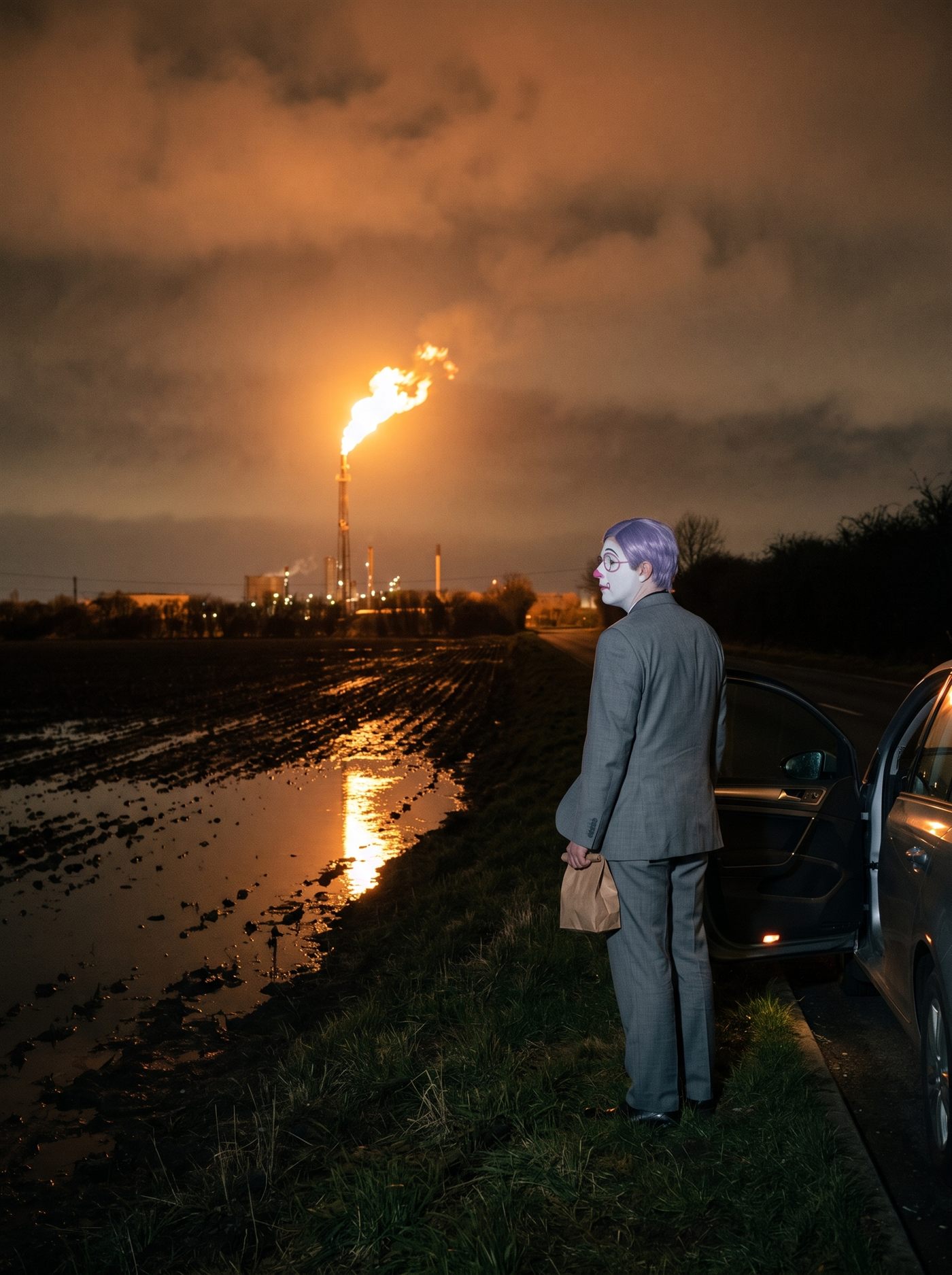
This page and the next are a pair, and they are the last two before the bottom. On both days energy was the only sector that rose — 1.6 percent here, 1.9 percent on Friday — while everything else was sold, and on both days the index went out at or within a whisker of its low. The photograph is a refinery flare at night, seen from a verge two fields away: the flame bent sideways in the wind, throwing a bar of orange across a flooded ploughed field, and nothing else visible for miles. It is the only light in the picture. It is also the fire.
The artifact
The ledger — what actually happened
| Measure | Close | Change | Marginalia |
|---|---|---|---|
| S&P 500 | 6,477.16 | −114.74 · −1.74% | opened 6,555.86 · high 6,573.22 at 10:10 · then down for five hours and twenty minutes without a real bounce · low 6,473.79 in the final ten minutes |
| Energy | +1.6% | the only sector with a meaningful gain. Communication services −3.5%, technology −2.7%, industrials −2.3% | |
| NVIDIA | 171.24 | −4.16% | low 171.14 — closed ten cents off it, on 186 million shares. The Dow's worst |
| SanDisk | 603.17 | −11.02% | the largest fall on the board; Intel −6.53% to 44.10. The memory and chip names that had led the 9 March rebound gave the whole of it back |
| Dow Jones Industrial Average | 45,960.11 | −469.38 | down one percent; twenty-two of the thirty components finished lower. The Nasdaq Composite fell 2.4 percent to 21,408.08 |
| The pause | ten days | announced on strikes against Iranian energy infrastructure, with talks under way. The market opened higher on it and spent the rest of the day disagreeing | |
| From the record | −7.19% | against the closing high of 6,978.60 set on 27 January. Two more sessions to the bottom |
Sources
- Robinhood market-data feed — SPX 10-minute bars and day bar; NVDA, SNDK, INTC, AVGO, AMZN, JPM, CAT, IBM, NEE and ULTA day bars, adjustment none. Pulled 2026-08-28
- Zacks via Yahoo Finance — "Stock Market News for Mar 27, 2026" (covers the 26 March session: index closes, the ten-day pause and talks, sector ETFs, Nvidia, Dow component breadth) — https://finance.yahoo.com/markets/stocks/articles/stock-market-news-mar-27-103600328.html