Twenty-five million, again
DOW JONES 296.51 · −0.99 · −0.33% · twenty-five million, twenty-two years on
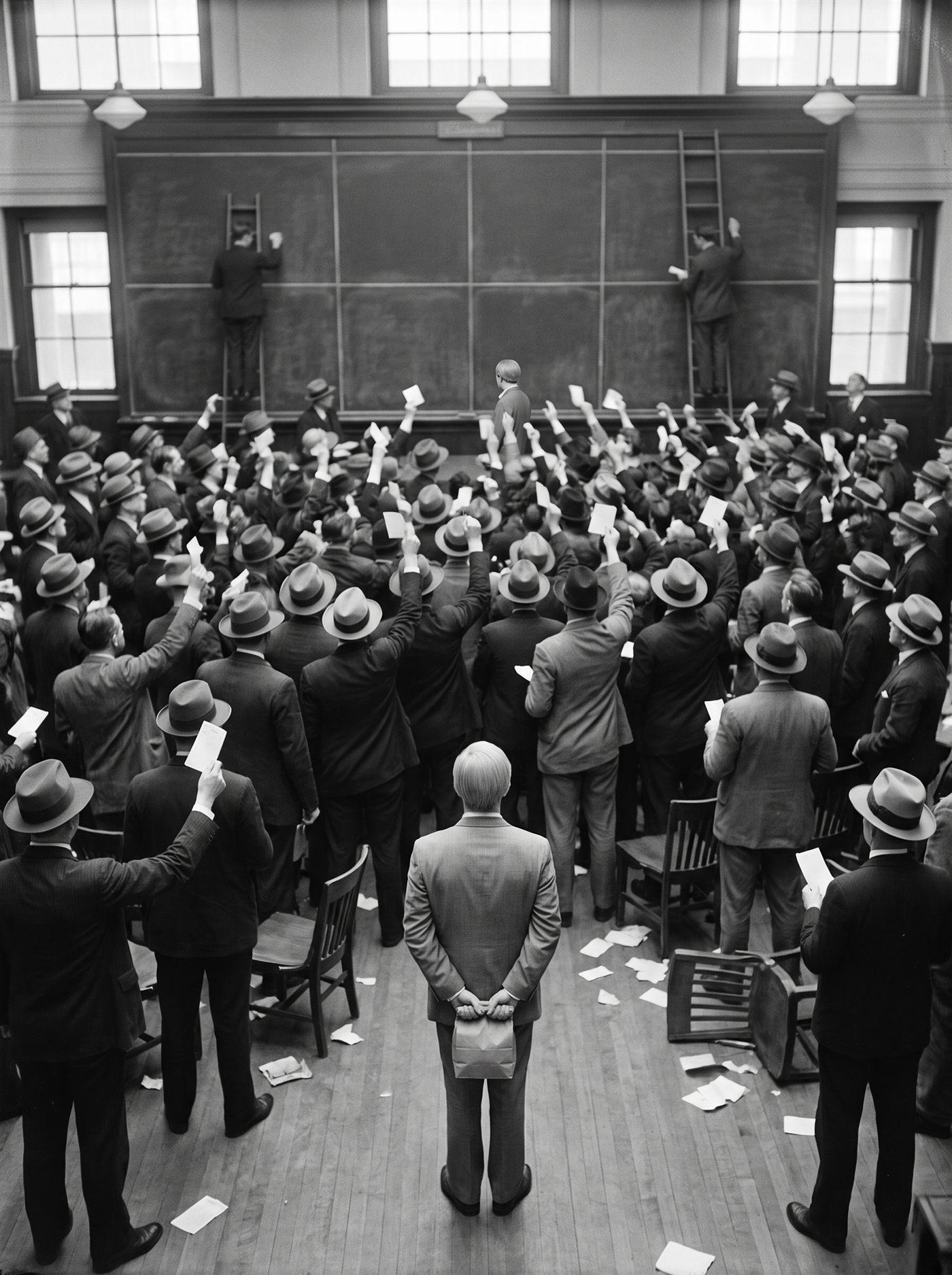
The boom of the twenties was built on call loans — money lent overnight against stock, renewable each morning, and withdrawable on a day's notice. In the last week of March 1929 the lenders began withdrawing it. The rate went to twenty percent, brokers began selling their customers' positions to repay loans they could not roll, volume set a record, and for a few hours the machinery looked exactly as it had looked in October 1907. What stopped it was the same instrument as in 1907, for the same amount: one man announcing that his institution would supply twenty-five million dollars. The difference is that in 1907 there was no central bank to defy, and in 1929 there was, and he defied it. The close that afternoon was down a third of one percent.
The day's protagonist
Charles E. Mitchell — no symbol.
Move: $25,000,000 — pledged against a Federal Reserve warning
The Federal Reserve Board had spent the early months of 1929 trying to discourage banks from lending against stock, on the reasonable view that the boom was being financed with credit that ought to be doing something else. It issued warnings rather than raising rates, and the warnings had begun to work: on March 26 the call money rate reached twenty percent and 8,239,000 shares traded, a record, as brokers liquidated to repay loans. Charles Mitchell, chairman of National City Bank and a director of the New York Federal Reserve Bank, announced that National City would put twenty-five million dollars into the call market, saying his institution had an obligation that was paramount to any Federal Reserve warning or anything else, to avert a dangerous crisis in the money market. The rate broke, the selling stopped, and the boom resumed. It resumed for five months and eight days. Mitchell was indicted for tax evasion in 1933 and acquitted; the bank did not recover its name.
The deeper account
This page is the hinge of the batch. Twenty-two years earlier, on October 24, 1907, the president of the Exchange told J. P. Morgan the floor would have to close; Morgan raised twenty-five million dollars in minutes and sent it to the money post, and the index closed down 0.05 percent. Here the sum is identical, the mechanism is identical, and the close is down 0.33 percent. Both rescues are invisible in the tape and both are the most important thing that happened that day.
What changed between them is that the second rescue had an institution to overrule. The Federal Reserve had been created because of the first one, and in March 1929 a member bank's chairman announced in public that he would act against its stated wishes, and was proved right for five months.
The Pecora hearings of 1933 took Mitchell's conduct apart in detail, and the securities legislation of 1933 and 1934 is in part an answer to it. He was acquitted of the criminal charge.
From here the archive continues without a gap. The next page on this shelf is September 3, 1929 — the top of everything, on the hottest day of the year, with nobody looking up.
The artifact
Everything in the boom of the twenties stood on money lent overnight and renewable each morning at the lender's discretion, and in the last week of March 1929 the lenders began exercising it. The call rate reached twenty percent, brokers sold their customers' positions to repay loans they could not roll, and volume set a record at 8,239,000 shares. Charles Mitchell, chairman of National City Bank and a director of the New York Federal Reserve Bank, announced publicly that his institution would put twenty-five million dollars into the call market — against the Board's stated wish that banks stop lending against stock. The rate broke and the boom resumed. Twenty-two years earlier, almost to the gesture and for exactly the same sum, Morgan had done it at the money post; that page is on this shelf too, and its close was down 0.05 percent. This one is down 0.33. Neither number knows anything happened.
Read the notice
Printed text is shown plain; the loan clerk's entries are shown in script.
CALL LOAN · NOTICE OF RENEWAL TERMS — Tuesday, March 26, 1929
- loan against listed collateral · rate ruling at noon 15% · rate ruling at one o'clock 20%
- renewal: AT THE LENDER'S DISCRETION · failing renewal: COLLATERAL SOLD AT THE MARKET
- STATEMENT ISSUED THIS AFTERNOON: THIS BANK WILL PLACE $25,000,000 IN THE CALL MARKET — "an obligation which is paramount to any Federal Reserve warning, or anything else" — CHAIRMAN · NATIONAL CITY BANK
- LOAN CLERK'S HAND: rate broke on the announcement. we are renewed.
- the industrials closed at 296.51 · −0.33%
On March 26, 1929 the call money rate reached twenty percent and a record 8,239,000 shares changed hands. Charles E. Mitchell's pledge of $25 million from National City broke the squeeze and the advance resumed; the Dow reached its record close of 381.17 five months and eight days later, on September 3, 1929. The hourly rates on this notice are illustrative of the afternoon; the twenty percent peak, the volume, the sum and the quoted justification are from the record. Mitchell was indicted for tax evasion in 1933 and acquitted.
The ledger — what actually happened
| Measure | Close | Change | Marginalia |
|---|---|---|---|
| Dow Jones | 296.51 | −0.99 · −0.33% | a third of one percent, on the day the credit behind the boom briefly failed |
| Call money | 20% | the overnight rate against stock collateral, at its peak that afternoon | |
| Volume | 8,239,000 shares | a record, made by brokers selling to repay loans rather than by anyone forming a view | |
| The pledge | $25,000,000 | National City's, announced publicly and explicitly against the Federal Reserve's warnings | |
| Time bought | 5 months, 8 days | to September 3, 1929 — the record close of 381.17, and this archive's other opening page |
Sources
- MeasuringWorth — Daily Closing Values of the Dow Jones Average (March 22–29, 1929, queried directly) — https://www.measuringworth.com/datasets/DJA/
- Novel Investor — Timeline of the 1929 Market Crash: the March 26 record volume of 8,239,000 shares, the twenty percent call rate, and Mitchell's $25m announcement with his quoted justification — https://novelinvestor.com/timeline-of-the-1929-market-crash/
- Charles E. Mitchell — chairman of National City Bank, director of the Federal Reserve Bank of New York, the March 1929 intervention, and the 1933 indictment and acquittal — https://en.wikipedia.org/wiki/Charles_E._Mitchell