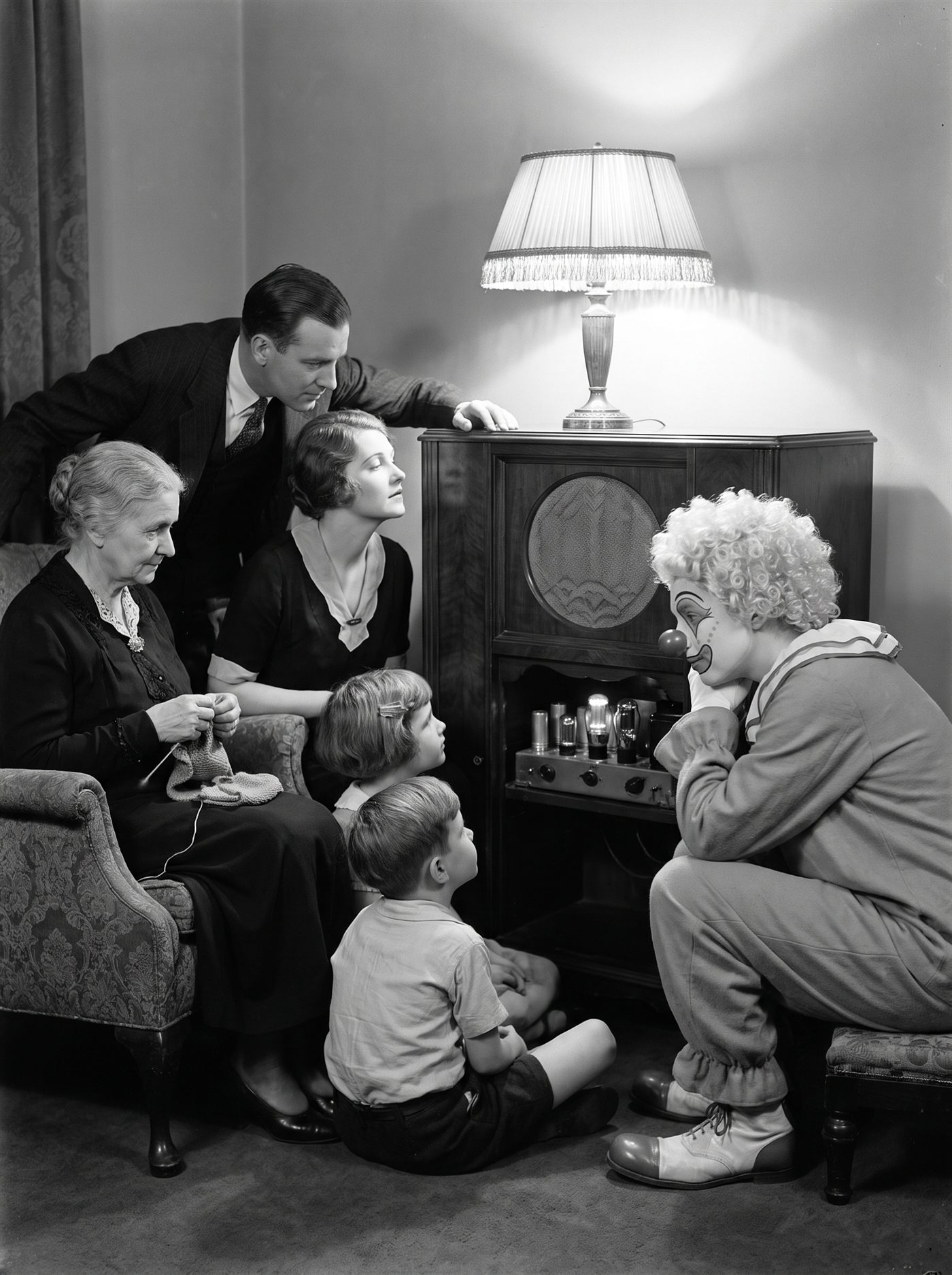
Radio
DOW JONES 203.33 · +3.09 · +1.54% · the decade stops investing and starts watching
The stock was the future and everybody knew it — a company that sent voices through the air into the parlours of people who had grown up in silence — and that made it the perfect thing to push. A group of operators around Michael Meehan began buying Radio Corporation of America from one another in the first week of March, passing the same shares around at rising prices to manufacture the appearance of a crowd. The appearance produced the crowd. Radio went up twelve dollars on this Monday and eighteen more on the Tuesday, the newspapers moved the market from the financial pages to the front, and within a month the pool sold everything to the audience it had assembled and divided something like ten million dollars.
The day's protagonist
Radio Corporation of America RCA
Move: +$12.00 on the day — and +$18.00 the next
A pool was a simple arrangement and, at the time, a legal one: a group of operators would accumulate a stock quietly, then trade it among themselves at steadily higher prices on visible volume, so that the tape reported enthusiasm that did not exist. The tape was persuasive. Michael Meehan, the specialist in Radio on the floor, is generally placed at the centre of the March 1928 operation; the group is reported to have begun on March 3, to have run the stock up through the middle of the month — twelve dollars on the 12th, eighteen on the 13th — and to have reached roughly a hundred and ninety-five dollars by the end of March, a hundred dollars above where they started. Then they sold it to the people the run-up had attracted, and split about ten million dollars. RCA never paid a dividend in the 1920s. It did not need to; nobody was buying it for the dividend.
The deeper account
Pools of this kind were not prosecutable in 1928. The Securities Exchange Act of 1934 exists in large part to describe what happened in this fortnight and forbid it; Meehan was among the first people expelled from the Exchange under the new rules, in 1937.
The distinction that matters here is between a bubble and an operation. Most of what this archive keeps from 1929 is a crowd deceiving itself. This is a crowd being deceived on purpose, early, by people who then sold into it.
The figures on this page for Radio itself come from the contemporary account rather than from a price series, and are marked as reported. The index numbers are from the daily record.
From here the archive's road to September 1929 is continuous: the mania acquires an audience in March 1928, survives a bank rescue in March 1929, and tops out on the hottest day of that September.
The artifact
A pool was a legal arrangement in 1928 and a simple one. A group accumulated a stock quietly, then bought and sold it among themselves at rising prices on visible volume, so that the tape reported an enthusiasm that did not exist; the enthusiasm then arrived to meet it. Michael Meehan, the specialist in Radio Corporation of America on the floor, is generally placed at the centre of the March 1928 operation, which is reported to have begun on the 3rd, to have carried the stock up twelve dollars on the 12th and eighteen more on the 13th, to have reached about a hundred and ninety-five dollars by the end of the month, and to have returned the participants something like ten million dollars once they sold into the audience they had assembled. RCA paid no dividend all decade. Nobody was buying it for the dividend. This memorandum is the archive's reconstruction of that mechanism, not a surviving document.
Read the memorandum
Printed text is shown plain; the manager's entries are shown in script.
PARTICIPATION ACCOUNT · NOT FOR CIRCULATION — Monday, March 12, 1928
- account opened: MARCH 3 · participants: 7 · the issue: named nowhere on this form
- purchases and sales this day: BETWEEN PARTICIPANTS
- closing advance on the day: +$12.00 · position: RETAINED
- object of the account: to establish an appearance of activity in the issue.
- MANAGER'S HAND: the tape is doing the talking now. we need only keep it moving until the public arrives.
- IT WAS NOT UNLAWFUL. THE SECURITIES EXCHANGE ACT IS SIX YEARS AWAY.
The Dow closed March 12, 1928 at 203.33, up 1.54 percent. The per-day dollar moves in Radio — twelve dollars on the 12th and eighteen on the 13th — come from the contemporary account rather than a price series and are flagged as reported on the day page. Pools of this kind were prohibited by the Securities Exchange Act of 1934; Meehan was among the first people expelled from the Exchange under the new rules, in 1937.
The ledger — what actually happened
| Measure | Close | Change | Marginalia |
|---|---|---|---|
| Dow Jones | 203.33 | +3.09 · +1.54% | the average confirms, for once — on the 13th Radio rose more and the average fell |
| Radio | +$12.00 | in one session; +$18.00 the following day (as reported contemporaneously) | |
| By month end | about $195 | roughly $100 above the pool's starting point of March 3 | |
| The pool's profit | about $10m | divided among the operators once the stock had been sold to the crowd it attracted | |
| Dividend | none | RCA paid no dividend on its common stock through the decade |
Sources
- MeasuringWorth — Daily Closing Values of the Dow Jones Average (March 8–15, 1928, queried directly) — https://www.measuringworth.com/datasets/DJA/
- PBS American Experience, The Crash of 1929 — "A Hot Stock": the Meehan pool of March 1928, the daily moves, and the roughly $10m profit — http://www.shoppbs.pbs.org/wgbh/amex/crash/sfeature/sf_rca.html
- Digital History teaching materials, Rise and Crash — the March 3 formation of the pool and the $12 and $18 sessions (single-source for the per-day dollar moves; flagged on the page)