Announced after it closed
DOW JONES 99.34 · +12.86 · +14.87% · +14.87%, inside the collapse
On Sunday night the President went, discarding all precedent, to the Treasury Secretary's apartment, and put a plan before six men assembled in secret. On Tuesday the market rose fourteen and eighty-seven hundredths percent — the greatest day in the index's history to that date, and its second-greatest ever since — on what the Chronicle called, without embarrassment, advance knowledge of the move being made by the President. The move itself was promulgated at a hurriedly called conference near midnight, after the close, for Wednesday's papers. Five hundred and twenty-two banks had suspended that month. The rally ran five more weeks, gave it all back by January, and the bottom of July 1932 sits 58 percent below this close. The second-greatest day the Dow ever had bought exactly nothing.
The day's protagonist
The pool — no symbol.
Move: $500,000,000 of confidence, announced near midnight — spent by January
The plan was the National Credit Corporation: a bankers' pool of not less than five hundred million dollars to lend to weakened banks on sound assets the Federal Reserve couldn't touch, with the New York Clearing House banks pre-pledging two percent of their deposits and authority for a billion in debentures whose interest was payable only if earned. It was conceived on a Sunday night in Mellon's apartment before six men sworn to secrecy, leaked into Tuesday's tape as advance knowledge, and announced formally at a White House conference called so hurriedly that the thirty-odd congressmen and bankers summoned did not know the topic — near midnight, after the second-greatest day in the Dow's history had already closed. The market's Tuesday was 14.87 percent; the same day the Exchange quietly created the ancestor of the uptick rule, and Thursday added 8.70 more. Then the machinery met reality: the pool lent timidly, the banks kept failing — 522 had suspended in October alone — and Congress replaced the whole apparatus with the Reconstruction Finance Corporation in January, by which time the index stood below where the rally began. From this close to the final bottom of July 1932, a page this archive keeps, is another 58 percent down. The market had celebrated the promise of money. The money never quite arrived.
The deeper account
The whipsaw around this day has no equal in the index's record: Saturday −4.24, Monday −6.78 with U.S. Steel at its lowest since 1915, Tuesday +14.87, Wednesday −2.03, Thursday +8.70 — two of the seventeen greatest up-days ever, three days apart, inside the worst year the American banking system ever had.
The same Tuesday the Exchange required every sell order to be marked long or short and barred short sales on a downtick — the ancestor of the uptick rule, aimed at the bear raids. Some of the day's fury was simply shorts running for the one exit.
This page and the one before it are the batch's matched pair: 1929's rally had its statement timed to the minute; 1931's had its announcement after the bell entirely. Both were the greatest day ever recorded at the moment they happened. Both were repealed within weeks. The archive notes, without further comment, that the all-time list's top three are one rally out of a real bottom — the sprout page of March 1933 — and these two.
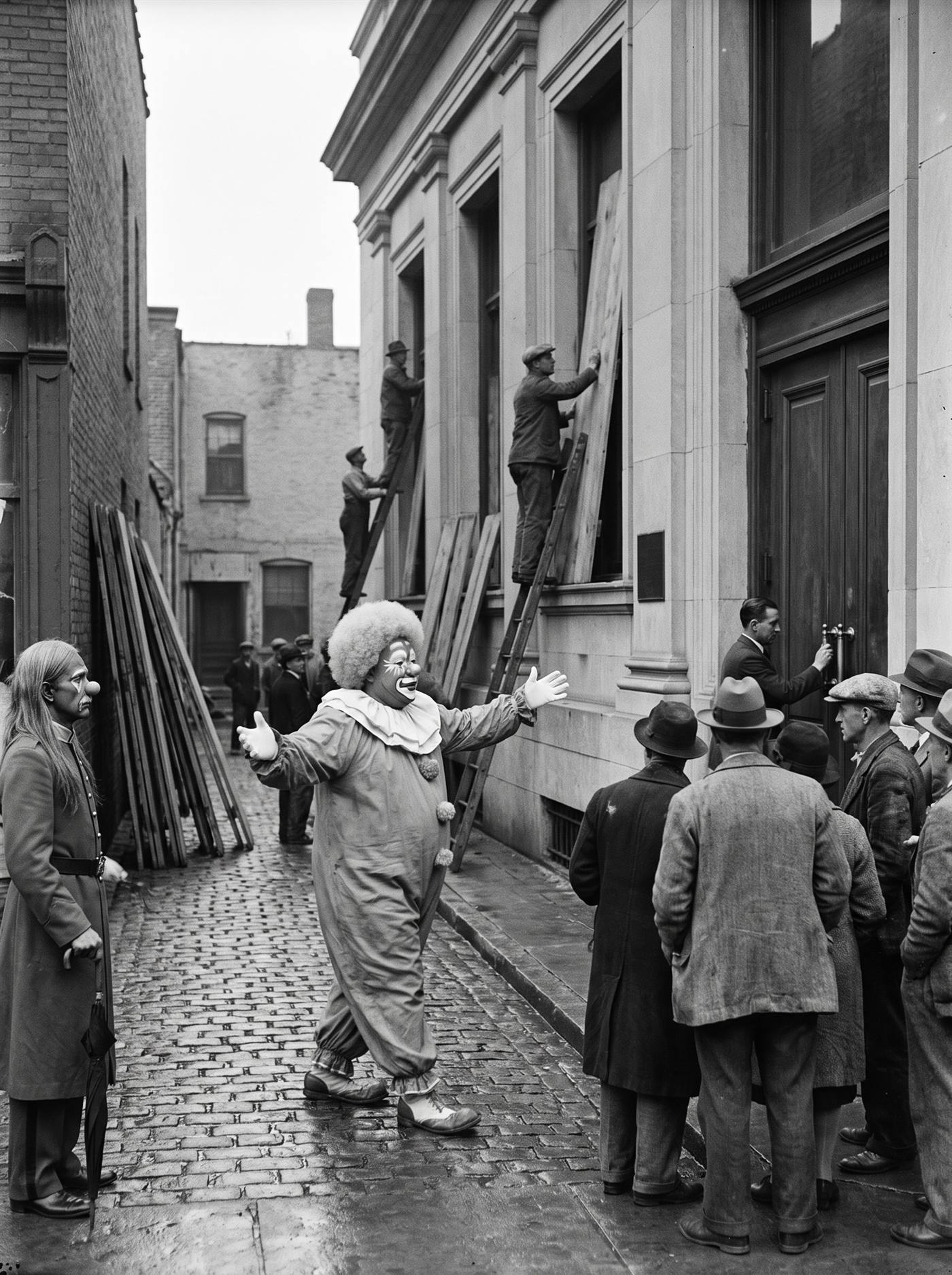
In the photograph of this day the boards are coming off the bank's windows and the big one comes up the street mid-laugh, arms wide, personally ending the Depression. The crowd's arms stay crossed. And the one with the umbrella watches the alley, where the boards are being stacked — not burned.
The artifact
The National Credit Corporation was confidence organized as paperwork: a half-billion-dollar pool by which the strong banks would lend to the weak ones, on the sound assets the Federal Reserve's rules couldn't reach, with the Clearing House pre-pledging two percent of deposits and a billion in debentures whose interest was owed only if earned. The market bought it a day early — up 14.87 percent, the Chronicle recording without embarrassment that the reversal ran "on advance knowledge of the move being made by President Hoover" — and the plan itself was promulgated at a hurriedly called White House conference near midnight, after the close. The pool then lent almost nothing, the banks kept failing, Congress replaced it with the RFC in January, and the index gave back the whole rally and 28 percent more. The clerk's arithmetic is the epitaph.
Read the form
Printed text is shown plain; the clerk's entries are shown in script.
THE NATIONAL CREDIT CORPORATION · OCTOBER 1931 — SUBSCRIPTION OF MEMBERSHIP
- the pool: not less than $500,000,000. clearing house banks subscribe 2% of deposits. debentures to $1,000,000,000 — interest payable only if earned.
- the strong shall lend to the weak. confidence is anticipated.
- tuesday: 86.48 → 99.34 · up 14.87 percent — the greatest day in the book — "on advance knowledge."
- the plan itself: announced near midnight, after the close.
- MARGIN CLERK'S HAND: the rally came before its reason. by january, both were gone.
- THE SECOND-GREATEST DAY IN DOW HISTORY BOUGHT EXACTLY NOTHING.
On Tuesday, October 6, 1931, the Dow rose 12.86 points, 14.87 percent, to 99.34 — its largest one-day gain ever at the time and its second-largest to this day. The rally extended to 116.79 by November 9, then failed: 71.24 by January 5, 1932, and 41.22 — the bottom this archive already keeps — by July, 58.5 percent below this close. The National Credit Corporation was superseded by the Reconstruction Finance Corporation in January 1932.
The ledger — what actually happened
| Measure | Close | Change | Marginalia |
|---|---|---|---|
| Dow Jones | 99.34 | +12.86 · +14.87% | the SECOND-GREATEST day in the index's history, then and now — the largest at the time; some tables print +12.36%, a corruption of the point change, killed against the daily record |
| Volume | 4,304,519 shares | per the Chronicle's weekly table — its figure alone, printed with its name | |
| The knowledge | in advance | "the market reversed its course on advance knowledge of the move being made by President Hoover" — the Chronicle, without embarrassment; the announcement came near midnight, after the close | |
| The month around it | 522 banks | suspended in October 1931 alone, per the Federal Reserve's later count (tertiary lineage, flagged); Britain had left gold September 21 | |
| The trap | 71.24 by Jan 5 | the rally topped at 116.79 on Nov 9, then gave back everything and 28 percent more; the July 1932 bottom, already on this shelf, is −58.5% from here |
Sources
- MeasuringWorth — Daily Closing Values of the Dow Jones Average (the whole week, the Nov 9 top, the Jan 5 and July 8, 1932 lows, queried directly — the +14.87% dispute settled here) — https://www.measuringworth.com/datasets/DJA/
- Commercial & Financial Chronicle, Oct 10, 1931 (Vol. 133 No. 3459, via FRASER, pp. 2303–07) — the advance-knowledge sentence, the near-midnight conference, the pool's terms, the volumes (PRIMARY)
- TIME, "Banks: At Mr. Mellon's" (October 1931) — the Sunday-night gathering at 1785 Massachusetts Avenue
- Charles M. Jones (Columbia GSB), "Shorting Restrictions: Revisiting the 1930s" — the October 6 downtick rule
- Federal Reserve History / the Federal Reserve Bulletin's suspension series — the NCC's failure, the RFC's January 1932 creation, the October bank count (lineage flagged)