Worked before it happened
DOW JONES 663.20 · +32.04 · +5.08% · the record nobody explains
The bear's exact bottom was Tuesday — 631.16, the lowest close since late 1962, at the end of a May the New York Fed itself described as a deepening gloom: Cambodia, Kent State, profits falling, a railroad dying. Wednesday there was no news at all. There was only an invitation — the President's dinner for the men of business and finance, scheduled for that evening — and the market rose 32.04 points ahead of it, 5.08 percent, the largest one-day point gain in its history to that date. The chief of staff's diary entry is the era in two sentences: "Guess it worked before it even happened... Really neurotic." This time, unlike 1962, the turn was real.
The day's protagonist
The dinner — no symbol.
Move: +32.04 before the soup — the record set in anticipation of a cocktail hour
The White House had scheduled a dinner for that evening — business and financial leaders, the administration's attempt, in the chief of staff's own words, "to try to calm down the stock market which has been dropping steadily at an alarming rate." The market did not wait for the food. On no other news — none; the wires were checked then and historians have checked since — it rose all session and closed up 32.04 points at 663.20, a gain of 5.08 percent that took out the oldest record in the book: the 28.40 points of October 30, 1929, the bounce after Black Tuesday, which happens to be the first page of this batch. The era's gloom was total. Cambodia had been invaded April 30, Kent State was May 4, margin requirements had been cut for the first time in two years, and the Penn Central railroad was three weeks from the largest bankruptcy in American history. None of it mattered against an invitation. Haldeman's diary that night: "Guess it worked before it even happened because market gained 31 points - highest one day rise in history... Really neurotic." He was off by a point on the gain and exactly right about everything else. John Brooks named the evening for the record: a cocktail hour of staggering economic importance. And unlike the snapback of 1962 two pages back, this turn held — plus 11 percent in three days, 700.44 by Friday, and the Dow never saw 631.16 again.
The deeper account
The record deserves its context: forty-one years of market history — the entire Depression, the war, the postwar boom — and the biggest single-day point climb remained October 30, 1929's dead-cat 28.40 until this Wednesday. The number that finally beat the most famous false bounce in history was set by a rally in honor of hors d'oeuvres.
The NY Fed's own monthly review wrote the month's epitaph in one sentence: a deepening gloom settled over financial markets during most of May, and the darkest clouds appeared to be lifting as the month closed. Between those two clauses sits this day.
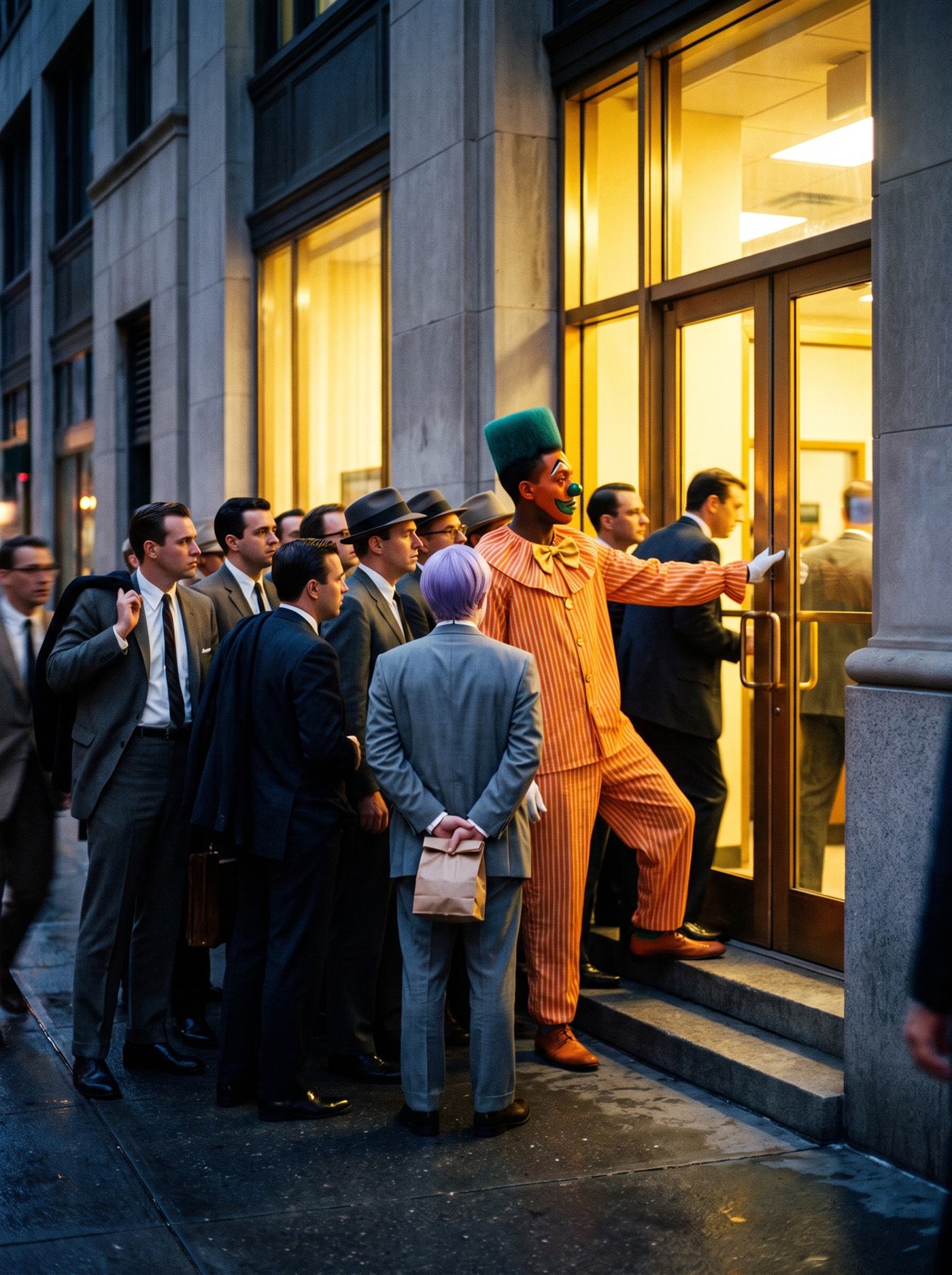
In the photograph of this day the office lights are burning after hours and the crowd is pressing back IN through the door — and the one holding it open is the same tall figure who led a crowd through another door in September 1939, nine pages back, in black and white. He does not look back this time either. The one with the paper bag follows, as he followed then, as he always follows.
The ground is the blue-dark of the evening street; the pigment is the office's late-burning gold — the light of a floor that suddenly had a reason to stay open.
The artifact
The dinner was real and its purpose was written down by the man who kept the President's diary of record: "to try to calm down the stock market which has been dropping steadily at an alarming rate." The market rose before a single guest arrived — 32.04 points, 5.08 percent, breaking a point-gain record that had stood since the bounce after Black Tuesday, forty-one years — on no other news whatsoever, one day after the 1969–70 bear touched its exact bottom. Haldeman's entry that night is the whole era in nine words. John Brooks supplied the christening: a cocktail hour of staggering economic importance. And unlike 1929's record, unlike 1962's snapback two pages back, this one held — eleven percent in three days, and the low never traded again.
Read the card
Printed text is shown plain; the diary line is shown in script.
THE PRESIDENT REQUESTS THE PLEASURE OF YOUR COMPANY AT DINNER — IN HONOR OF THE LEADERS OF AMERICAN BUSINESS AND FINANCE — wednesday evening, may the twenty-seventh
- by four o'clock: up 32.04, to 663.20 — the largest one-day gain in the book, before the soup.
- the record it broke: +28.40 — october 30, 1929, the bounce after black tuesday. it stood 41 years.
- yesterday: the bear's exact bottom. this time it held.
- FROM THE CHIEF OF STAFF'S DIARY, THAT NIGHT: "guess it worked before it even happened... really neurotic."
- A COCKTAIL HOUR OF STAGGERING ECONOMIC IMPORTANCE.
On Wednesday, May 27, 1970 — the day after the 1969–70 bear's closing low of 631.16 — the Dow rose 32.04 points, 5.08 percent, to 663.20, the largest one-day point gain in its history to that date, ahead of that evening's White House dinner for business leaders. The S&P 500 rose 5.02 percent off its 69.29 trough. The advance ran to 700.44 by month-end; Penn Central still failed in June; the low never traded again.
The ledger — what actually happened
| Measure | Close | Change | Marginalia |
|---|---|---|---|
| Dow Jones | 663.20 | +32.04 · +5.08% | the largest one-day point gain on record at the time — the record it broke was October 30, 1929's +28.40, this batch's first page; per the daily record |
| S&P 500 | 72.77 · +5.02% | off 69.29 — the 1969–70 bear's exact closing trough, 36.1% below the peak, close-to-close | |
| The catalyst | dinner, 8 p.m. | no other news existed; the rally ran ahead of the White House's evening for business leaders — "worked before it even happened" (Haldeman's diary, that night) | |
| The follow-through | +2.5% · +2.6% | the S&P's next two sessions; the Dow closed May at 700.44 — eleven percent off the low in three days | |
| The turn | held | unlike 1962's snapback two pages back, this was the bear's end — 631.16 never traded again. The railroad still failed in June; the market had stopped caring |
Sources
- MeasuringWorth — Daily Closing Values of the Dow Jones Average (May 1970 and the Oct 30, 1929 prior record, queried directly) — https://www.measuringworth.com/datasets/DJA/
- H.R. Haldeman's diary, May 27, 1970 (Nixon Library) — the dinner's purpose and the evening's verdict, verbatim; the White House Digest of Announcements confirms the dinner
- Federal Reserve Bank of New York, Monthly Review, June 1970 — "a deepening gloom"; the 631.16 low as "lowest since late 1962"; the margin cut; 700.44 at month-end
- John Brooks, The Go-Go Years — "a cocktail hour of staggering economic importance"
- S&P 500 daily series (official); Museum of American Finance (Earle) — the 69.29 trough and its −36.1% basis