The tape ran late
S&P 500 92.48 · +2.28 · +2.53% · a record
On Sunday night the President said he would not run again, and on Monday the market bought the peace it hoped that meant — 17,730,000 shares, the first session ever to out-trade Black Tuesday itself. The prize came printed on paper, one certificate at a time, and somewhere below the trading floor the men who had to count it understood the day before anyone else did.
The day's protagonist
The back office — no symbol.
Move: 17,730,000 shares — the record nobody could file
On Sunday evening, March 31, President Johnson halted most of the bombing and took himself out of the race; some who heard it Monday assumed April Fools'. The market bought the hope from the opening bell — the S&P 500 up 2.53 percent, the Dow up 20.58 to 861.25 — and by the close 17,730,000 shares had traded, the first session ever to surpass Black Tuesday 1929. The record was the sound of the plumbing failing: every share was a physical certificate to be counted, endorsed, messengered and re-registered by hand, and the Street's back offices were already weeks behind. The record set this day fell twenty-four more times before the year was out. The clerks never caught up.
The deeper account
Sequence: Johnson's broadcast Sunday evening, March 31 → Monday's peace-hope stampede breaks the 1929 volume record → records keep falling all year → from June 12 the Exchange goes dark every Wednesday to count paper → fails to deliver peak near $4 billion in December.
A quarter to two-fifths of broker deliveries to banks were coming back stamped DK — "don't know": wrong count, wrong certificate, wrong everything. Certificates were lost, misdelivered, and stolen in the deluge; a 1971 Senate hearing was told organized crime had taken more than $400 million of them.
The reckoning came when volume receded: in 1969–70 roughly a sixth of the Exchange's member firms died of the paperwork, by merger or failure. Out of the wreckage came the SEC's 1971 study of unsafe practices, investor insurance (SIPC, 1970), and the Depository Trust Company (1973) — the market taught itself to stop touching paper.
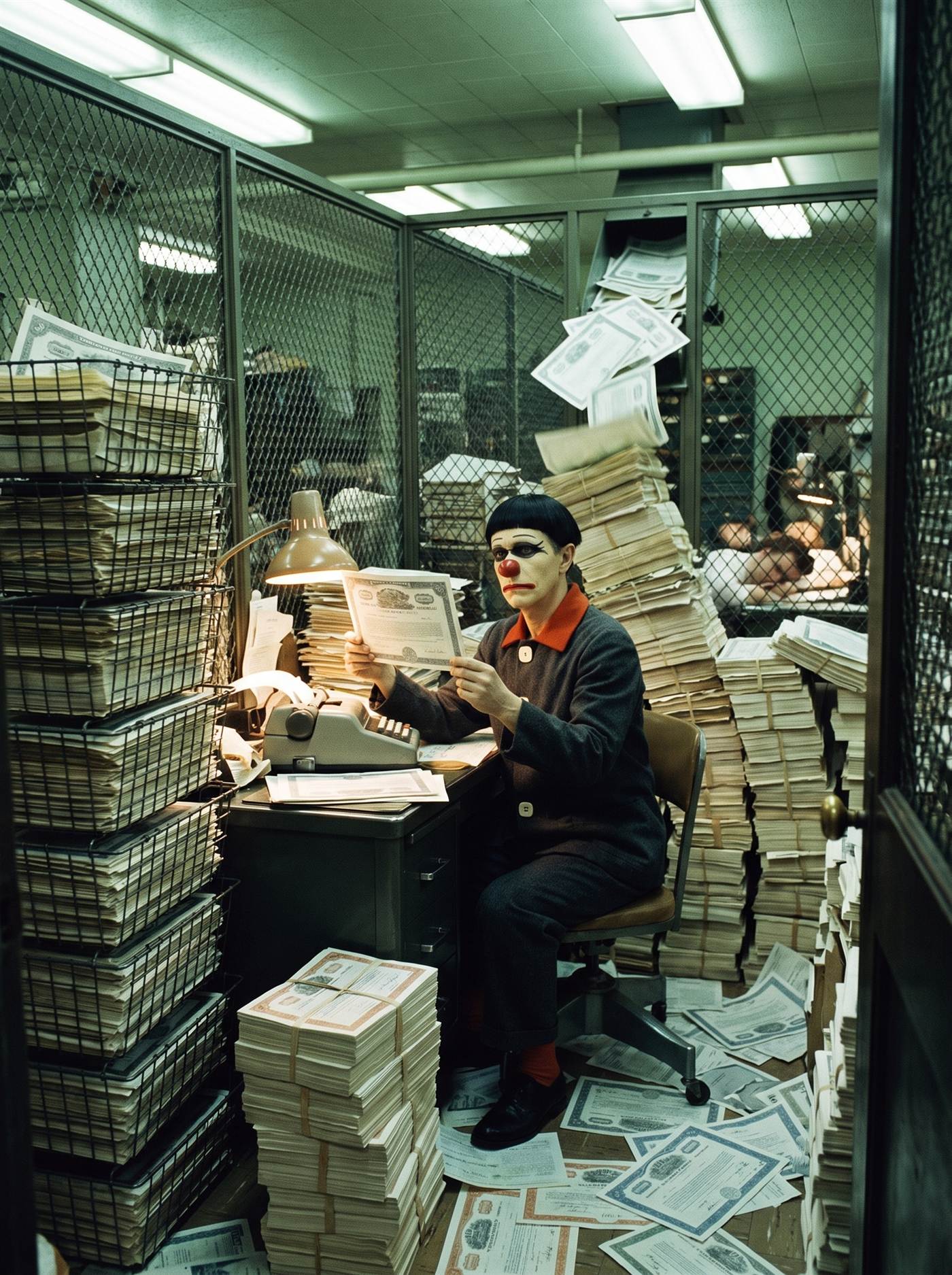
In the photograph of this day the house itself sits in the counting room at midnight, reading one certificate of seventeen million, unimpressed. The chute behind him is still delivering. The tallest stack leans.
The ground is certificate buff; the pigment is the engraver's green of the borders — the pigment doctrine's loud register, for a record written on paper.
The artifact
"DK" — don't know — was the back office's word for a delivery it could not recognize: wrong count, wrong certificate, wrong everything. In 1968 a quarter to two-fifths of broker deliveries to banks came back stamped like this. The peace-hope stampede of April 1 out-traded Black Tuesday itself — the first session ever to do so, ending a thirty-nine-year record — and every one of those 17,730,000 shares was a physical certificate someone had to count, endorse, messenger and file by hand. By June the Exchange was closing every Wednesday just to count paper; by December the unsettled backlog touched four billion dollars; and within five years the market had quietly re-invented itself so that no one would ever have to touch the paper again.
Read the ticket
Printed text is shown plain; the clerk's entries are shown in script.
DELIVERY TICKET · NEW YORK · MONDAY, APRIL 1, 1968
- DELIVER: ONE HUNDRED (100) SHARES — certificate n°s: illegible, smudged in transit · DK — DON'T KNOW, RETURN TO SENDER
- received by: blank · against payment of: blank
- volume today: 17,730,000 shares — more than any day, ever. the old record: October 29, 1929. it stood thirty-nine years. the tape closed late.
- CLERK'S HAND: eleventh basket since lunch. box 12 is full. so is 13. whoever bought this — we will find out who you are. eventually.
- EVERY SHARE IS A PIECE OF PAPER. TODAY THERE WERE SEVENTEEN MILLION PIECES OF PAPER.
On Monday, April 1, 1968 — the first session after President Johnson announced he would not seek re-election — peace hopes drove the New York Stock Exchange to 17,730,000 shares, the first day ever to surpass Black Tuesday 1929's volume. The S&P 500 rose 2.53 percent to 92.48. The record fell twenty-four more times that year, and the paper it generated buried the Street's back offices: by June the Exchange closed Wednesdays to catch up, by December some four billion dollars in trades sat unsettled, and the reckoning of 1969–70 carried off roughly a sixth of the Exchange's member firms.
The ledger — what actually happened
| Measure | Close | Change | Marginalia |
|---|---|---|---|
| S&P 500 | 92.48 | +2.28 · +2.53% | 90.20 → 92.48 on peace hopes — the President's Sunday broadcast, priced by Monday's bell |
| Dow Jones | 861.25 | +20.58 · +2.45% | per the daily record |
| Volume | 17,730,000 shares | the first session ever to out-trade Black Tuesday, 1929 — a 39-year record, broken 24 more times before New Year's | |
| Fails to deliver | ≈$4 billion | by December — trades the back offices simply could not settle | |
| The response | Wednesdays, dark | from June 12 the Exchange closed one day a week, just to count |
Sources
- SEC Historical Society — Securities Depositories: the DTC history (the April 1, 1968 record; broken 24 more times that year) — https://www.sechistorical.org/collection/papers/1990/1999_0101_DTCHistory.pdf
- Time, 1968 — "Wall Street: The Paperwork Predicament" — https://time.com/archive/6636314/wall-street-the-paperwork-predicament/
- John Brooks, The Go-Go Years — "The Enormous Back Room" (the DKs, the clerks, the December fails)
- SEC — Study of Unsafe and Unsound Practices of Brokers and Dealers, H. Doc. 92-231 (1971)
- Forbes — the Wednesday closings, June 12 to December 31, 1968