Hours behind the day
DOW JONES 603.96 · +27.03 · +4.69% · the snapback
The machine that tells everyone what happened could not keep up with what was happening. Monday the ticker printed the last trade at 5:59 in the evening, two hours and twenty-nine minutes after the close; Tuesday it fell behind again — same helpless machine, opposite day. An alarming morning first, sinking below Monday's wreck. Then the market changed direction and charged upward with astonishing vigor, as one chronicler put it: up 4.69 percent on nearly fifteen million shares, the heaviest volume since 1929. Somewhere between those two prints, 91,700 margin calls went out by telegram. The rally was real. The bottom, a month further down, was real too.
The day's protagonist
The late tape — no symbol.
Move: two days behind — printing Monday's panic into Tuesday's rally
The New York Stock Exchange's ticker was engineered for an ordinary day, and May 1962 stopped having those. Monday — the Kennedy Slide's worst session, the biggest one-day fall since 1929, the page one step back on this shelf — the tape could not finish reporting the floor's transactions until 5:59 PM, two hours and twenty-nine minutes after the closing bell, so that for most of the afternoon nobody selling knew what anything was worth. Tuesday the machine fell behind again on nearly fifteen million shares, the heaviest volume since 1929 — except this time it was printing the wrong direction. The morning sank below Monday's close, alarmingly; then the market turned and charged upward with what John Brooks called astonishing vigor, closing up 27.03 points, 4.69 percent, the best day anyone could remember since the war. The week's paperwork told its own story: an estimated 91,700 margin calls went out between Friday and Thursday, mainly by telegram. And the rally did not hold. The bear ground down another month to its June 26 bottom, eleven percent below this close, and did not truly turn until the missiles left Cuba in October — a page that already hangs five frames ahead.
The deeper account
Monday's page ends with the tape printing into the evening; this one begins there. The two days share their machine, their volume class and their helplessness — the only thing that changed was the sign.
There was no news. No speech, no statute, no rescue — bargain hunters and short-coverers on record volume, and public buying statements from a billionaire and a fund manager that the wires repeated hopefully. The market simply stopped falling faster than anyone could explain, one day after falling faster than anyone could explain.
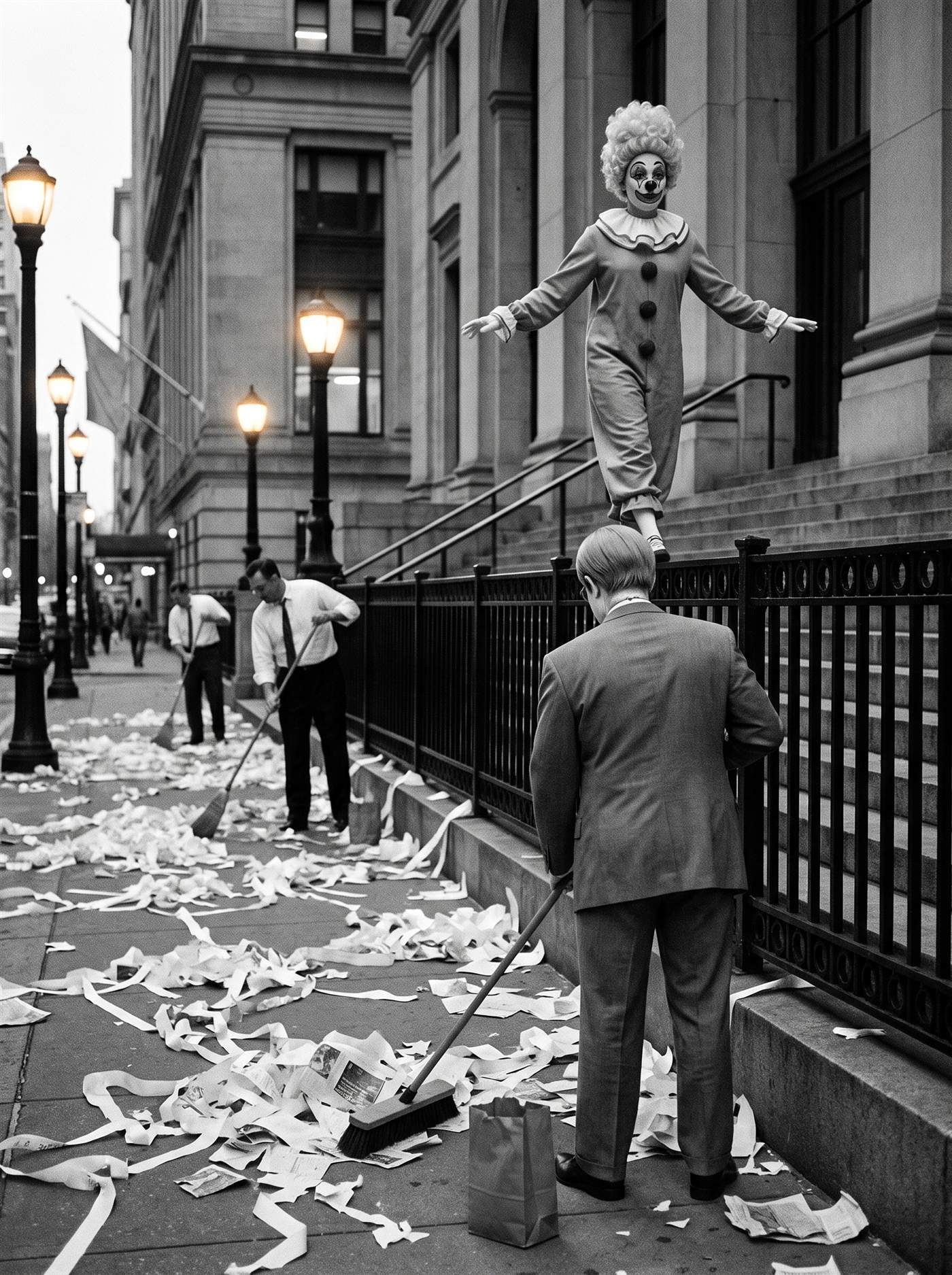
In the photograph of this day the clerks are sweeping yesterday out of the gutters under the first lamps, and she crosses above the whole scene on the fence rail, arms out, unhurried — risk carried lightly over the wreckage of the people who carried it heavily. The one sweeping his own small pile never looks up. He is learning the costliest lesson the tape teaches: the rally you miss while cleaning up is not the bottom. The bottom is a month away.
The ground is evening-indigo; the pigment is the off-white of the tape itself — the paper that told everyone what happened, hours after it mattered.
The artifact
The Exchange's members sent out an estimated 91,700 margin calls between May 25 and May 31, mainly by telegram — the fastest medium the street had, carrying the slowest possible news. The machine that printed prices ran hours behind both days: Monday it finished at 5:59 PM, two and a half hours after the close of the worst session since 1929; Tuesday it fell behind again on the heaviest volume since 1929, printing the opposite day. An alarming morning that sank below Monday's wreck, then the avalanche upward — up 4.69 percent, the finest day since the war, arriving before most of the week's telegrams did. The rally didn't hold; the bottom was a month away. But the telegram's real cruelty stands: the man sold out on Monday's margin call missed Tuesday by one delivery.
Read the telegram
Printed text is shown plain; the clerk's entries are shown in script.
TELEGRAM · TUESDAY, MAY 29, 1962 · ONE OF ≈91,700 THAT WEEK
- YOUR ACCOUNT REQUIRES ADDITIONAL MARGIN STOP DEPOSIT BY NOON TOMORROW STOP POSITIONS WILL OTHERWISE BE LIQUIDATED STOP
- monday: down 5.71 percent — the tape finished at 5:59 p.m., two hours and 29 minutes late.
- tuesday: up 4.69 percent — 14,750,000 shares, the most since 1929. the tape ran late again. an alarming morning, then the avalanche upward.
- MARGIN CLERK'S HAND: by the time this reached him, the market had bought his stocks back without him.
- THE TELEGRAM TRAVELED SLOWER THAN THE TURN.
On Tuesday, May 29, 1962 — the day after the Kennedy Slide's worst session — the Dow rose 27.03 points, 4.69 percent, to 603.96, and the S&P 500 rose 4.65 percent, on 14,750,000 shares. The rally did not hold: the bear bottomed June 26 at 535.76 (S&P 52.32), eleven percent below this close, and the durable turn waited for the missile crisis's resolution in October — the page five entries ahead.
The ledger — what actually happened
| Measure | Close | Change | Marginalia |
|---|---|---|---|
| Dow Jones | 603.96 | +27.03 · +4.69% | the morning sank below Monday's wreck first; per the daily record |
| S&P 500 | 58.08 · +4.65% | per the official series | |
| Volume | 14,750,000 shares | "nearly 15 million... highest total since 1929" — LIFE's ranking, single-sourced, printed as theirs | |
| The margin calls | ≈91,700 | sent between May 25 and May 31, mainly by telegram — per Brooks | |
| The trap | 535.76 · June 26 | the rally did not hold; the bottom came a month later, 11% below this close. Stability waited for October — five pages ahead |
Sources
- MeasuringWorth — Daily Closing Values of the Dow Jones Average (May 25 – June 26, 1962, queried directly) — https://www.measuringworth.com/datasets/DJA/
- The Wall Street Journal, May 29, 1962 (via Jason Zweig's retrospective) — the 5:59 p.m. tape, the exhausted traders
- John Brooks, Business Adventures — the alarming morning and the reversal's vigor; the 91,700 margin calls
- LIFE — the closing-time floor "boiling"; "nearly 15 million shares... highest total since 1929" (their ranking)
- S&P 500 daily series (official) — 58.08, +4.65%; the June 26 bottom at 52.32