The light before the worst Monday
S&P 500 2,711.02 · +230.38 · +9.29% · the Friday light
The day never went red — its floor stood eighty-five points above Thursday's wreck — but by mid-afternoon the bounce had faded to almost nothing, and the tape sat waiting for the announced three-thirty. Then the Rose Garden: a national emergency declared in two very big words, fifty billion dollars, drive-through tests, a website — and the Dow rose one thousand four hundred and twenty-eight points during the first half hour of the speech, ringing the closing bell mid-ramp. Up 9.29 percent, the best day since October 2008, fear's gauge down a quarter. It was a Friday. Monday was the worst day since 1987, the volatility index printed the highest close in its history, and every point of the speech was gone before the open. The archive already keeps the Monday; this is the gold light that preceded it.
The day's protagonist
The half hour — no symbol.
Move: 3:30 to 4:00 — 1,428 Dow points during a speech, all of them spent by Monday's open
The whole day was an antechamber for a scheduled announcement. The bounce off Thursday — the worst session since 1987 — ran thirteen hundred points early and then bled away, until by half past three the Dow stood at 21,747, up barely five hundred, waiting. The Rose Garden delivered: a national emergency officially declared — two very big words, the President observed of his own sentence — up to fifty billion dollars unlocked, retail parking-lot testing under discussion, a screening website attributed to Google that Google's own sister company would quietly downsize within days. The market asked no follow-up questions. From the start of the speech to the closing bell it rose one thousand four hundred and twenty-eight points, ringing out mid-ramp at 23,185.62 — up 1,985 on the day, the biggest point gain in the Dow's history, the best percentage day since October 2008, with the S&P closing 0.31 from its high. And then the weekend did what the weekends of this batch's oldest pages did. Monday fell 11.98 percent — the worst day since 1987, taking Thursday's crown after three days — and the volatility index closed at 82.69, the highest in its history, past even 2008's records. The greatest rally since the financial crisis and the worst crash since Black Monday, separated by forty-eight hours and a proclamation. The archive already kept the Monday. Now it keeps the Friday too — the one in gold.
The deeper account
This page slots into a week the archive already tells the ends of: the fire drill of March 9 stands before it, and Monday the sixteenth — which took Thursday's worst-since-1987 title after one trading day — after. The batch inserts the golden Friday between the disasters: the only green page in the sequence, and the least trustworthy.
The shape deserves its record: not a day-long rally but a day-long wait. The morning's thirteen hundred points had faded to five hundred by half past three; the announcement was scheduled, the ramp was vertical, and the bell cut it off still rising. Rarely has the tape been so literal about what it was pricing: a speech, by the half hour.
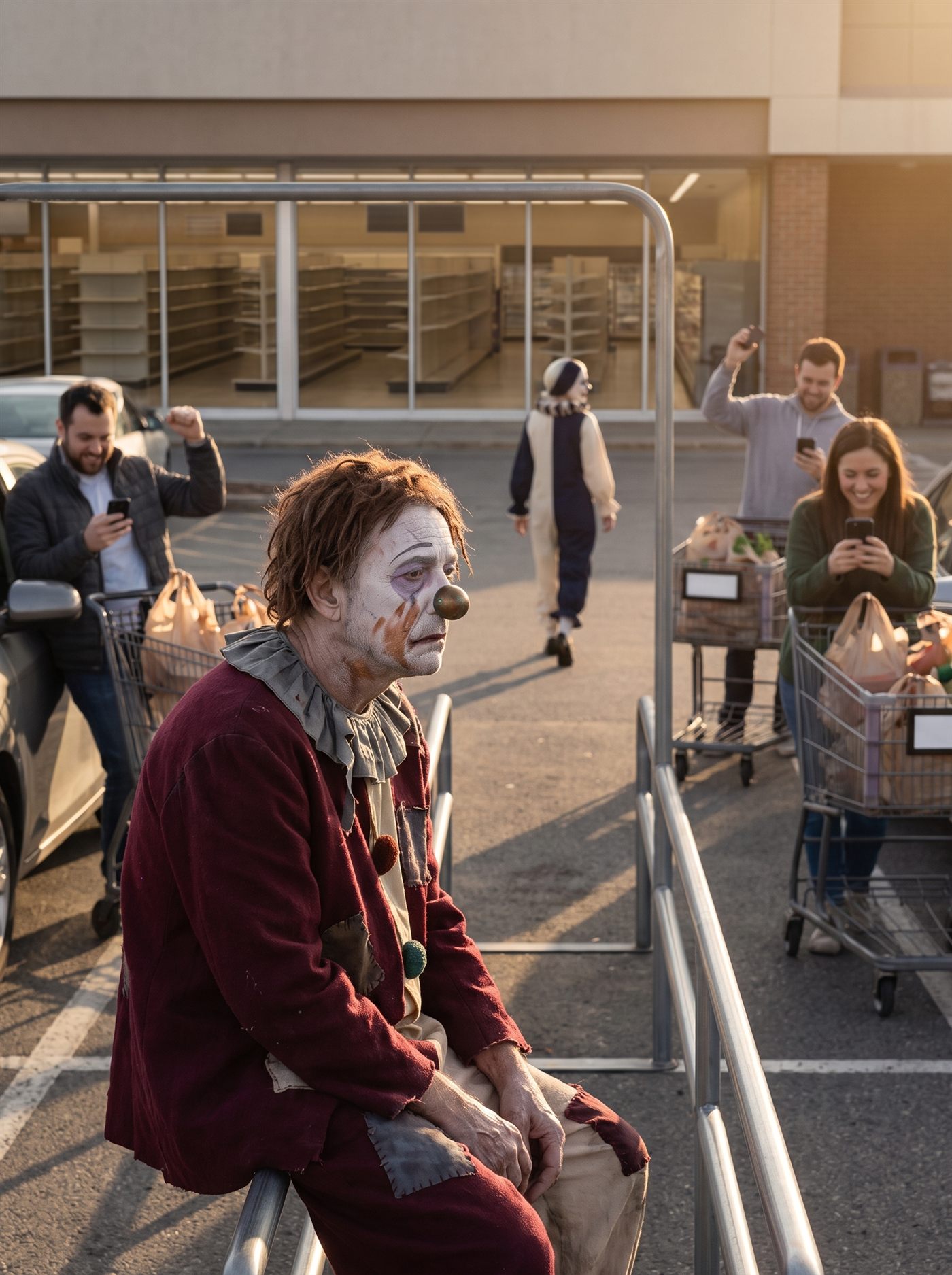
This is the batch's bookend, and the casting says so: the old clown who sat far off on a 1929 curb while the swept street celebrated its false dawn sits close now, in the foreground of 2020's — ninety-one years of watching the same golden evening. And the split-faced one who stood mid-street then walks away now, out of the frame, taking the light with her. Monday is hers; he has already seen it.
The ground is the lot's asphalt dark; the pigment is the false gold of that specific Friday sunset — heavy, generous, and forty-eight hours from the highest close fear's gauge ever printed.
The artifact
The store had run out of nearly everything by that Friday evening, so the slip is in period: a rain check, the retail promise that what's missing will return. What was missing was calm, and the market bought a weekend's worth in the last half hour — 1,428 Dow points between the start of the Rose Garden speech and the closing bell, the biggest point gain in the index's history, the best percentage day since 2008, sold to a bell that rang mid-ramp. The slip's terms were exact. Monday fell 11.98 percent, the worst day since 1987; fear's gauge printed the highest close of its existence; and Friday's every point was gone before the open. This batch began with a clown on a 1929 curb watching a golden bounce he didn't believe. Ninety-one years later he has a better seat.
Read the slip
Printed text is shown plain; the clerk's entries are shown in script.
RAIN CHECK · FRIDAY, MARCH 13, 2020 — we are sorry — this item is temporarily out of stock.
- item: calm. quantity: one weekend's worth. valid: monday.
- friday: up 9.29 percent — the best day since 2008. 1,428 dow points during a speech in a garden, 3:30 to 4:00. the bell rang mid-ramp.
- monday: down 11.98 — the worst day since 1987. fear's gauge: 82.69 — the highest close it has ever printed. friday's 1,985 points: gone by the open.
- STOCK CLERK'S HAND: the shelves were empty and the phones were cheering. he sat on the rail and waited for monday. he'd seen this evening before — 1929.
- VALID MONDAY. MONDAY CAME.
On Friday, March 13, 2020 — the day the COVID-19 national emergency was declared — the S&P 500 rose 9.29 percent to 2,711.02 and the Dow gained 1,985 points, its largest ever, with 1,428 arriving during the 3:30 Rose Garden announcement. On Monday, March 16, the S&P fell 11.98 percent — the worst day since 1987 — and the VIX closed at a record 82.69. Monday's page was already in this archive; this one is the light that came before it.
The ledger — what actually happened
| Measure | Close | Change | Marginalia |
|---|---|---|---|
| S&P 500 | 2,711.02 | +230.38 · +9.29% | the best day since October 2008, closed 0.31 off the high — the bell rang mid-ramp; per the feed and the record |
| Dow Jones | 23,185.62 · +1,985.00 | the biggest point gain in its history — 1,428 of it between 3:30 and 4:00, during the speech | |
| The declaration | 3:30 p.m. | "Today I am officially declaring a national emergency. Two very big words." — the Dow stood at 21,747.52 as he began | |
| VIX | 57.83 · −23.4% | fear's gauge gave back a quarter — for one weekend; Monday it closed 82.69, the highest in its history | |
| The trap | Monday: −11.98% | the worst day since 1987, across a single weekend — Friday's 1,985 points were gone by the open. Monday's page already hangs on this shelf |
Sources
- The market-data feed + the official daily record — the closes, the never-red floor, the 0.31-off-the-high finish, the VIX path
- PolitiFact (Mar 19, 2020), citing The Hill and AP — the 3:30 start, 21,747.52 at the speech's opening, the 1,428-point half hour, and both superlatives as day-of press
- The Miller Center transcript — "Today I am officially declaring a national emergency. Two very big words."; the $50 billion; the testing and website announcements
- CNN Business live coverage, Mar 13, 2020 — "best day since October 2008"
- Bloomberg, Mar 16, 2020 — the record VIX close of 82.69