The dose that didn't take
DOW JONES 258.47 · +28.40 · +12.34% · the false dawn
The sweepers were still clearing Tuesday out of the gutters when the buying flooded in. By early afternoon the Exchange had prescribed itself a rest cure — noon opening Thursday, closed Friday and Saturday, owing, the announcement said, to the exhaustion of the staffs — and minutes later, timed like medicine, the tickers flashed that Mr. Rockefeller and his son had been buying sound common stocks for days and would continue. Up 12.34 percent, the largest day in the index's history to that hour, on the third-heaviest volume ever recorded. It was a magnificent recovery, and it recovered nothing: two weeks later the market was 23 percent lower, and the true bottom — 84 percent below this close — waited at the end of a page this archive has already written.
The day's protagonist
The statement — no symbol.
Move: flashed at two o'clock — a master stroke, timed to the minute, worth two weeks
Shortly before two the Exchange announced it would open at noon Thursday and stay closed Friday and Saturday — for the exhaustion of the brokerage staffs, after a week in which the tape had run hours late and the clerks had slept in their offices. And minutes later, so precisely that the papers called it a master stroke at exactly the right moment, the financial tickers flashed that John D. Rockefeller was buying. The statement had been dictated at Pocantico Hills and released through his son's office at 26 Broadway — his first comment on the market in years: believing fundamental conditions of the country sound, he and his son had for some days been purchasing sound common stocks, and would continue, in substantial amounts. The market, already flooded with buying since the open — Steel and American Can had declared extra dividends into the teeth of Tuesday's ruin — closed up 28.40 at 258.47, twelve and a third percent, the greatest day in the Dow's history to that date on the third-heaviest volume ever recorded. Then the record shows what reassurance is worth: 198.69 by November 13. A spring rally in 1930 that fooled nearly everyone a second time. And the long grind to 41.22 — July 8, 1932, a page this archive already keeps — eighty-four percent below the close of the greatest rally anyone had ever seen.
The deeper account
This page completes a sequence the archive began with three days of catastrophe: the Wound of the 24th, the Empty Post of the 28th, the Flood of the 29th. Here is the fourth day, the one the sequence never mentions — the morning the canyon filled with light and nearly half the two-day loss was bought back before dinner.
The chronology matters and the contemporary record is exact: the closing announcement came first, shortly before two, and the Rockefeller flash minutes later — medicine timed against side effects. The Times called the recovery already well under way when the statement electrified it. The comedian's famous retort — sure, who else had any money left? — is said to have come later; nobody has ever found it printed in 1929.
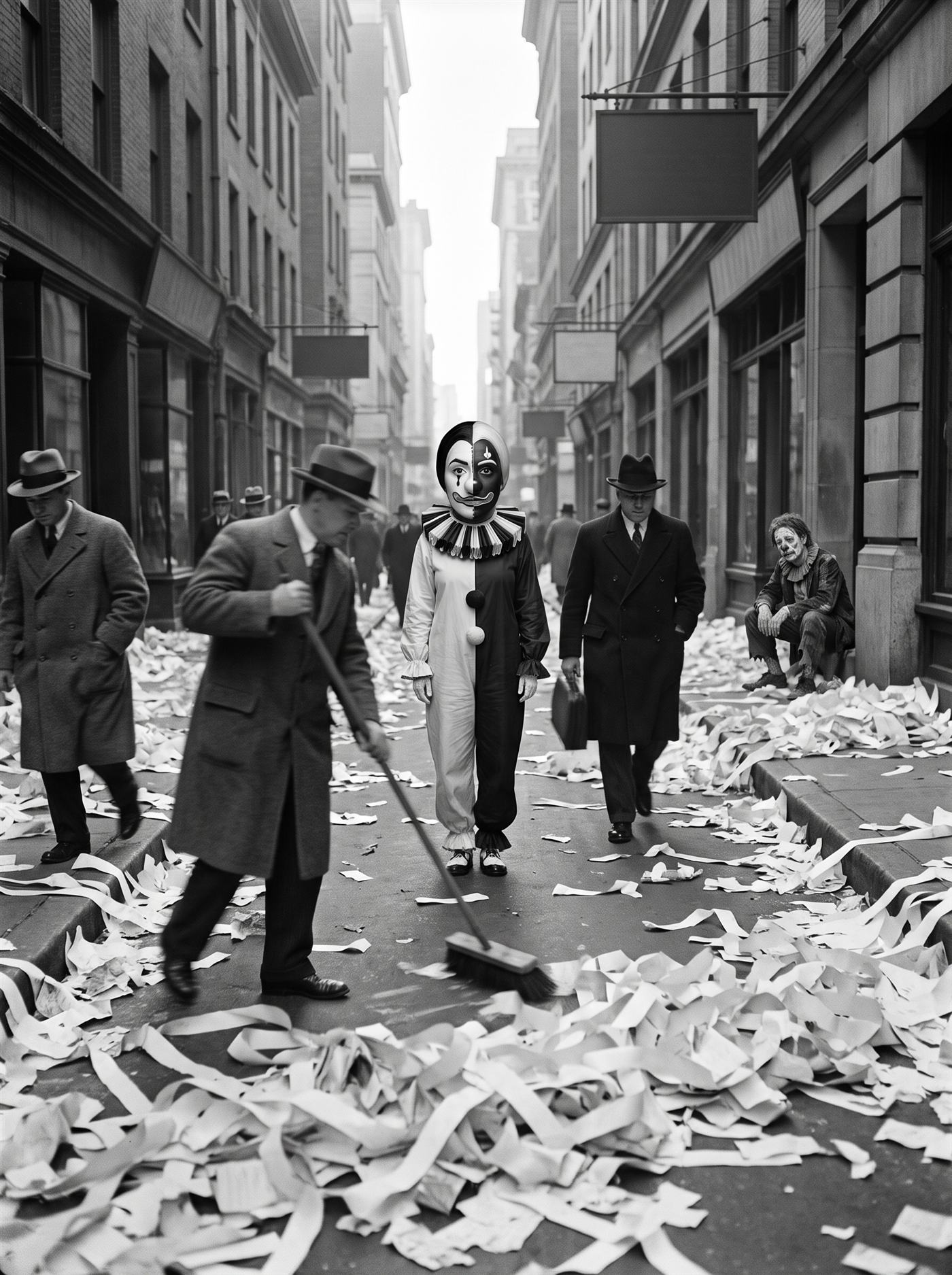
In the photograph of this day she stands in the one swept lane with the sun on the rising half of her mouth, and the falling half in shadow — a candle deciding, at the exact moment everyone chose to believe the deciding was done. The old clown on the far curb is not part of the celebration. He is three years early for his own page, and he knows the address.
The ground is the street's iron dark; the pigment is the pale of swept ticker paper — ten million shares of Wednesday, drifted over Tuesday, waiting for the brooms.
The artifact
The order of events, per the contemporary record: the Exchange's closing announcement came first — noon opening Thursday, dark Friday and Saturday, for the exhaustion of staffs who had slept in their offices for a week — and the Rockefeller flash followed within minutes, dictated at Pocantico Hills, released at 26 Broadway, and hailed by the next morning's Times as a master stroke at exactly the right moment. The rally it accelerated was already under way; the day closed up 12.34 percent, the Dow's greatest to that date. Two weeks later the market was 23 percent lower, and the bottom — 84 percent below this close — took three more years to arrive. The archive keeps that page too.
Read the notice
Printed text is shown plain; the clerk's entries are shown in script.
NOTICE TO MEMBERS · OCTOBER 30, 1929 — the exchange will open at noon tomorrow and remain closed friday and saturday, owing to the exhaustion of the staffs. rest is prescribed.
- the industrials: 230.07 → 258.47 · up 12.34 percent — the greatest day in the book, on 10,727,320 shares.
- at two o'clock the tickers flashed: mr. rockefeller is buying. "my son and I have for some days been purchasing sound common stocks." — his first word in years.
- MARGIN CLERK'S HAND: the announcement came first, the medicine minutes after. timed like a doctor's visit.
- REST WAS PRESCRIBED. THE PATIENT DID NOT RECOVER.
On Wednesday, October 30, 1929, the Dow rose 28.40 points, 12.34 percent, to 258.47 — its largest one-day gain ever at the time, on the third-heaviest volume on record. By November 13 the index stood at 198.69, 23 percent lower; the spring 1930 rally failed in its turn; and the final bottom of July 8, 1932 — 41.22, a page this archive keeps — lay 84.1 percent below this day's close.
The ledger — what actually happened
| Measure | Close | Change | Marginalia |
|---|---|---|---|
| Dow Jones | 258.47 | +28.40 · +12.34% | the largest one-day gain in the index's history at the time; still third of all time, behind 1933's sprout page and the day that follows this one; per the daily record |
| Volume | 10,727,320 shares | the third-largest day on record then — per the Chronicle's own table; the Curb added 3.8M | |
| The statement | just before 2:00 | "my son and I have for some days been purchasing sound common stocks" — flashed minutes after the Exchange announced its rest cure, and timed to blunt it | |
| The rest cure | Fri + Sat: closed | noon opening Thursday, then two days dark — "owing to the exhaustion of brokerage staffs" | |
| The trap | 198.69 · Nov 13 | −23.1% in two weeks; the final bottom of July 1932 — already on this shelf — sits 84.1% below this close |
Sources
- MeasuringWorth — Daily Closing Values of the Dow Jones Average (every close, Oct 24 – Nov 13, 1929, and the 1930–32 waypoints, queried directly) — https://www.measuringworth.com/datasets/DJA/
- Commercial & Financial Chronicle, Nov 2, 1929 (Vol. 129 No. 3358, via FRASER) — the daily volume table, the buying-flood account, the closing announcement's wording, and the NYT of Oct 31 reprinted in full (the Rockefeller statement and its timing)
- The New York Times, Oct 31, 1929 (via the Chronicle's reprint) — "STOCKS MOUNT IN STRONG ALL-DAY RALLY; ROCKEFELLER BUYING HEARTENS MARKET; 2-DAY CLOSING ORDERED TO EASE STRAIN"
- New York Herald Tribune, Oct 31, 1929 (via PBS American Experience) — the volume ranking