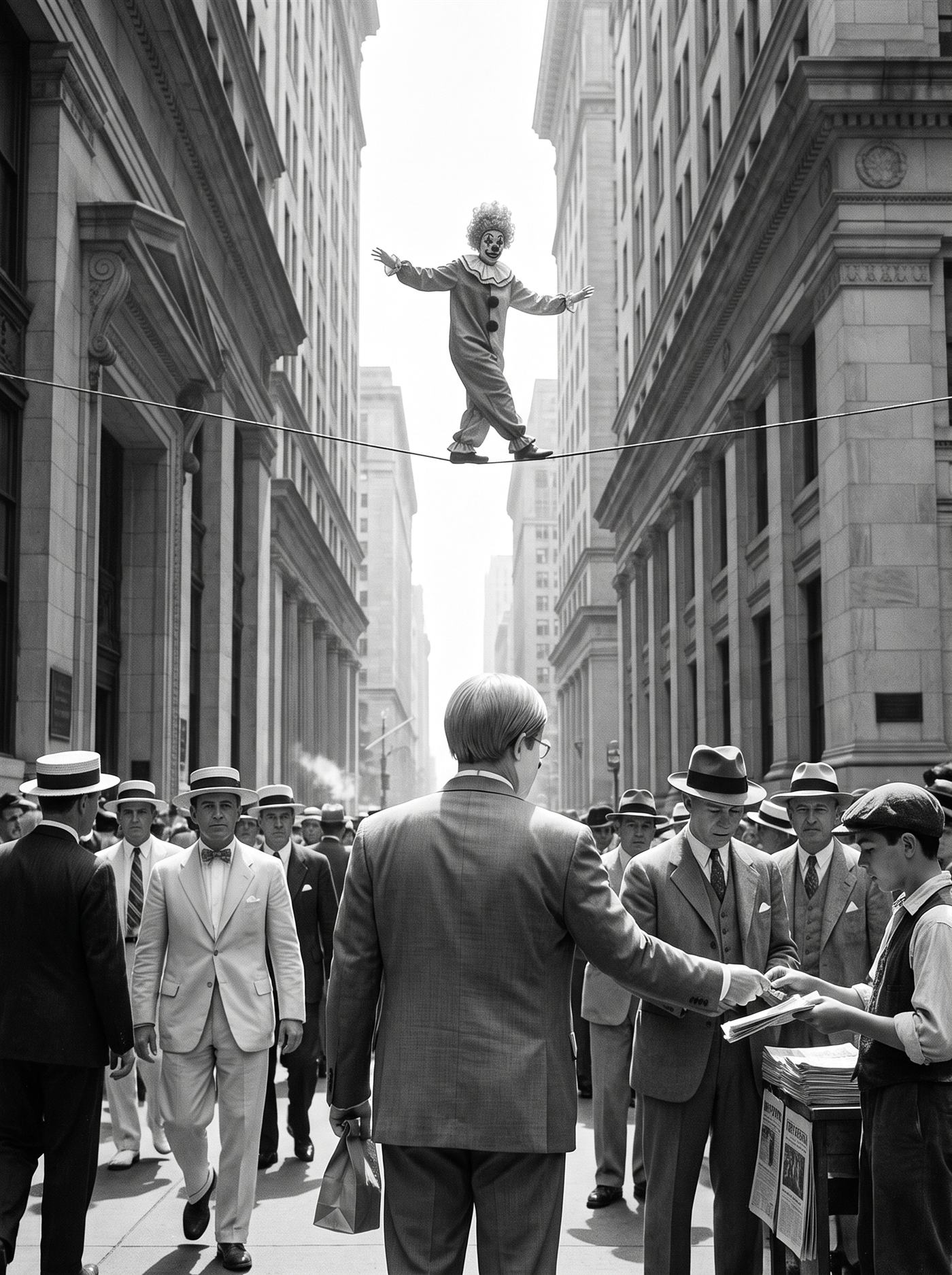
Nobody looked up
DOW JONES 381.17 · +0.84 · +0.22% · the top of everything
It was the hottest day of the year — ninety-nine degrees at Central Park, the record for the date to this day — and the first session after Labor Day, and the orders had accumulated over the holiday the way heat accumulates in a closed room. Buying was conducted, the Chronicle wrote, with great avidity. Call money cost nine percent and no one apparently gave it much concern; brokers' loans were fast approaching eight billions. The close was a record by eighty-four cents. There was no bell, no headline, no sensation of arrival — records had come all summer, and this was Tuesday's. It was the top of the world for the next twenty-five years.
The day's protagonist
The eighty-four cents — no symbol.
Move: 380.33 → 381.17 — the margin by which the top of a generation exceeded the previous Friday
The number itself did almost nothing, which is the whole story of tops: up 84 cents over Friday's record, two tenths of one percent, on 4,438,910 shares — a big day, not a famous one. The famous things around it were ambient. Call money lent at nine percent all day including renewals; the Federal Reserve's weekly count of brokers' loans stood at $6.35 billion against $4.29 billion a year before, and the Exchange's own monthly count was fast approaching eight; the year-to-date gain was 27 percent on top of 1928's; and the city was a furnace, 99 degrees at Central Park, the hottest day of 1929. Two days later an economist named Babson told a conference in Massachusetts that sooner or later a crash was coming, and the market dropped 2.59 percent on the wires' account of it — then recovered by Friday, with new highs for the year, because it had absorbed a hundred warnings that summer and this was one more. What no one could absorb was arithmetic. From this close the road ran seven weeks to the Wound, three years to 41.22 — 89.19 percent below this day — and twenty-five years, two months and twenty days to the afternoon in November 1954 when the tape finally printed 382.74. This archive has kept that 1954 page for years. As of this page, the shelf begins where the story does: at the very top, in the heat, with nobody looking up.
The deeper account
This page changes the shape of the archive: it used to begin with the Wound of October 24. Now it begins seven weeks earlier, at the summit the crash pages always implied — and the 1954 Round Trip page, which has hung here for years measuring "25 years" against a number, finally has its number on the shelf.
Two days after this close came the day with the name — the Babson break, minus 2.59 percent on an economist's warning that a crash was coming sooner or later. The Chronicle preferred blaming the brokers'-loans statement and a bear drive, and the market made new yearly highs again by Friday. Warnings were a weather everyone had learned to live in.
In the photograph of this day she is at the exact middle of the highest wire she will ever walk, tiny against the white sky, and not one face on the street is lifted. The man with the paper bag is at the front of the crowd at the curb, buying. It is the first photograph in the archive, and he is already in it, already buying. He has always been in it.
The ground is the street's baked dark; the pigment is the white of that sky — the heat-blind light nobody looked up into.
The artifact
The sheet's advice was the era's entire methodology, and on this particular Tuesday it was, for a few hours, correct. A record by 84 cents on the year's hottest day, call money at nine percent that nobody worried aloud about, the loan totals climbing toward a number with ten digits — the Chronicle recorded all of it in the tone of a paper describing weather. The fine print is the house's oldest joke and its oldest mercy: without guarantee of repetition. The repetition took twenty-five years, two months and twenty days, and when it came — November 23, 1954, a page this archive kept for years before it had this one — the men who bought at the curb were old.
Read the sheet
Printed text is shown plain; the clerk's entries are shown in script.
CONFIDENTIAL · SEPTEMBER 3, 1929 · TEN CENTS — TO-DAY'S SELECTIONS
- BUY. to-day, everything is a selection.
- the industrials: 380.33 → 381.17 — a record — by 84 cents. the summer's hundredth.
- call money: nine percent, renewals included. brokers' loans: fast approaching eight billions.
- ninety-nine at the park — the hottest day of the year. buying conducted with great avidity.
- MARGIN CLERK'S HAND: he bought this sheet and the top of the world — same dime.
- OFFERED WITHOUT GUARANTEE OF REPETITION. REDEEMED NOVEMBER 23, 1954.
On Tuesday, September 3, 1929 — the first session after Labor Day and the hottest day of the year in New York — the Dow closed at 381.17, up 0.22 percent, a record it would not exceed for twenty-five years. The Babson break came two days later; the Wound of October 24 is the next page; the bottom of July 1932 lies 89.19 percent below this close; and the round trip completed on November 23, 1954, at 382.74.
The ledger — what actually happened
| Measure | Close | Change | Marginalia |
|---|---|---|---|
| Dow Jones | 381.17 | +0.84 · +0.22% | a record by 84 cents over Friday's record; the highest close for the next 25 years; per the daily record |
| Volume | 4,438,910 shares | per the Chronicle's own table; the Curb added 2.1M | |
| The money | call: 9% | every loan, all day, renewals included — "not apparently being given much concern." Brokers' loans: $6.35B on the Fed's weekly count, and the Exchange's monthly count fast approaching eight billions | |
| The weather | 99°F | the hottest day of 1929 at Central Park — still the record for the date | |
| The road down | −89.19% · July 8, 1932 | close-to-close to the bottom the archive keeps; and the round trip: November 23, 1954, 382.74 — the page that waited 25 years for this one |
Sources
- MeasuringWorth — Daily Closing Values of the Dow Jones Average (every close: the week, the 1932 bottom, the Nov 23, 1954 round trip — queried directly) — https://www.measuringworth.com/datasets/DJA/
- Commercial & Financial Chronicle, Sept 7, 1929 (Vol. 129 No. 3350, via FRASER) — the volume, the 9% call money, both brokers'-loans series, "great avidity," and Babson's Sept 5 address as printed (PRIMARY)
- National Weather Service, Central Park September almanac — the 99°F record for the date (second-sourced)
- Galbraith, The Great Crash 1929 — noted only as the source of the familiar "...and it may be terrific" rendering; the page prints the Chronicle's contemporaneous text