The warning
DOW JONES 299.47 · −6.38 · −2.09%
By half past eleven the Dow had lost eleven percent, and the ticker was hours behind the prices it described; the crowd on Broad Street knew more than the tape did. At noon the heads of the great banks met at 23 Wall Street. At half past one Richard Whitney walked to the Steel post and bid 205 for ten thousand shares — above the market, loudly, on purpose. By the bell the day had clawed most of the morning back and closed down two percent. The close persuaded many that the worst had passed. The crowd had seen the morning.
The day's protagonist
The bankers' pool — no symbol.
Move: one bid — 205 for 10,000 U.S. Steel
By late morning the Dow was down 11%, the ticker ran hours behind, and crowds had gathered on Broad Street. At noon Morgan's Thomas Lamont and the heads of the great New York banks met at 23 Wall Street and assembled a fund to hold the line. At 1:30 Richard Whitney, the Exchange's vice president, walked to the U.S. Steel post and bid 205 for ten thousand shares — above the market, spending the pool's money loudly and on purpose. The market steadied and clawed most of the morning back by the bell. It was the last time the old private order would appear to hold; the pool had bought four days.
The deeper account
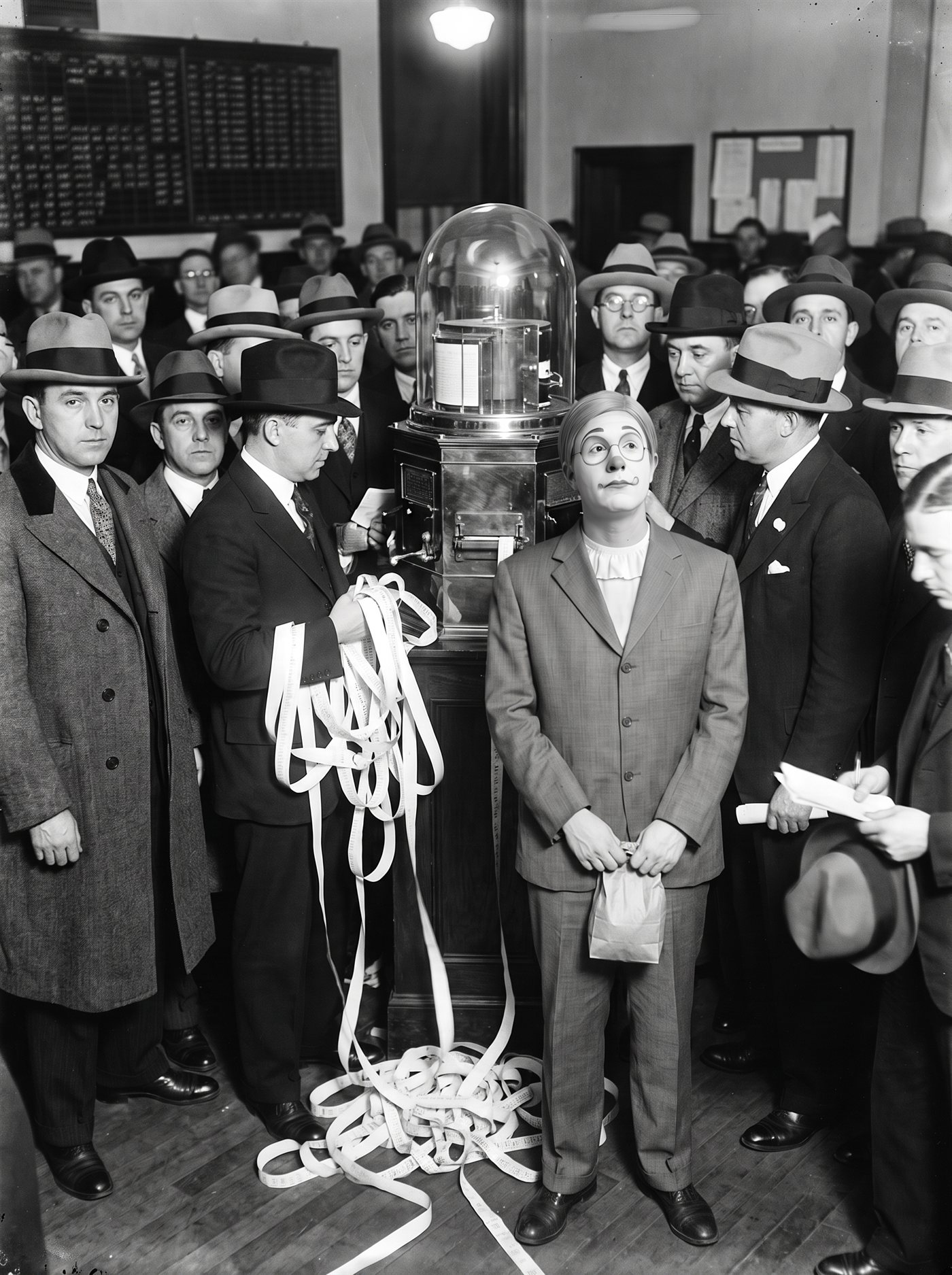
The ticker ran hours behind all day. Volume came to roughly 12.9 million shares — three times normal, a record — and the machine that told the country its prices could not keep up; through the worst of the morning nobody on the floor or off it knew the true price of anything. By half past eleven the Dow had lost eleven percent of its value, touching 272.32, and crowds had gathered on Broad Street to learn from each other what the tape could not tell them.
At noon, Thomas Lamont of Morgan and the heads of the great New York banks met at 23 Wall Street and assembled a fund to hold the line. Lamont's briefing produced one of the era's great sentences: "There has been a little distress selling on the Stock Exchange." At half past one, Richard Whitney, the Exchange's vice president, walked to the U.S. Steel post and bid 205 for ten thousand shares — above the market, spending the pool's money loudly and on purpose. The market steadied, and clawed most of the morning back by the bell.
The close, down only 2.09 percent, was read as deliverance; it persuaded many that the worst had passed. Saturday's half-session held. It was the last time the old private order would appear to hold the line — the pool had bought four days. Then came Monday.
The artifact
Steel stepped down all morning and stopped exactly at Whitney's number. The label was typed that week; the pencil came later: "(it did not.)"
Read the mount
Tape prints and typed label shown plain; the pencil line is shown in script.
THE TAPE · three runs, mounted in order
- STEEL 212½ ... 211 ... 210 ...
- 208¼ ... 207 ... 206½ ... 205½
- STEEL 205 ... 205 ... 205 ...
THE LABEL · typed
- TICKER TAPE, OCT. 24, 1929 — U.S. STEEL, MORNING INTO AFTERNOON
- kept as proof the bottom held.
- "(it did not.)" — in pencil, added later
The tape stops at 205 because the pool wanted it to. The pencil was added by someone who had seen the following week.
The ledger — what actually happened
| Measure | Close | Change | Marginalia |
|---|---|---|---|
| Dow Jones | 299.47 | −6.38 · −2.09% | the close is a bandage |
| Intraday low | 272.32 | down 11% late morning, before the rescue | |
| Volume | ≈12.9M shares | roughly three times normal — a record; the ticker ran hours late | |
| The pool's bid | 205 | Whitney's order for 10,000 U.S. Steel — the most famous single order in Wall Street history |
Sources
- Federal Reserve History — "Stock Market Crash of 1929" — https://www.federalreservehistory.org/essays/stock-market-crash-of-1929
- Britannica — "Stock market crash of 1929" — https://www.britannica.com/event/stock-market-crash-of-1929
- EH.net Encyclopedia — "The 1929 Stock Market Crash" — https://eh.net/encyclopedia/the-1929-stock-market-crash/
- The New York Times, October 25, 1929 — front page