Abandonment
DOW JONES 260.64 · −38.33 · −12.82%
The discovery that Thursday's floor had been rented, not owned. No meeting, no bid, no bandage — thirteen percent between one bell and the next.
The day's protagonist
The absent pool — no symbol.
Move: No bid at the Steel post
Thursday's lesson had been that the banks would hold the line. Monday's lesson was that they would not — or could not. There was no noon meeting at 23 Wall Street, no theatrical order above the market. Margin calls from Thursday's wound came due into a falling tape, each liquidation feeding the next, and the selling accelerated into the final hour: the close was nearly the low. The Dow's 12.82 percent fall stood as the worst single day in its history for fifty-eight years, until another October Monday took the title.
The deeper account
The from-price is Saturday's — the Exchange still traded six days a week; the weekend gave the fear two nights to compound instead of one.
Thursday's margin calls came due Monday into a falling market: forced selling fed forced selling, the mechanism 1987's portfolio insurance would industrialize. The evening's new demands went out by wire, due before Tuesday's open.
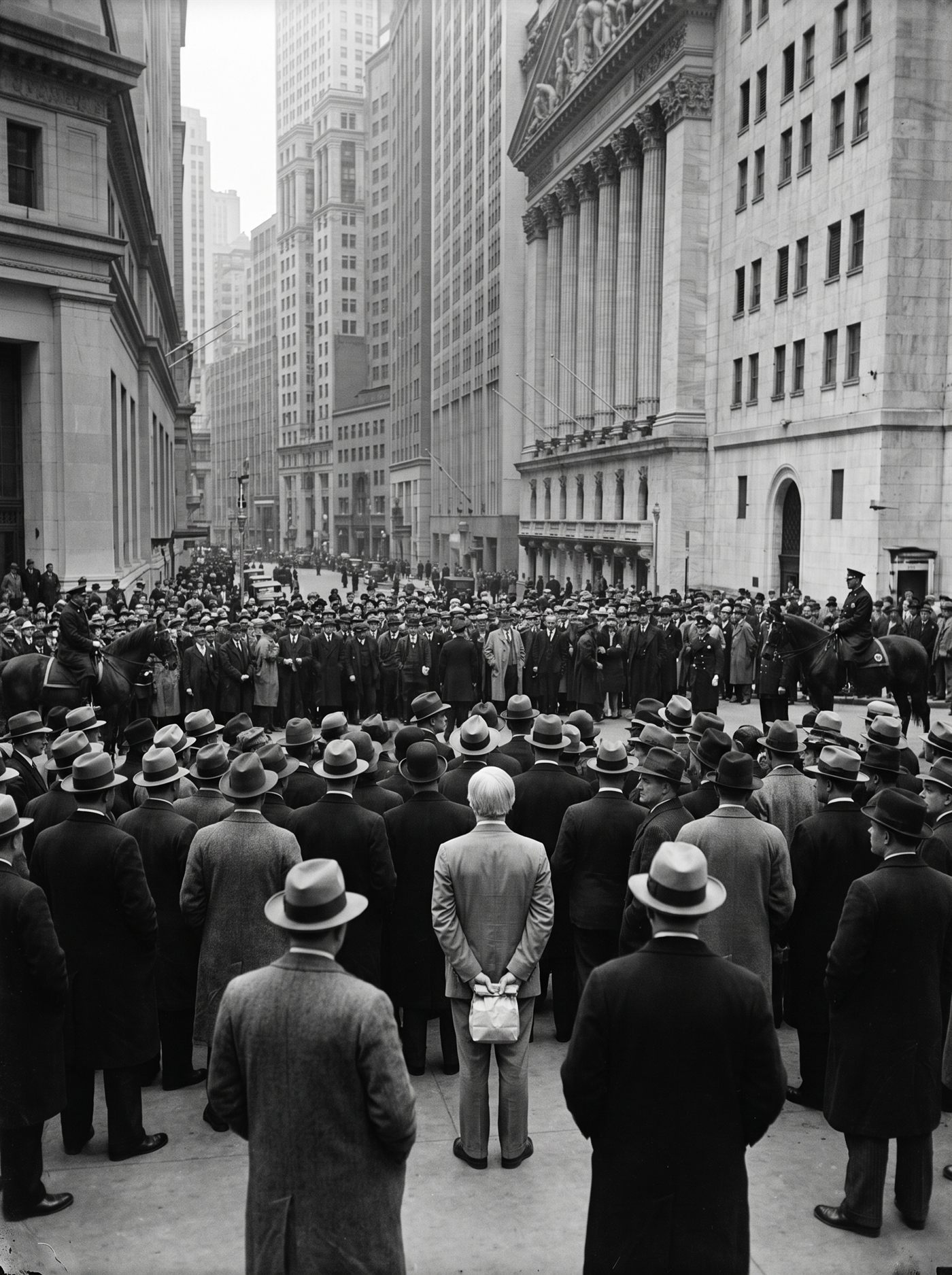
In the photograph of this day he is one hat among hundreds, all angled the same direction, waiting outside a building that had no news to give. On Thursday the crowd had watched a rescue; on Monday it watched a door.
Tomorrow was worse in every way but one — Tuesday's percentage was smaller. Together the four days took a quarter of everything.
The artifact
Thursday's lesson had been that the banks would hold the line; Monday's was that they would not. The wires carried thousands of these into the night — Thursday's wound come due into a falling tape, each unanswered demand becoming Tuesday's forced selling. The stamp is the whole mechanism: what was not wired by morning would be sold at whatever the market would pay.
Read the telegram
Printed text is shown plain; the clerk's entries are shown in script.
TELEGRAM · MONDAY EVENING · OCT 28
- FURTHER MARGIN REQUIRED ON YOUR ACCOUNT STOP
- WIRE FUNDS BEFORE OPENING TUESDAY STOP
- the day beneath it: 298.97 → 260.64 — down 12.82 percent, the worst day in the dow's history. · UNANSWERED
- CLERK'S PENCIL: no meeting at 23 wall. no bid held the line this time. the close was nearly the low.
- THE TITLE STOOD FIFTY-EIGHT YEARS, UNTIL ANOTHER OCTOBER MONDAY · THURSDAY'S FLOOR HAD BEEN RENTED, NOT OWNED
On Monday, October 28, 1929, the Dow fell 12.82 percent to 260.64 — the worst day in its history, a title it held until October 19, 1987. There was no noon meeting at 23 Wall Street and no bid above the market at the Steel post; the selling accelerated into the final hour and the close was nearly the low. Thursday's margin calls had come due into a falling market, and the evening's new demands went out by wire — due, and largely unanswerable, before Tuesday's open.
The ledger — what actually happened
| Measure | Close | Change | Marginalia |
|---|---|---|---|
| Dow Jones | 260.64 | −38.33 · −12.82% | the worst day in the Dow's history — held the title until October 19, 1987 |
| Volume | ≈9.2M shares | heavy, but thinner than Thursday — fewer rescuers | |
| The final hour | accelerating | the close was nearly the low; no late rescue this time |
Sources
- Federal Reserve History — Stock Market Crash of 1929 — https://www.federalreservehistory.org/essays/stock-market-crash-of-1929
- Britannica — Black Tuesday and the 1929 crash — https://www.britannica.com/topic/Black-Tuesday-1929
- The New York Times, October 29, 1929 — front page