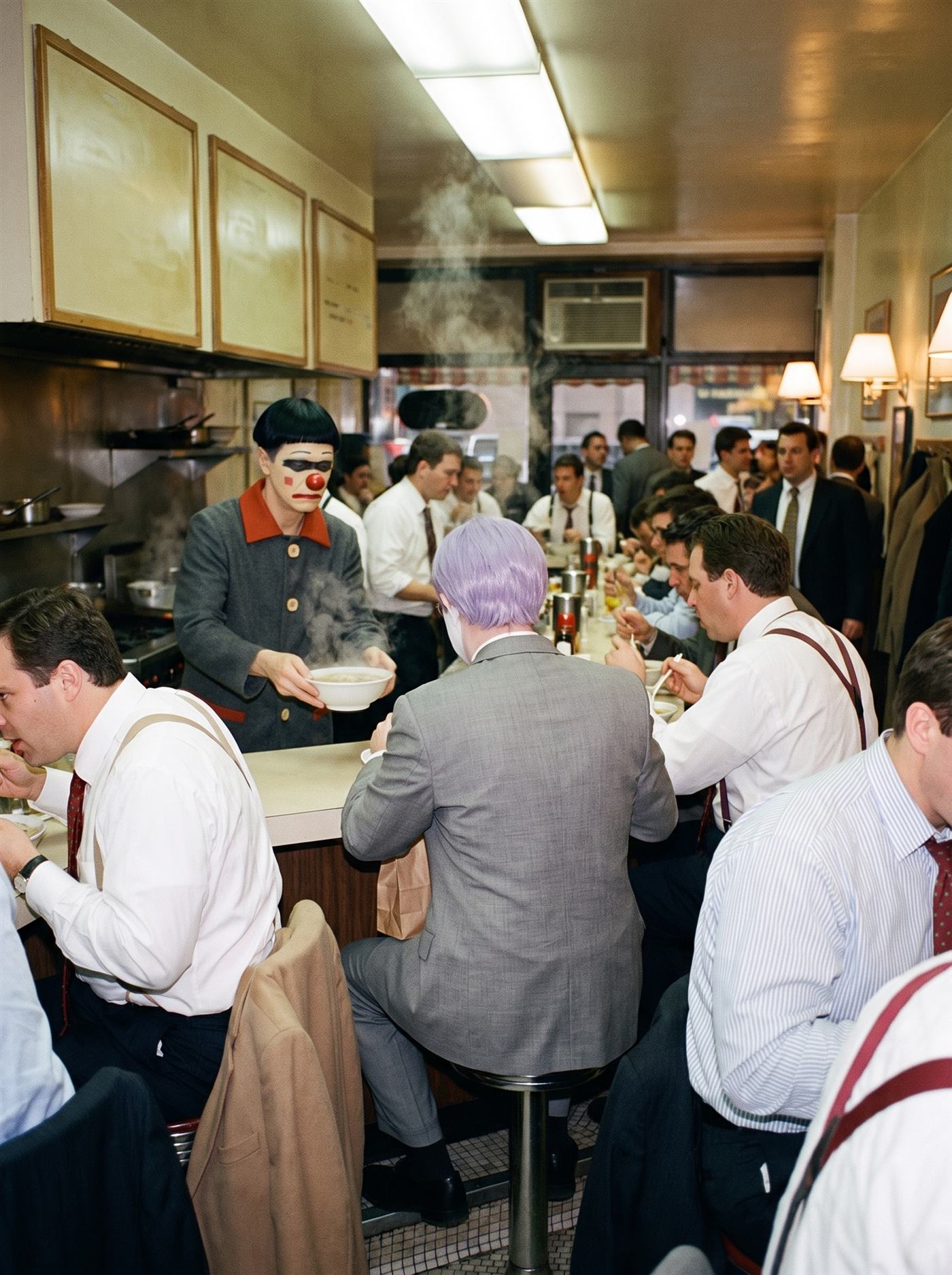
The busiest lunch the house ever had
S&P 500 921.85 · +44.86 · +5.12% · a billion shares
Hong Kong had fallen another thirteen and seven-tenths percent overnight, London was down nine before New York even opened, and the first thirty-six minutes obliged all of it — down 188 by 10:06, with the last of the thirty Dow stocks only just managing to open through the flood of orders. Then 10:07. The SEC later reconstructed the whole session minute by minute and found the turn sitting there between two time stamps with no cause attached: falling five hundredths of a percent a minute, and then rising eleven. From minus 188 to plus 137 took twenty-eight minutes. By the bell the Exchange had traded 1.2 billion shares — the first billion-share day in its history, with the Nasdaq crossing its own billion the same afternoon — and the house had served every last one of them.
The day's protagonist
The minute — no symbol.
Move: 10:06 to 10:07 — the turn nobody has ever explained
The Securities and Exchange Commission did something after this week that it had rarely done before: it reconstructed two entire sessions minute by minute, order flow and index level and velocity, and published the anatomy. The study shows the morning falling at five hundredths of a percent per minute from the bell; it shows the low at 10:06, 187.86 Dow points down, with the last delayed Dow stocks barely open; and it shows the market rising at eleven hundredths per minute from 10:07. Between those stamps it names nothing. Mid-morning IBM announced another three and a half billion dollars of buybacks, and the wires gave it credit for the turn — a story the SEC's own minute log conspicuously declines to tell, since the turn was already twenty minutes old; the page keeps both facts and lets them argue. What is beyond argument is the volume: 1.2 billion shares by the close, the first billion-share day in the Exchange's history, with the Nasdaq crossing its own billion the same day — and the plumbing, which had failed in 1987 and been rebuilt for exactly this, held so well that traders spent the week complimenting it. Greenspan told Congress the next morning it was quite conceivable the episode would be looked back on as salutary. Hong Kong, whose 13.7 percent overnight collapse had set the morning's dread, rose 18.8 percent the following night — the rebound went east with the sun.
The deeper account
Monday's page — the circuit-breaker day, the first time the market was ever halted by rule — ends with the machinery untested. Tuesday tested it: a billion shares through a system built after 1987 for exactly this weight, and the week's oddest verdict, recorded by the SEC itself, was that the traders spent it complimenting the plumbing.
IBM's three and a half billion gets its sentence, as it got its headlines. The SEC's minute log, which names the turn at 10:06–10:07, does not mention the announcement that came twenty minutes later. The archive prints the clock and lets the reader choose their story.
Greenspan, testifying the next morning, reached for the exact word this batch keeps testing: salutary. Sometimes the morning after is the cure — this one was; the October 24 level was back in three weeks, the August peak by February. And sometimes, as the 1929 and 1931 pages at this batch's head show, the word is the trap.
In the photograph of this day the house is at capacity — every stool taken, the standees eating over the counter, the air white with steam — and the one who runs it is setting a bowl down without hurry, because he has seen a thousand of every kind of lunch. It is the busiest day his counter will ever have. His face does not say so.
The artifact
The Commission's study of this week is the most precise autopsy a rebound ever received: order flow, index velocity, opening delays, all of it time-stamped. It shows the market falling five hundredths of a percent a minute until 10:06 and rising eleven hundredths a minute from 10:07, and between those stamps it records no cause at all. The buyback announcement the wires credited came twenty minutes after the turn it supposedly caused; the log declines to mention it. What the log does establish, beyond any argument: 1.2 billion shares — the first billion-share day in the Exchange's history, on plumbing rebuilt after 1987 for exactly this load — and a turn that belongs to no one. The clerk's guess is as good as the Commission's.
Read the log
Printed text is shown plain; the clerk's entries are shown in script.
MINUTE LOG · TUESDAY, OCTOBER 28, 1997 · RECONSTRUCTED
- 9:30 — falling from the bell. hong kong −13.7 overnight.
- 10:06 — LOW — minus 187.86. the last of the thirty just open.
- 10:07 — rising. cause: none recorded.
- 10:20 — within 25 points of monday. 10:34 — plus 137.27.
- 4:00 — plus 337.17 — on 1,202,550,000 shares, the first billion in the exchange's history.
- (mid-morning, for the record: a certain machine company announced $3.5 billion of buying. the turn was already 20 minutes old.)
- TAPE CLERK'S HAND: twenty-eight minutes, monday to tuesday. the study never found the reason. maybe the reason was the billion.
- NOBODY RANG ANYTHING AT 10:06.
On Tuesday, October 28, 1997 — the day after the first circuit-breaker halt in NYSE history — the S&P 500 rose 5.12 percent to 921.85 and the Dow 337.17 points to 7,498.32, its largest point gain to that date, on the Exchange's first billion-share day. The times and figures are the SEC's own minute-level reconstruction. The October 24 level returned within three weeks; the August 1997 peak by February 10, 1998.
The ledger — what actually happened
| Measure | Close | Change | Marginalia |
|---|---|---|---|
| S&P 500 | 921.85 | +44.86 · +5.12% | after falling 2.62% more by 10:06; per the official record |
| Dow Jones | 7,498.32 · +4.71% | +337.17 — the largest one-day point gain in its history at the time; per the SEC's figures | |
| Volume | 1,202,550,000 shares | THE FIRST BILLION-SHARE DAY on the NYSE — and the Nasdaq crossed its own billion (1.4B) the same session | |
| The turn | 10:06 → 10:07 | the SEC's minute-level study finds the reversal between two time stamps and attaches no cause; −188 to +137 took 28 minutes | |
| The overnight | Hang Seng −13.70% | INTO this day; its famous +18.82% rebound came the night AFTER — the sequence the retellings reverse, kept straight here |
Sources
- SEC Division of Market Regulation, "Trading Analysis of October 27 and 28, 1997" — the minute-level reconstruction: the 10:06 low, the velocity figures, the 10:20/10:34 waypoints, the 1.2B and 1.4B volumes, the sidecar procedures (PRIMARY) — https://www.sec.gov/news/studies/tradrep.htm
- Alan Greenspan, testimony to the Joint Economic Committee, Oct 29, 1997 — "a salutary event" (verbatim, federalreserve.gov)
- IBM 1997 Annual Report — the additional $3.5B repurchase authorization of Oct 28; CNN's day-of headline "IBM in on buyback trend" (its catalyst framing labeled as press narrative)
- The official daily series — S&P/Dow/Nasdaq closes; the Hang Seng's −13.70% and next-night +18.82%