The fuse blows
S&P 500 877.01 · −64.63 · −6.86%
Built from 1987's autopsy, never used in a decade — and on first use, the question that never went away: did the breaker calm the market, or become its magnet?
The day's protagonist
The circuit breakers — no symbol.
Move: Tripped at 2:36 PM and 3:30 PM — the first and only early close by rule
The Asian financial crisis — baht, ringgit, won, then Hong Kong down six percent overnight — finally reached New York, and for the first time since their invention after 1987, the circuit breakers fired. At 2:36 PM the Dow hit minus 350 and the market stopped for half an hour. It reopened at 3:06, fell to minus 550 in twenty-four minutes, and at 3:30 the second breaker closed the exchange for the day. The SEC's own study leaned toward the countdown having become a magnet; the thresholds were redesigned within months, from points to percentages. The next day the Dow rose a then-record 337.17. The machine worked, or the machine was the problem — 1997 never settled it.
The deeper account
Hong Kong's Hang Seng had fallen 6% overnight defending its dollar peg; the selling followed the sun west, 1987-style, but slower and with safety equipment installed.
The 3:06 reopening lasted twenty-four minutes — the visible distance to the 550-point trigger arguably pulled the market toward it, per the SEC's study.
The breaker thresholds were redesigned within months (points became percentages) — today's 7/13/20% levels descend from this afternoon's lesson.
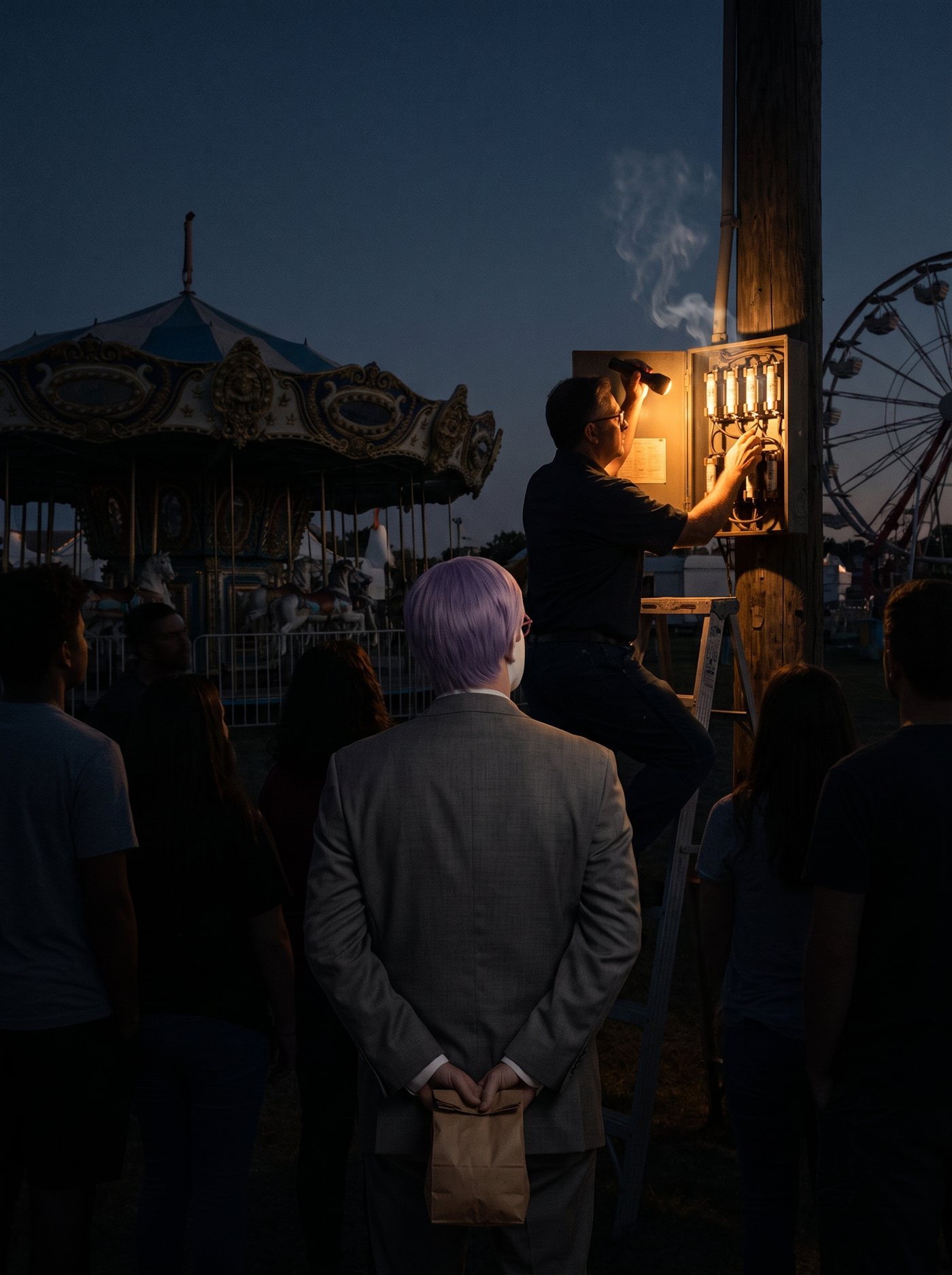
In the photograph of this day the whole midway waits in the dark while one man inspects the panel by flashlight. Retail stood with the rest of them; when the fuse is yours, the dark is too.
This book's 2020-03-09 page keeps the other end of this wire: its fire-drill log records that the alarm installed in 1988 sounded in earnest exactly once — this afternoon.
Sits in this wing beside 1963's 2:07 — the two stopped clocks: one stopped by grief, one by engineering.
The artifact
The tag records the only session in American market history ended early by rule: the safety hardware built from 1987's autopsy, fired twice on its first use. The twenty-four minutes between reset and second trip are the tag's quiet scandal — the SEC's own study leaned toward the visible countdown pulling the market to the trigger. The next day recovered sixty-one percent of the wound, and the question in the electrician's hand was never settled.
Read the tag
Printed text is shown plain; the electrician's entries are shown in script.
MONDAY, OCT 27 · WIRED TO THE PANEL · ELECTRICIAN'S TAG
- mechanism: the breakers. installed: 1988, after the crash. fired in earnest: today. first time.
- 2:36 — tripped at −350. held thirty minutes. · 3:06 — reset. twenty-four minutes of load. · 3:30 — tripped at −550. remainder of the day.
- CLOSED BY RULE
- ELECTRICIAN'S HAND: did the breaker calm the room, or become its magnet? — not settled.
- THRESHOLDS REDESIGNED WITHIN MONTHS · THE ALARM'S OWN LOG: SEE MARCH 9, 2020
On Monday, October 27, 1997, the Asian financial crisis reached New York and the post-1987 circuit breakers fired for the first time: a 30-minute halt at 2:36 PM with the Dow down 350, and a full close at 3:30 PM at down 550 — the only early close by rule in U.S. market history. The S&P 500 fell 6.86 percent to 877.01. The thresholds were converted from points to percentages within months, and the next session's +337.17 was a then-record point gain.
The ledger — what actually happened
| Measure | Close | Change | Marginalia |
|---|---|---|---|
| S&P 500 | 877.01 | −64.63 · −6.86% | Asian contagion arrives in New York |
| Dow Jones | 7,161.15 | −554.26 · −7.18% | the largest point loss in its history to that date |
| 2:36 PM | first halt, 30 min | the 350-point breaker — first use ever | |
| 3:30 PM | market closed | the 550-point breaker; the only early close by rule in U.S. market history | |
| The next day | +337.17 | a then-record point gain — sixty-one percent of the wound recovered |
Sources
- Wikipedia — October 27, 1997, mini-crash — https://en.wikipedia.org/wiki/October_27,_1997,_mini-crash
- SEC — Trading Analysis of October 27 and 28, 1997 — https://www.sec.gov/news/studies/tradrep.htm
- CNBC — 20 years ago, this unprecedented trading curb kicked in — https://www.cnbc.com/2017/10/27/20-years-ago-friday-this-unprecedented-trading-curb-kicked-in.html