Nothing before two
S&P 500 7,551.81 · −33.92 · −0.45%
The S&P 500 fell 33.92 points to 7,551.81 on Wednesday, forty-five hundredths of one percent, on the afternoon the Federal Open Market Committee raised interest rates for the first time since 2023. For the four and a half hours before the announcement the index moved inside twenty-nine points. In the two hours after it, it moved inside a hundred and fifteen. Of the 133 sessions for which this site holds a complete half-hourly intraday record, none had drawn so little of its day by two o'clock: 24.52 percent of the session's range, where the median session has already made both its high and its low and gone quiet. The quarter-point rise, to a target range of 3.75 to 4.00 percent, was unanimous, had been priced at ninety-three, and moved almost nothing. What moved the market was the half hour after it, in which Kevin Warsh took questions and declined to sound finished.
The day's protagonist
Goldman Sachs GS
Move: −3.91% to $938.44, on the day the Federal Reserve raised interest rates
A bank makes its money on the difference between what it pays for money and what it charges for it, which is why a rate rise is supposed to be good news on a trading floor. Wednesday was not, and the reason is in which end of the curve moved. The Federal Open Market Committee lifted its target range a quarter point, to 3.75 to 4.00 percent, and Kevin Warsh spent his press conference making clear he did not regard the job as done — sixteen of the eighteen participants had pencilled in another increase before the year is out. The front end of the Treasury curve sold off accordingly, and the ten-year went back through 5 percent. But the long end did not sell with it. The twenty-year-plus Treasury fund finished the day up 0.22 percent. A central bank that is willing to be unpopular about inflation is, to a thirty-year bond, reassuring news; the bond is being paid in dollars it now expects to be worth something. So the curve flattened, and a flatter curve is a thinner margin on every dollar a bank lends. Goldman Sachs fell 3.91 percent, Bank of America 2.74, the regional bank fund 1.74, and financials were the second-worst sector of the eleven at −1.60. Goldman had already lost 3.96 percent on Monday on weak dealmaking guidance, so this is its second fall of nearly four percent inside three sessions, in a market down 1.3 percent over the same stretch. There is an old and slightly unkind observation that banks ask the central bank for credibility and then object when they get it. Wednesday is the arithmetic underneath the joke.
The deeper account
The stock market keeps its own hours, and on most days they are earlier than anyone assumes. Of the 133 sessions for which this site holds a complete half-hourly intraday record, the median session has drawn one hundred percent of its range — both the high and the low, the whole span of the day — before two o'clock in the afternoon. The afternoon is mostly bookkeeping. On Wednesday the index arrived at two o'clock having drawn 24.52 percent of its day, the least of any session in the record, and then made the remaining hundred and fifteen points in the two hours that were left.
The shape of it is plain. The market opened at 7,601.25, fifteen points above Tuesday's close, drifted up to 7,626.79 at a quarter to twelve, and for the four and a half hours before the announcement stayed inside a band 29.18 points wide — thirty-eight hundredths of one percent. At 13:59 it stood at 7,613.32, up 27.59 on the day. At two o'clock the Federal Open Market Committee raised its target range a quarter point, to 3.75 to 4.00 percent, unanimously, the first increase since 2023. By the close the index was at 7,551.81, down 33.92. From the decision to the bell it lost 61.51 points, which is 181 percent of the whole day's fall: everything the session did, it did after two, and then some.
The Fed-day signature is not a metaphor, it is in the data, and it is unusually clean. The record window contains five FOMC decision days — 18 March, 29 April, 17 June, 29 July, 16 September. The three sessions that had drawn the least of themselves by two o'clock are three of those five, in order: Wednesday at 24.52 percent, 17 June at 34.41, 18 March at 50.67. Only seven of the 133 sessions came to two o'clock with less than sixty percent of their range made, and three of those seven are Fed days. Four of the seven days that made the most of their range after two are Fed days. The mean for the 128 ordinary sessions is 92.10 percent drawn by two; for the five decisions it is 51.81. Eight times a year the market agrees to postpone itself, and on Wednesday it postponed more of itself than it ever has in this record.
What it was waiting for was not the number. A quarter point had been priced at ninety-three for days; Tuesday's page printed that figure. The statement came out at two and produced a twenty-four-point round trip in ten minutes — up to 7,622.77, down to 7,598.77, and back to 7,617.78, which is very close to where it started. The market read the words, could not decide, and put them down. The decision was settled half an hour later by a man answering questions. From 14:30, when Kevin Warsh began his first post-hike press conference, to 15:30, the index fell 104.24 points. Sixteen of the eighteen participants had pencilled in another increase this year. Too many categories, he said, still showed price gains above three percent. "Inflation is a choice," he said, "and today we took a step in delivering it." The low of the day, 7,507.77, came at 15:27, and the index bounced 44 points off it into the bell.
Then the indexes disagreed about what had happened, in a way worth writing down. The Dow fell 631.21 points, 1.21 percent. The S&P 500 fell 0.45. The Nasdaq Composite fell three and a fifteenth points — one hundredth of one percent — on the day the Federal Reserve raised interest rates for the first time in three years. That is a stair-step, not a sell-off, and it says exactly which businesses a higher cost of money is a problem for. Financials lost 1.60 percent and energy 2.84; technology gained 0.13 and was the best of the eleven sectors, with Nvidia, Meta, Apple and Broadcom all higher. The most rate-sensitive sector in the index, utilities, closed one hundredth of a percent up: unchanged, on the day rates went up.
The subtlest number on the page is the long bond. The front end sold off and the ten-year went back through five percent, but the twenty-year-plus Treasury fund ROSE 0.22 percent. A thirty-year lender does not mind a central bank that is willing to be disliked; it minds one that is not, because it is the lender who is paid last and in the least certain money. So the curve flattened — and a flatter curve is a narrower margin on every dollar a bank lends. Goldman Sachs fell 3.91 percent, its second fall of nearly four percent in three sessions; Bank of America 2.74; regional banks 1.74. The homebuilders, the other rate trade, went quietly: the homebuilder fund exactly 1.00 percent.
All of which leaves the morning, where the largest single move of the day happened and the index did not register it. Energy was the worst of the eleven sectors at −2.84 percent, having been the best of the eleven on Tuesday at +2.17 — a complete reversal inside one session, caused by one sentence. The US Energy Secretary, Chris Wright, described the shut Saudi East–West pipeline as a brief and temporary interruption that would be measured in days; independent analysts, looking at satellite images of the damaged pumping station, said weeks. Brent settled 2.7 percent lower at $105.83 against the $108.75 this site printed on Tuesday. And the ten companies that had all risen together the day before split on which end of the barrel they stand on: Occidental fell 6.54 percent, Conoco 6.13, EOG 5.74, Exxon 3.54 — while Valero rose 1.64 and Marathon Petroleum 0.74, because crude that costs less is a price to the firm that lifts it and a margin to the firm that refines it. All of that happened before two o'clock, inside twenty-nine points, on a tape that had decided not to move until it was told.
The artifact
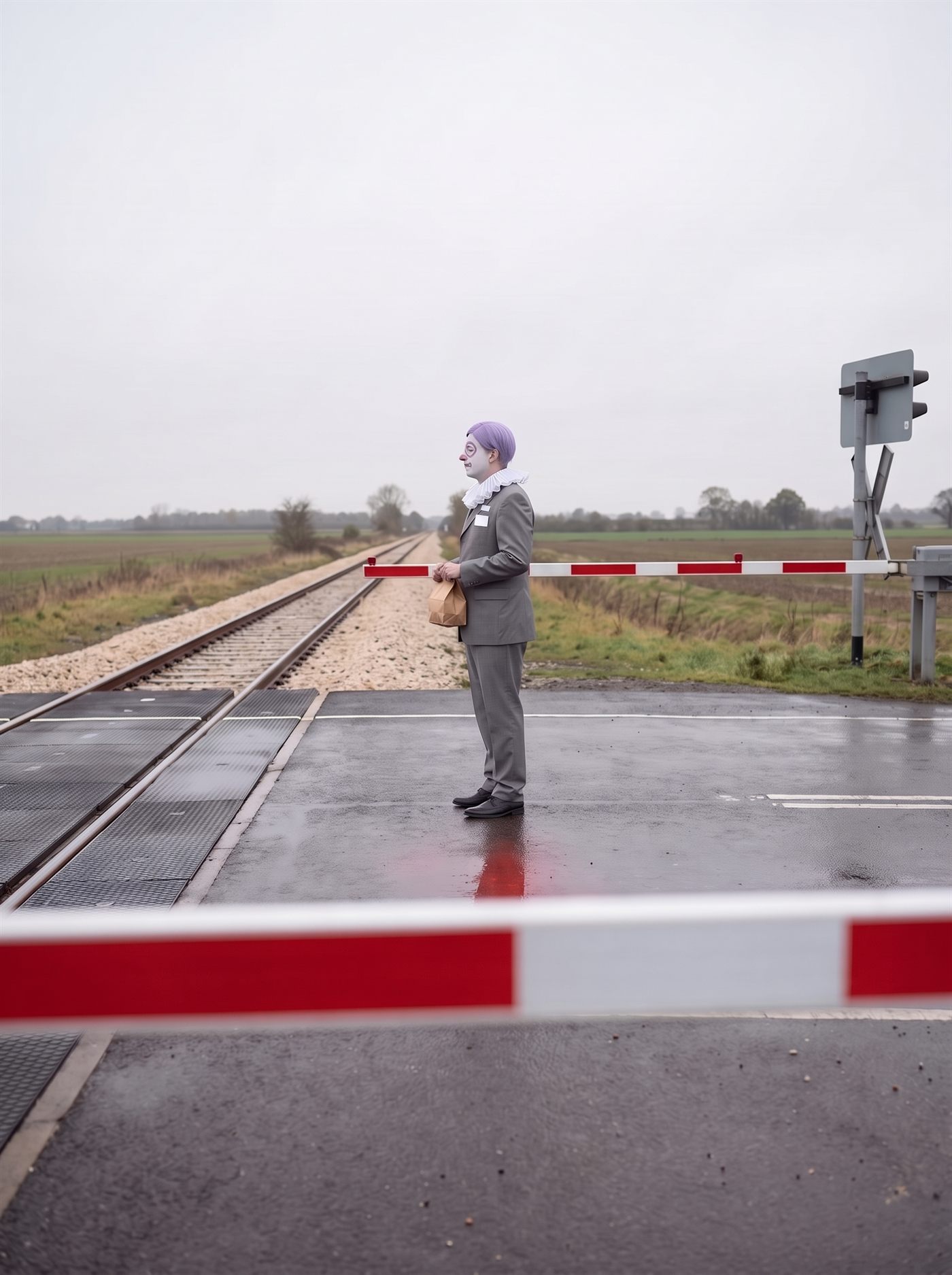
A shop that has to step out hangs a card inside the glass with a clock printed on it and two movable hands, so that whoever arrives can read how long they have missed it by. Wednesday's market hung one on the door at half past nine. In the four and a half hours before the announcement the S&P 500 moved inside 29.18 points; in the two hours after it, inside 115.00. At two o'clock exactly 24.52 percent of the day's range existed, which across the hundred and thirty-three sessions the feed carries at this resolution is the least any session has ever brought to the hour.
The median session brings a hundred percent — both the high and the low already made, the afternoon spent filing. What makes eight days a year different is not that more happens on them but that nothing is permitted to happen first. The card is not an apology for being closed. It is a promise about when the day will start.
The ledger — what actually happened
| Measure | Close | Change | Marginalia |
|---|---|---|---|
| S&P 500 | 7,551.81 | −33.92 · −0.45% | opened 7,601.25, a gap of +15.52; high 7,626.79 at 11:47, low 7,507.77 at 15:27, range 119.02, closing 37.0 percent of the way up it. The lowest close since 31 July, for the second day running, and the sixth fall in seven sessions |
| Before two o'clock | 29.18 | in the 270 minutes from the opening bell to the announcement the index held between 7,597.61 and 7,626.79 — a band 29.18 points wide, thirty-eight hundredths of one percent of its own level. At 13:59 it stood at 7,613.32, up 27.59 on the day | |
| After two o'clock | 115.00 | in the 121 minutes from the announcement to the close it covered 115.00 points, high 7,622.77 and low 7,507.77. Tuesday's entire session range was 44.57 — this afternoon alone was 2.58 times the whole of the day before it | |
| Drawn by two o'clock | 24.52% | the share of the day's full range that existed when the statement was published. Across the 133 sessions for which the feed carries a complete thirteen-bar intraday record, 9 March to date, this is the lowest — second place is 17 June at 34.41 percent, a gap of ten points. The MEDIAN session across those 133 is 100.00 percent: more than half of all days have already made both their high and their low before two in the afternoon | |
| The Fed-day signature | 3 of 3 | the record window holds five FOMC decision days — 18 March, 29 April, 17 June, 29 July, 16 September. The three sessions that had drawn the least of themselves by two o'clock are three of them, in order. Only seven of the 133 sessions were below 60 percent at two, and three of those seven are Fed days; four of the seven highest shares made after two are Fed days. Mean for the 128 ordinary sessions: 92.10 percent. Mean for the five decisions: 51.81 | |
| The decision | 3.75–4.00% | a quarter-point increase, voted unanimously 12 to 0 — the first rise since 2023. The statement said inflation remains elevated and that the action would support a timelier return to the Committee's 2 percent goal. Sixteen of the eighteen participants expect another increase this year; none is pencilled in beyond it, with one cut indicated for 2028 and at least one for 2029 | |
| The statement, and the ten minutes after it | 24.00 | between 14:00 and 14:10 the index ran up to 7,622.77 and down to 7,598.77 and finished the bar at 7,617.78 — a 24.00-point round trip that ended roughly where it began. The words alone did not settle the question | |
| The press conference | −104.24 | from 14:30, when Kevin Warsh began taking questions, to 15:30, the index fell from 7,612.01 to 7,507.77. "Inflation is a choice, and today we took a step in delivering it," he said, and noted that too many categories still showed price gains above 3 percent. From the decision to the close the index lost 61.51 — 181 percent of the whole day's decline | |
| The other indexes | −1.21 / −0.01 | the Dow 51,461.90, down 631.21; the Nasdaq Composite 25,978.42, down 3.15 — three and a fifteenth points, one hundredth of one percent, on the day the Federal Reserve raised interest rates for the first time in three years. Both reconcile exactly against this site's own published Tuesday closes | |
| The ten-year Treasury | 5.01% | back through 5 percent after the decision, quoted at about 5.008 — this site published 5.00 on Tuesday. The move was at the front end: the twenty-year-plus Treasury fund ROSE 0.22 percent on a day the Fed raised rates, which is the long end accepting the bargain | |
| Goldman Sachs | 938.44 | −3.91% | the flattening taken out of the banks: Bank of America −2.74, JPMorgan −0.96, the regional bank fund −1.74, financials the second-worst sector at −1.60. Goldman fell 3.96 percent on Monday as well, on dealmaking guidance |
| Energy | −2.84% | the worst of the eleven sectors, having been the best of the eleven on Tuesday at +2.17 — a complete reversal in one session. Technology +0.13 was the best and one of only three green, with health care +0.07 and utilities +0.01; the spread across all eleven was 2.97 | |
| The pipeline sentence | −2.7% | Brent settled 2.7 percent lower at $105.83 and WTI 3.2 percent lower at $102.43 after the US Energy Secretary, Chris Wright, called the Saudi East–West pipeline outage a brief and temporary interruption that would be measured in days. Independent analysts reading satellite images of the damaged pumping station said weeks. Tuesday's page had Brent at $108.75 with the same pipeline shut; the feed's broad crude fund fell 3.51 percent | |
| The producers against the refiners | −6.54 / +1.64 | every one of these ten names rose on Tuesday. On Wednesday they split on which end of the barrel they stand: Occidental −6.54, ConocoPhillips −6.13, EOG −5.74, Exxon −3.54, Schlumberger −3.49, Halliburton −3.22, Chevron −2.87 — against Valero +1.64 and Marathon Petroleum +0.74, with Phillips 66 flat at −0.11. Cheaper crude is a price to the company that lifts it and a margin to the company that cracks it | |
| Crude stocks | −0.6m | the EIA's weekly report, published the same morning: commercial crude inventories down 0.6m barrels to 423.4m, about 1 percent above the five-year average for the time of year — a third consecutive draw, but smaller than the 1.4m the street had looked for. Refinery inputs averaged 17.3m barrels a day, down 256,000 on the week | |
| The homebuilders | −1.00% | the other rate trade, and it went quietly by comparison: Lennar −2.12, KB Home −1.70, PulteGroup −1.63, D.R. Horton −1.34, Toll Brothers −1.17, NVR −1.07, and the homebuilder fund itself exactly −1.00 | |
| The megacaps | +0.82 / −1.36 | what kept the Nasdaq at a standstill: Nvidia +0.82, Meta +0.46, Apple +0.35 and Broadcom +0.11 against Microsoft −1.36, Amazon −1.04 and Alphabet −0.62. Technology was the only sector to finish more than a tenth of a percent higher | |
| Volatility | 17.71 | from 17.20, up 0.51, or 2.97 percent — the highest close since 10 September. The feed's own index series — the same one that puts Friday 11 September's close at 15.84, a figure this site adopted today in place of the 15.75 that page first carried |
Sources
- Robinhood market-data feed — SPX 1-minute bars for 2026-09-16 (391 real bars, zero interpolated) with the settle from get_index_quotes, the 2026-09-16 day bar itself still being interpolated; SPX 30-minute bars for every session from 2026-03-01, of which 133 from 2026-03-09 carry a complete thirteen-bar regular-hours record, for the range-by-two-o'clock study; the VIX index series; and 9/15 official closes against 9/16 settled closes for the eleven sector SPDRs and for XOM, CVX, COP, OXY, SLB, HAL, VLO, MPC, PSX, EOG, USO, TLT, KRE, GS, BAC, JPM, DHI, LEN, PHM, NVR, KBH, TOL, XHB, NVDA, MSFT, AAPL, GOOGL, AMZN, META and AVGO
- Board of Governors of the Federal Reserve System — FOMC statement, 16 September 2026 — https://www.federalreserve.gov/newsevents/pressreleases/monetary20260916a.htm
- CNBC — "Fed rate decision September 2026: Rates rise to 3.75%-4%" — https://www.cnbc.com/2026/09/16/fed-rate-decision-september-2026.html
- CNBC — Fed meeting recap: Warsh says inflation is still too high as the Fed hikes for the first time since 2023 — https://www.cnbc.com/2026/09/16/fed-meeting-today-live-updates.html
- CNBC — "10-year Treasury yield climbs back to 5% after Fed hikes rates, Warsh highlights inflation risks" — https://www.cnbc.com/2026/09/16/treasury-yield-bond-market-fed-decision.html
- Yahoo Finance — live markets coverage, Wednesday 16 September 2026 — https://finance.yahoo.com/markets/live/stock-market-today-wednesday-september-16-dow-sp-500-nasdaq-fed-meeting-decision-080356525.html
- Kiplinger — "Stocks Turn Down as Warsh Talks Up Rates: Stock Market Today" — https://www.kiplinger.com/investing/stocks/stocks-turn-down-as-warsh-talks-up-rates-stock-market-today
- CNBC — "Oil prices fall after U.S. says damaged Saudi pipeline will restart operations in days" — https://www.cnbc.com/2026/09/16/oil-prices-today-brent-wti-hormuz-iran-war.html
- U.S. Energy Information Administration — Weekly Petroleum Status Report, week ended 11 September 2026 — https://www.eia.gov/petroleum/supply/weekly/