The last hour
S&P 500 333.65 · −21.74 · −6.12% · the last hour
The day was cream until 2:43 and indigo after. A quiet Friday, four sessions off all-time highs, drifting toward the weekend — then a single trading halt, one airline deal's money failing to arrive, and the whole leveraged decade repriced in the final hour. Most of the room never heard the news before the selling started. It didn't need them to.
The day's protagonist
The buyout machine — no symbol.
Move: one deal fails at 2:43 — the decade reprices by 4:00
The financing for the $6.75 billion employee-management buyout of United Airlines' parent collapsed on Friday afternoon: the banks would not fund it. The exchange halted the stock at 2:43 at 279¾, pending news, and when the news came the market understood it was not about one airline — UAL was the totem of the junk-financed takeover era, and its failure said the era was over. Institutions dumped takeover stocks, arbitrageurs unwound, program trading amplified into the close: 108 million shares in the final hour, the S&P down 6.12 percent to 333.65, the Dow down 6.91 — the steepest day since Black Monday, four sessions after all-time highs. A later survey of a hundred professionals found only a third had heard the UAL news before the selling began.
The deeper account
The setup made the fall steeper: the indices had set all-time highs on Monday, October 9 — four sessions before. Junk bonds were already wobbling around Campeau's troubles; the UAL financing was the era's confidence vote, and it failed.
The mechanics rhymed with 1987 on purpose and by machinery: program trading and index arbitrage amplified the last forty-five minutes, and the SEC commissioned a formal study of the day to sort blame — its count of the final hour is the number in the ledger.
The Feltus–Shiller survey afterward found 36 percent of professionals had heard the UAL news before the selling started, and half called the news a mere attention-grabber for selling that wanted to happen — a crash as internal dynamics wearing a headline.
What did NOT happen distinguishes the day: the post-1987 plumbing held, liquidity arrived, and Monday the S&P recovered 2.76 percent. The lasting casualty was the leveraged-buyout era — deal financing never got its 1988 swagger back.
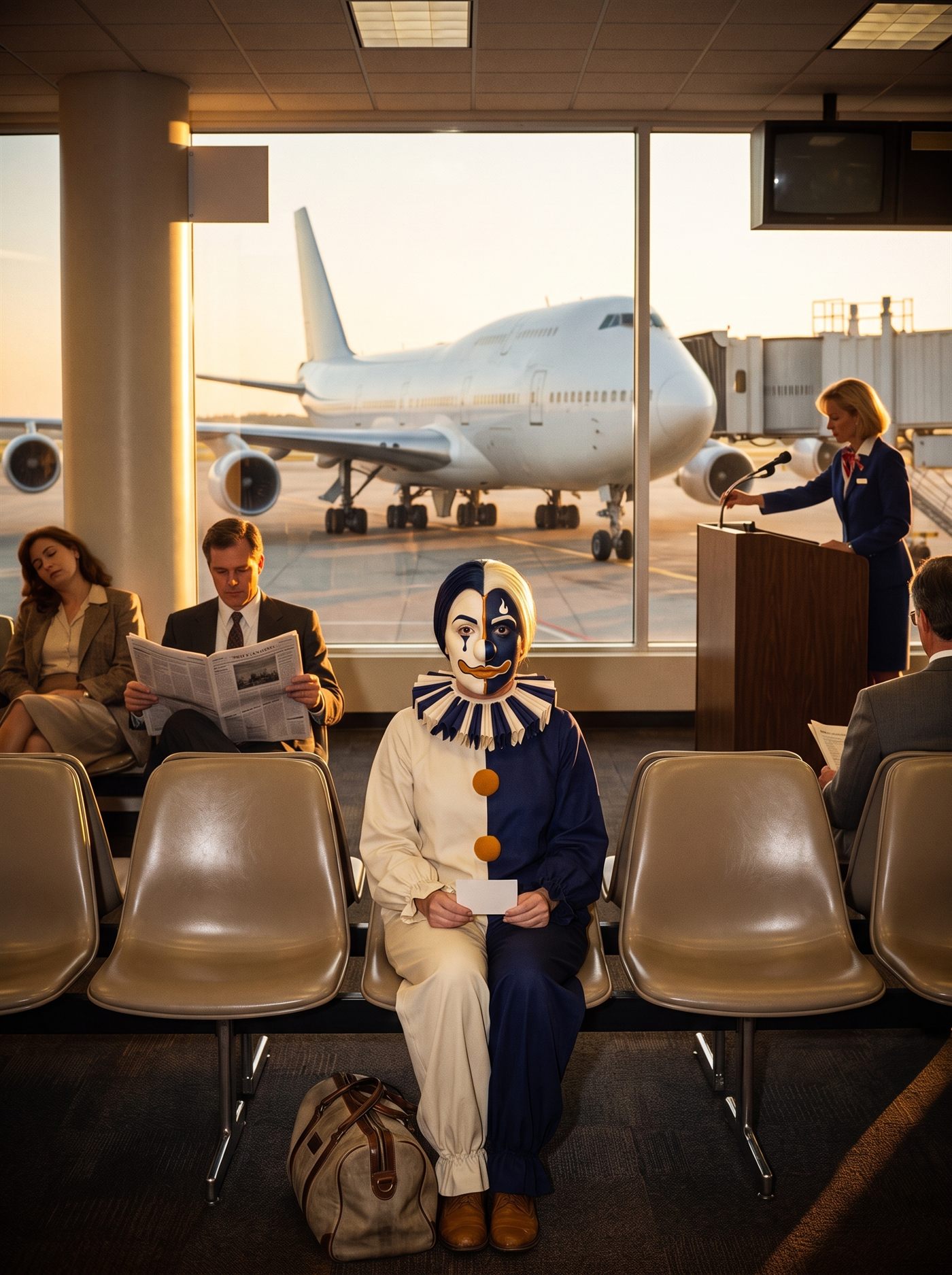
In the photograph of this day the deal un-departs: a widebody pushed back from the gate unboarded at golden hour, the lounge not yet understanding, and the split-faced clown sitting exactly on the seam of the light — cream side sunlit, indigo side already in shadow.
The ground is after-2:43 indigo; the ink is the cream of the morning; the pigment is the amber seam between them — the loud register, for a day cut in two.
The artifact
The halt was real: at 2:43 that afternoon the exchange stopped trading in the airline holding company at 279¾, pending news. The news was that the banks had walked away from the six-and-three-quarter-billion-dollar buyout — and because that one deal was the totem of the whole leveraged decade, the market repriced the decade in the final hour: 108 million shares, forty-three percent of the day's volume, after the stamp. The averages had stood at all-time highs on Monday. By the close they had given back six-point-nine percent, the worst day since October 1987 — and unlike that day, Monday brought a rebound. It was never 1987 again. It was never quite the eighties again, either.
Read the notice
Printed text is shown plain; the clerk's entries are shown in script.
NOTICE OF TRADING HALT · FRIDAY, OCTOBER 13, 1989 · 2:43 P.M. — one airline holding company · last sale 279¾, down 5½
- reason given: news pending. THE NEWS, WHEN IT CAME: the money for the deal is not coming.
- the final hour: 108,170,000 shares — forty-three cents of every dollar traded today, after this stamp.
- the industrials: down 6.91 percent — the steepest day since the one everyone was thinking about.
- CLERK'S HAND: quiet all day. then the phones.
- MONDAY THE MARKET ROSE. THE DEALS DID NOT COME BACK.
On Friday, October 13, 1989, the collapse of the financing for the $6.75 billion buyout of United Airlines' parent — halted on the tape at 2:43 p.m. — set off a cascade of selling in the final hour. The S&P 500 fell 6.12 percent to 333.65 and the Dow 6.91 percent to 2,569.26, the worst day since Black Monday 1987, four sessions after all-time highs. The exchange's own study counted 108 million of the day's 251 million shares in the last hour. On Monday the S&P recovered 2.76 percent; the era of the leveraged buyout did not.
The ledger — what actually happened
| Measure | Close | Change | Marginalia |
|---|---|---|---|
| S&P 500 | 333.65 | −21.74 · −6.12% | 355.39 → 333.65, closing on the session low — the indices had stood at records on Monday |
| Dow Jones | 2,569.26 | −190.58 · −6.91% | the steepest fall since the one everyone was thinking about — October 19, 1987 |
| The trigger | 2:43 p.m. | UAL halted at 279¾, down 5½, pending news; the $6.75B buyout's banks had walked | |
| The last hour | 108,170,000 shares | 43% of the day's volume after the halt — per the SEC's own post-mortem | |
| Monday | +2.76% | the rebound that said it wasn't 1987 again; the takeover stocks stayed down |
Sources
- UPI, October 13, 1989 — "UAL deal collapses, shakes Wall Street" (the 2:43 halt; −190.58 to 2,569.26) — https://www.upi.com/Archives/1989/10/13/
- SEC Division of Market Regulation — Trading Analysis of October 13 and 16, 1989 (the last-hour 108.17M shares)
- The Washington Post, October 14, 1989 — "Stock Market Takes Steepest Dive Since '87"
- Wikipedia — Friday the 13th mini-crash (closes; the October 9 highs; the Feltus–Shiller survey)
- Daily closes: Yahoo ^GSPC daily series (including Monday's 342.85)