The vault reopens
DOW JONES 62.10 · +8.26 · +15.34% · a record
The best day in the Dow's history was not about stocks. It was about the banking system being switched back on — and a voice on the radio doing what the bankers' pool could not.
The day's protagonist
The reopened vault — no symbol.
Move: +15.34% — the receipt for a fireside chat
The Exchange had been closed for eleven days. Roosevelt declared the bank holiday on March 6; Congress passed the Emergency Banking Act on the 9th; and on Sunday the 12th the first fireside chat told sixty million radio listeners it was "safer to keep your money in a reopened bank than under the mattress." The banks the examiners called sound reopened Monday — and deposits flowed in, not out. When the stock exchange followed on Wednesday, the country bought: three billion dollars of market value in a session, buy orders from every part of the country, the ticker running late on buying for the first time in its life. The +15.34% close has never been beaten.
The deeper account
Sequence: banks closed nationwide March 6 → Emergency Banking Act March 9 → fireside chat Sunday March 12 → sound banks reopen Monday → the Exchange reopens Wednesday to the best day it has ever had.
Deposits returned to the banks the same week — the run reversed by broadcast. Confidence, successfully manufactured, at scale, for the first time.
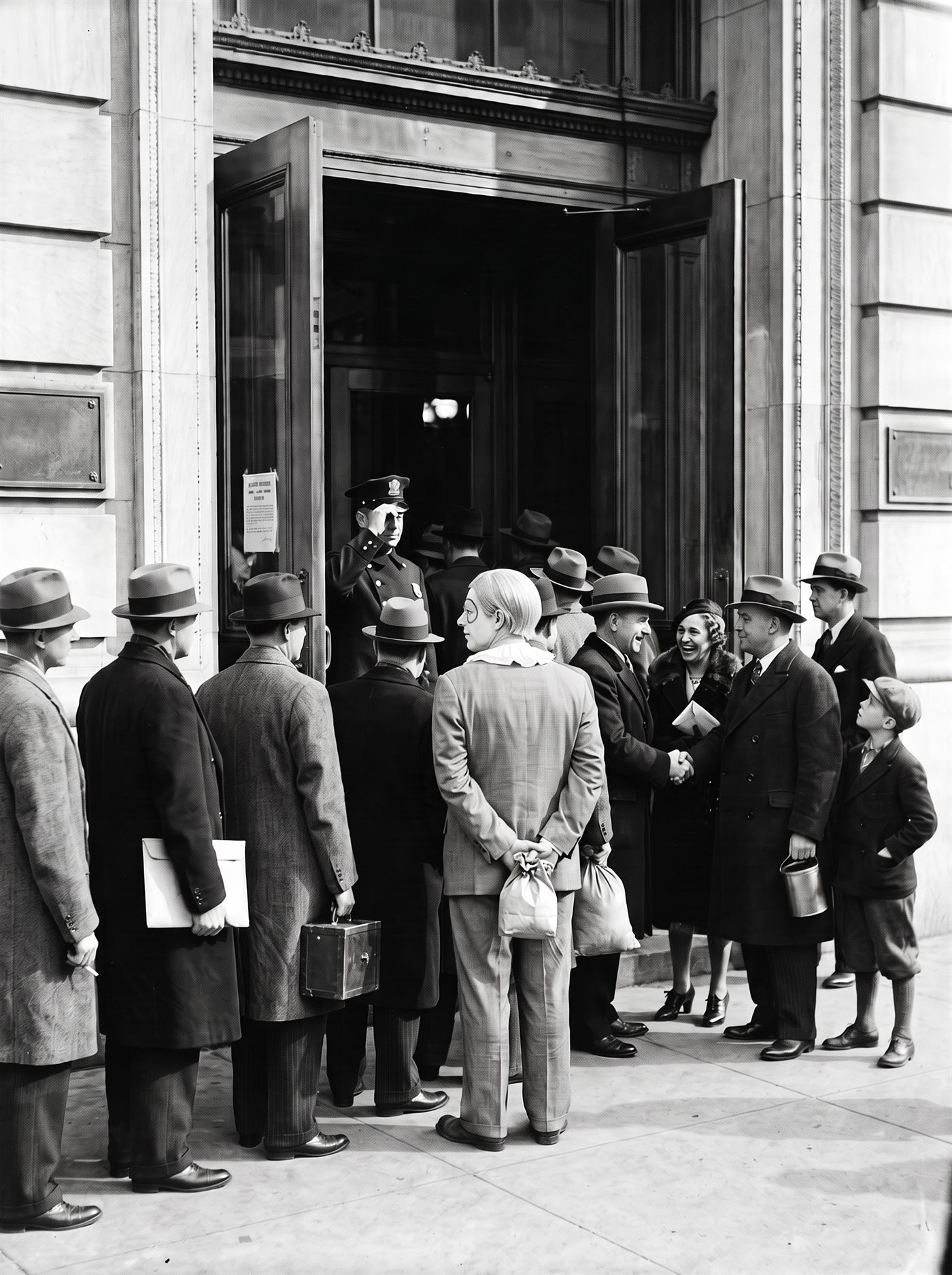
In the photograph of this day the line outside the bank goes in, not out, and he goes with it, carrying the same sack he has carried since the street filled with falling paper. Between that night and this morning lie three and a half years this book keeps no pages for.
The Dow stood at 62.10 that evening: still down 84% from September 1929. The best day ever happened near the bottom of the worst decade — the two facts are the same fact.
In the wing of greys this is the one loud page: sprout green and gold, per the pigment doctrine's loud register.
The artifact
The license was real: banks reopened only as the examiners cleared them, city by city, under Treasury license. The radio had done the underwriting on Sunday night — sixty million listeners told it was safer to keep money in a reopened bank than under the mattress — and Monday the deposits flowed in, not out. When the Exchange followed on Wednesday, the country bought: +15.34 percent, three billion dollars of value, the ticker late on buying for the first time in its life. Ninety-three years on, the record stands.
Read the notice
Printed text is shown plain; the teller's entries are shown in script.
NOTICE · WEDNESDAY, MARCH 15 · THIS BANK OPENS TODAY — under license of the Secretary of the Treasury
- examined: and found in sound condition. · SOUND
- dark: eleven days. · deposits this morning: arriving.
- and when the exchange followed: dow 53.84 → 62.10 · +15.34% — the best day it has ever had. still.
- TELLER'S HAND: they are carrying it back in. tins, envelopes, one strongbox. the line goes in, not out.
- SAFER HERE THAN UNDER THE MATTRESS, THE RADIO SAID. SUNDAY NIGHT, SIXTY MILLION LISTENING. MONDAY MORNING, THEY BELIEVED IT.
On Wednesday, March 15, 1933 — the first trading day after the national bank holiday — the Dow rose 15.34 percent to 62.10, still the best single day in its history. Roosevelt had closed the banks on March 6; the Emergency Banking Act passed on the 9th; the first fireside chat on Sunday the 12th told some sixty million listeners a reopened bank was safer than the mattress. The sound banks reopened Monday to net deposits, and the Exchange reopened Wednesday to roughly three billion dollars of buying.
The ledger — what actually happened
| Measure | Close | Change | Marginalia |
|---|---|---|---|
| Dow Jones | 62.10 | +8.26 · +15.34% | still the best single day in Dow history, ninety-three years on |
| Market value added | ≈$3 billion | per the New York Times | |
| Volume | ≈3M shares | the ticker fell behind on buying | |
| The closure | 11 days | the NYSE had been dark since March 3; the banks since the 6th |
Sources
- Federal Reserve History — Emergency Banking Act of 1933 — https://www.federalreservehistory.org/essays/emergency-banking-act-of-1933
- FRBNY Economic Policy Review — Why Did FDR's Bank Holiday Succeed? (Silber, 2009) — https://www.newyorkfed.org/medialibrary/media/research/epr/09v15n1/0907silb.pdf
- The New York Times, March 16, 1933 — market report