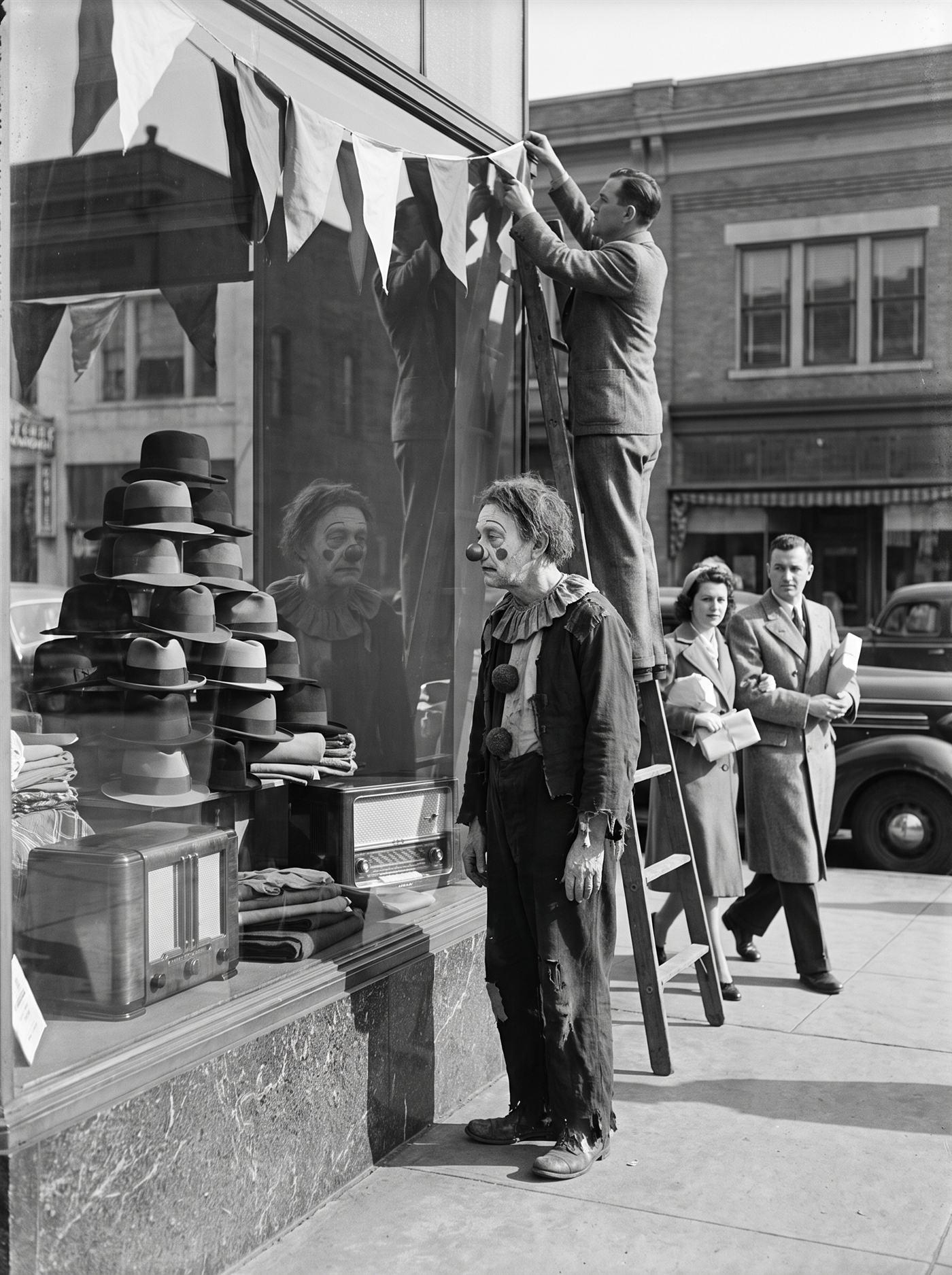
The window, refilled
DOW JONES 194.40 · +1.11 · +0.57% · the recovery's high-water mark
The shop windows had goods in them again — that was the recovery, told at street level: hats in pyramids, radios on risers, bunting going up, almost five-fold on the index in under five years. And the week of the top carried, in the same newspaper, every part of the machine that would empty the windows again: the Fed's doubling of reserve requirements mid-stride, one half effective nine days earlier and the other due May first; the Treasury sterilizing gold since December; profits taxed if retained; sixty thousand workers sitting down in six Chrysler plants since Monday; the Court about to be packed. The Chronicle logged it all and called the market fairly steady. 194.40 — the highest close since October 1930, and the highest anyone would see until 1945.
The day's protagonist
The machinery — no symbol.
Move: assembled in one week's paper — the top as a list of its own causes
No top in the archive carries its autopsy so neatly in its own week's news. The Federal Reserve, alarmed by excess reserves, had voted to double reserve requirements: half the increase took effect March 1, nine days before this close, and the second half was scheduled for May Day. The Treasury had been sterilizing gold inflows since December. The undistributed-profits tax squeezed exactly the retained earnings that had funded the recovery's reinvestment. U.S. Steel — the fortress that had broken every union since Homestead — had signed with the CIO on March 2, and on March 8 sixty thousand workers sat down inside all six of Chrysler's Detroit plants. The President's plan to pack the Supreme Court was five weeks old. The Chronicle noted, in the same issue that recorded this top, the speculative character of recent buying and a sharp unsettlement in government bonds. Every sentence was public. The market rose 1.11 points to 194.40 — its best close since October 1930, almost five-fold off the 1932 bottom in under five years — and then Thursday brought what the Chronicle called pronounced declines, and the pronounced declines never really stopped: down 41.5 percent by November, 49.10 by the following March, and 52.20 at the wartime bottom of April 1942, a page this archive keeps. The recovery's top was the recession's press kit. Nobody read it that way until after.
The deeper account
The archive's 1942 page carries the drawdown "−52.2% from 1937" and, until now, no page for the 1937 in question. Here it is: the numerator of the war bottom's arithmetic, the top of the only bull market the New Deal ever got.
The week's texture is the page's argument: a top is not an event but a coincidence — the moment the last buyer's conviction crosses the first machine already in motion against it. This week the machines were listed in the paper, with effective dates.
In the photograph of this day the window is full again and the bunting is going up, and the old clown's reflection hangs among the hats and the radio — the one item on display the recovery did not restore. He is the only figure in this batch who leads two pages: the recovery's top here, the false gold of 2020 eight pages on. Tops are his subject. He has never once believed one.
The ground is the street's cold iron; the pigment is plate glass — the silver of a pane holding the goods and the ghost at once.
The artifact
Fine goods again — the recovery in three words, propped in a window that had spent half a decade empty. The card's lower half is the part nobody read as a set: the Fed's doubling of reserve requirements taking effect in halves on either side of the peak, sixty thousand workers seated inside Chrysler since Monday, the government's own bonds sharply unsettled — every cause of the Roosevelt recession posted, dated, and public in the week of the top itself. The index stood at 194.40, its best since 1930, almost five-fold off the bottom in under five years. A year later it was 49 percent lower, and the whole road to April 1942's 92.92 — a page this archive keeps — measures from this card.
Read the card
Printed text is shown plain; the shopkeeper's entries are shown in script.
WINDOW CARD · MARCH 10, 1937 — FINE GOODS AGAIN
- new hats. new radios. cloth by the bolt. terms: cash or credit, gladly.
- the industrials: 194.40 — the highest since october 1930. almost five-fold from the bottom, in under five years.
- POSTED IN THE SAME WEEK'S PAPER: reserve requirements rise march 1 — and again may 1. sixty thousand sat down at chrysler monday. government bonds: sharply unsettled.
- SHOPKEEPER'S HAND: the recovery filled the window. he stood at the glass and saw only his reflection.
- THE WINDOW HELD. THE PRICE DIDN'T. −49 BY MARCH NEXT.
On Wednesday, March 10, 1937, the Dow closed at 194.40 — the exact closing high of the year, its best since October 1930, capping a near five-fold rally from July 1932's bottom. The Recession of 1937–38 followed: 98.95 by March 31, 1938 (−49.10 percent), and the ultimate low of 92.92 on April 28, 1942 (−52.20 percent) — the archive's wartime-bottom page, whose arithmetic begins here. The Dow did not close above 194.40 again until 1945.
The ledger — what actually happened
| Measure | Close | Change | Marginalia |
|---|---|---|---|
| Dow Jones | 194.40 | +1.11 · +0.57% | the exact closing high of 1937 (confirmed by full-year scan) and the best since October 1930; not exceeded until 1945; per the daily record |
| The rally it capped | ×4.72 · 4y 8m | from 41.22, July 8, 1932 — the archive's bottom page; almost five-fold in under five years | |
| The Fed | Mar 1 · May 1 | the reserve-requirement doubling's two halves — the first effective nine days before this close, per its own announcement | |
| The week's labor | 60,000 · six plants | the Chrysler sit-down began March 8, two days before the peak; U.S. Steel had signed with the CIO on March 2 | |
| The fall | −49.10% by Mar 1938 | 98.95 on March 31, 1938; the ultimate low, 92.92 in April 1942 (−52.20%), is the archive's wartime-bottom page — which measures from this day |
Sources
- MeasuringWorth — Daily Closing Values of the Dow Jones Average (the full-1937 scan confirming the high; every waypoint 1930–1945, queried directly) — https://www.measuringworth.com/datasets/DJA/
- Commercial & Financial Chronicle, Mar 13, 1937 (Vol. 144 No. 3742, via FRASER) — the reserve-requirement passage verbatim, the week's market review, the bond unsettlement (PRIMARY; OCR-scrambled passages paraphrased, not quoted)
- Federal Reserve History — "Recession of 1937–38": the Aug 1936 / Mar 1937 / May 1937 reserve steps, gold sterilization, the recession's dating
- Library of Congress / Reuther Library labor chronology — Flint's end (Feb 11), U.S. Steel–SWOC (Mar 2), the Chrysler sit-down (Mar 8, 60,000, six plants)