The counter, kept open
DOW JONES 112.53 · −4.07 · −3.49% · the market heard it standing up
The news came Sunday afternoon, when the tape had been silent a day already. Monday morning the president of the Exchange had the accumulated orders checked before he permitted the open — and then it opened, because the one thing the house does in every war in this ledger is stay open. At 12:30 the President addressed Congress for six minutes; the vote came 33 minutes after he finished; the market traded through all of it and closed down 3.49 percent. Tuesday was worse. There was no panic. There was also no picnic — the wires said exactly that.
The day's protagonist
The open — no symbol.
Move: −3.49% — the house stayed open, and that was the news
The attack came Sunday afternoon, New York time, with the tape a day into its weekend silence. Monday morning Emil Schram, the president of the Exchange, had the accumulated orders checked before he permitted the open — and then the market opened on schedule, because staying open was the institution's entire contribution to the argument. At 12:30 the President addressed Congress for about six minutes; the war vote came 33 minutes after he finished; the declaration was signed later that day; and the tape ran through all of it, closing down 3.49 percent at 112.53 on about two million shares, four times Saturday's half-day. The broader composite fell harder, 3.76 percent. Tuesday the selling worsened — down another 2.90 on heavier volume — before the slide flattened. The contemporary broker reading was precise: the shock was less that a shooting war had begun than that the country had been caught unprepared. Bonds held; the institutions declined to panic; and the real bottom was five months and twenty percent away, on a day this archive turns to next.
The deeper account
The week before the attack had actually firmed — 113.59 Monday to 116.60 Saturday. The market was not braced. It simply also did not break: TIME's verdict on the week was three words, "No Picnic, No Panic," and the post-attack levels were the lowest since mid-1938.
Volume tells the institution's story better than price: about 2.03 million shares, four times the Saturday half-day, every order checked before the open was permitted. The house's answer to the gravest morning of its century was procedural.
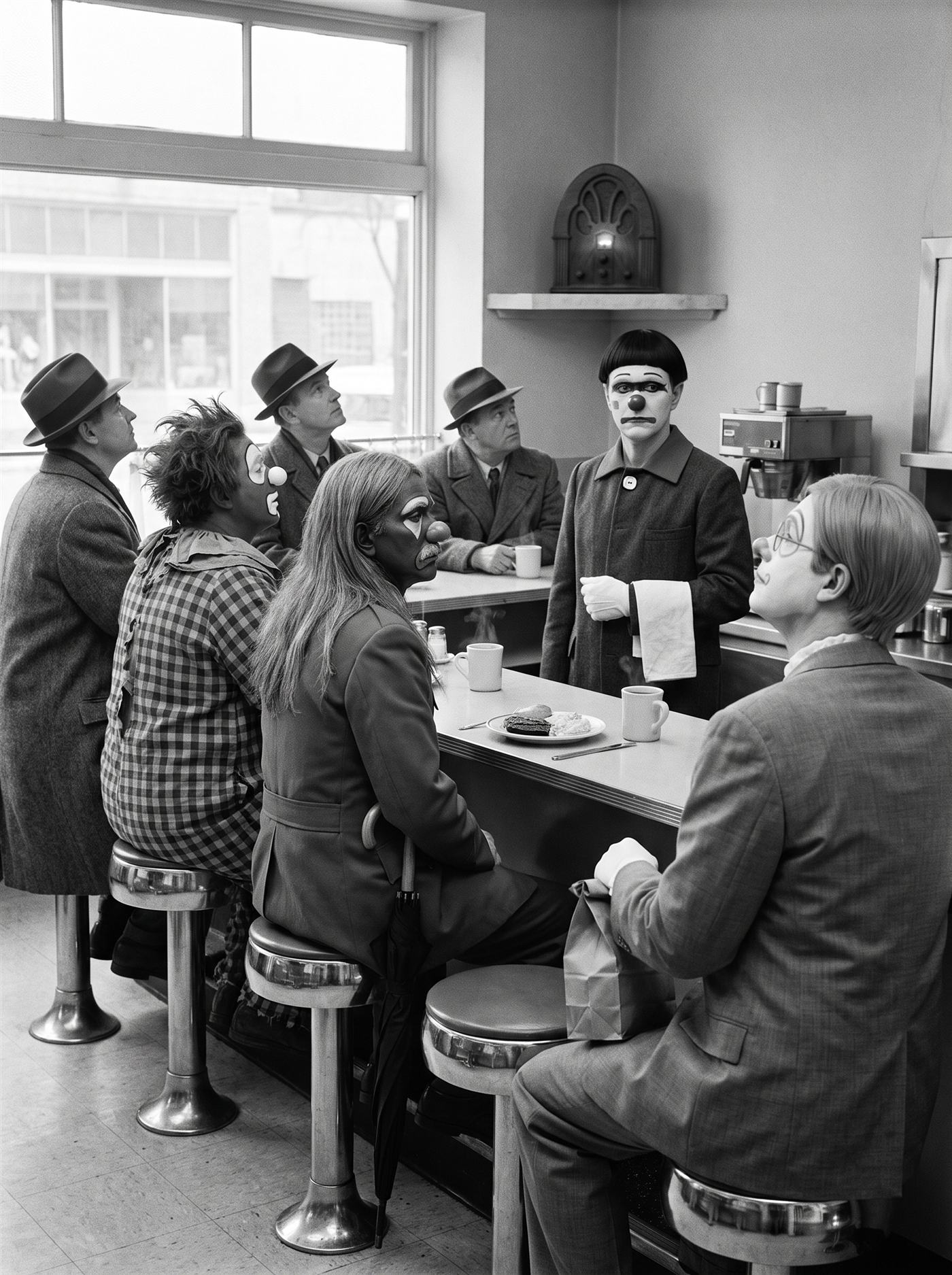
In the photograph of this day everyone at the counter looks at the radio except the one who runs the counter. He has seen a thousand of every kind of morning, and he watches the room instead. The umbrella by the third stool is closed — its owner opened it for the last war's beginning one page back, but there is no forecasting left to do once the rain arrives.
The ground is the counter's dark walnut; the pigment is dial light — the small amber glow the war arrived by.
The artifact
Four coffees and nothing else, all through the noon hour — the check is the whole room: everyone listening, nobody eating. The Exchange's own morning ran on the same register. Its president had the weekend's accumulated orders checked before he permitted the open; then it opened, on schedule, and traded straight through the six-minute address and the vote that followed 33 minutes later. Down 3.49 percent, worse the next day, the lowest levels since mid-1938 — and no panic, which the wires reported as the story it was. The counterman's line stands for the institution: staying open was the whole speech it gave.
Read the check
Printed text is shown plain; the handwritten entries are shown in script.
GUEST CHECK · MONDAY, DECEMBER 8, 1941 · THE NOON HOUR
- coffee. coffee. coffee. coffee. — nothing else ordered, all through the noon hour.
- the industrials: 116.60 → 112.53 · down 3.49 percent — the orders were checked before the bell was permitted.
- the address: 12:30 — six minutes. the vote: 33 minutes after he finished. the tape ran through all of it.
- COUNTERMAN'S HAND: nobody ate. the radio had the room. we stayed open — that was our whole speech.
- NO PICNIC. NO PANIC.
On Monday, December 8, 1941 — the first session after the attack on Pearl Harbor — the Dow fell 3.49 percent to 112.53 on about 2.03 million shares, and fell 2.90 more on Tuesday. The New York Stock Exchange opened on schedule and traded through the declaration of war; it would not close for the duration. The market's wartime bottom came five months later, on April 28, 1942 — the next page.
The ledger — what actually happened
| Measure | Close | Change | Marginalia |
|---|---|---|---|
| Dow Jones | 112.53 | −4.07 · −3.49% | from Saturday's half-session close, the orders checked before the bell; per the daily record |
| S&P composite | 8.97 · −3.76% | the 90-stock daily composite — the broad market fell harder than the thirty | |
| The address | 12:30 p.m. | six minutes to Congress, the vote 33 minutes after he finished — the market open through all of it | |
| The second day | −2.90% | Tuesday was worse, on heavier volume — a two-day slide of 6.3 percent, not a one-day crash | |
| The bottom to come | April 28, 1942 | another twenty percent down, five months out — the next page of this archive |
Sources
- MeasuringWorth — Daily Closing Values of the Dow Jones Average (every close, Dec 1–12, 1941) — https://www.measuringworth.com/datasets/DJA/
- Commercial & Financial Chronicle, Dec 16, 1941 (Vol. 154 No. 4020, via FRASER) — the transactions table (≈2.03M shares, read from the page scan); Dec 11 issue — the broker color and the bond market's refusal to panic
- TIME — "No Picnic, No Panic" (Dec 15, 1941): Schram checking the orders; "lowest since mid-1938"
- National Archives — the address to Congress, 12:30 p.m., "a date which will live in infamy"; the 33-minute vote