The weather arrives
DOW JONES 128.27 · −9.36 · −6.80% · the worst day of the war
The blitzkrieg was four days old and the market had mostly waited — Denmark and Norway had cost it nothing, and perhaps this too would stay a European affair. On the day Rotterdam burned mid-surrender, the waiting ended: down 6.80 percent, the worst single day the war would ever give the tape. The forecast in the morning papers had been fair. The cautious had carried umbrellas anyway, since April, to general amusement.
The day's protagonist
The blitzkrieg — no symbol.
Move: −6.80% — the war, finally priced
Germany struck the Low Countries at three in the morning on May 10; the market fell two percent and waited, as it had waited through Denmark and Norway. On the fourteenth the waiting ended. Rotterdam was handed an ultimatum in the morning — surrender or face the city's complete destruction — and at twenty past one, while the surrender was being negotiated, fifty-four bombers leveled the medieval center; by evening the Netherlands had capitulated. New York traded through all of it and closed down 6.80 percent at 128.27, the worst single day of the fall-of-France collapse and of the entire war. Eight sessions took more than a fifth off the index. Amsterdam's bourse had gone dark with the invasion; Brussels and Paris would follow within weeks. The New York Stock Exchange never closed — that was its entire contribution to morale.
The deeper account
Wall Street had shrugged at Denmark and Norway in April, and at the invasion itself on Friday the tenth — down only 2.3 percent. The fourteenth is the day the price finally believed the newsreels.
May 21, as the breakthrough at Sedan became the race to the Channel, fell 6.78 percent — two hundredths behind this day. May 1940 as a whole lost 21.7 percent, one of the ten worst months in the index's history.
The panic's name came later: France fell in June. The market saw it from Rotterdam.
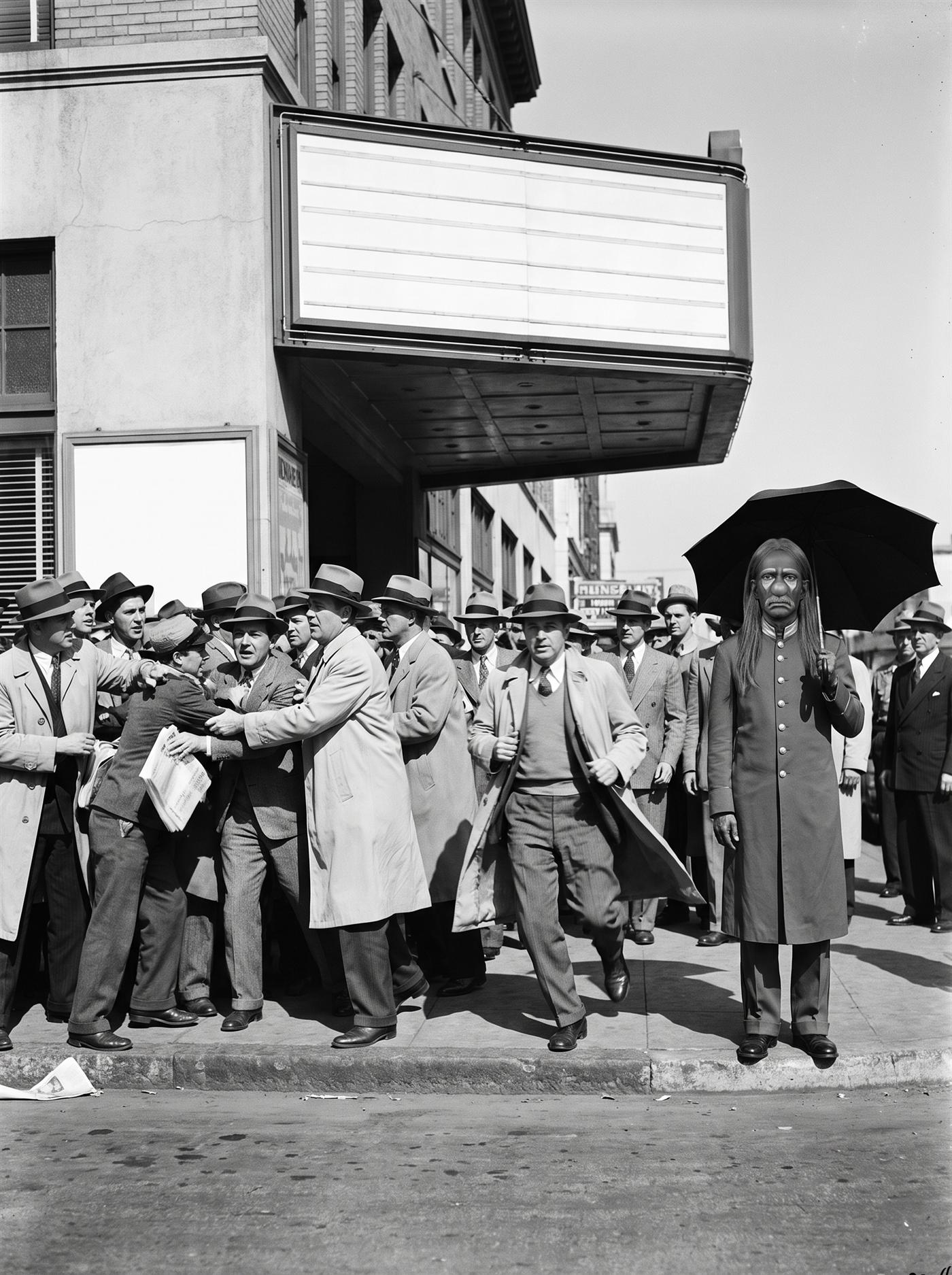
In the photograph of this day the crowd is at the headline boards and one man is already running — and the hedge stands at the curb with his umbrella open under a cloudless sky, the only figure dressed for what the forecast didn't say. His cheek is painted with raindrops: weather, not tears.
The ground is blackout green; the pigment is newsreel silver — the light the war arrived by.
The artifact
The forecast for New York was genuinely fair that day; the weather that mattered was four thousand miles east. Rotterdam received its ultimatum in the morning, the bombers arrived while the surrender was being negotiated, and the Netherlands capitulated by nightfall. New York traded through all of it — the exchange never closed once in the whole war, while Amsterdam's bourse went dark with the invasion and Brussels and Paris followed within weeks — and the industrials closed down 6.80 percent: the single worst day the Second World War would ever hand the American tape, worse than anything after Pearl Harbor. The cautious had been carrying umbrellas since April, to general amusement.
Read the card
Printed text is shown plain; the clerk's entries are shown in script.
THE WEATHER · TUESDAY, MAY 14, 1940 · FAIR AND WARMER — no rain expected.
- the industrials: 137.63 → 128.27 · down 6.80 percent — the worst day this war will ever give the tape.
- rotterdam: an ultimatum at half past ten. the bombers at twenty past one — mid-negotiation. the surrender: by evening.
- amsterdam's bourse is closed. new york never closes.
- MARGIN CLERK'S HAND: he had his umbrella open by nine. we laughed.
- THE FORECAST WAS FOR FAIR. THE WEATHER CAME ANYWAY.
On Tuesday, May 14, 1940 — the day Rotterdam was bombed mid-surrender and the Netherlands capitulated — the Dow fell 6.80 percent to 128.27, the largest single-day drop of the fall-of-France collapse and of the entire Second World War. The slide ran eight sessions, May 13–21, and took more than a fifth off the index from the eve of the invasion; the American market did not finally bottom until April 1942, near the high-water mark of Axis control.
The ledger — what actually happened
| Measure | Close | Change | Marginalia |
|---|---|---|---|
| Dow Jones | 128.27 | −9.36 · −6.80% | the worst single day the Second World War would ever hand the index — worse than anything after Pearl Harbor; per the daily record |
| The week | −17.1% in 8 sessions | May 13–21; from the eve of invasion to the trough, 148.17 → 114.13 — "a net decline of more than a fifth" (U.S. Commerce Dept) | |
| Rotterdam | 1:20 p.m. | fifty-four bombers, mid-negotiation; the Netherlands capitulated by evening | |
| The bourses | Amsterdam: closed | dark with the invasion, until August; Brussels and Paris followed in June. New York never closed | |
| The bottom to come | April 1942 | the American market kept falling, with rallies, until the Axis map peaked |
Sources
- Survey of Current Business, June 1940 (U.S. Department of Commerce, via FRASER) — the week's fall, "a net decline of more than a fifth" — https://fraser.stlouisfed.org/title/survey-current-business-46/june-1940-9371
- MeasuringWorth — Daily Closing Values of the Dow Jones Average (every close, May 8–25, 1940) — https://www.measuringworth.com/datasets/DJA/
- 24/7 Wall St. — historic-collapse comparison (May 14, 1940 the largest single-day decline of the fall-of-France break)
- Wikipedia — German bombing of Rotterdam (the ultimatum, 1:20 p.m., the capitulation sequence)
- Finaeon / Global Financial Data — the European exchange closures; the April 1942 bottom