The fall, reversed
DOW JONES 2,027.85 · +186.84 · +10.15% · the third day
Monday was the worst day in the market's history and Tuesday was, by most accounts of the people inside it, somehow worse — stocks that couldn't open, futures suspended, the plumbing itself failing. Wednesday the plumbing held. The Fed had said its one sentence — readiness to serve as a source of liquidity — and spent the day proving it at the discount window; some ninety large companies had announced they would buy their own shares back; Tokyo had bounced overnight. The Dow rose 186.84 points, 10.15 percent, the biggest single-day climb ever recorded to that date, in a session the wires kept calling orderly, as if surprised by the word. A broker told TIME the week had gone from hell to heaven. Thursday it went back for its coat: down 3.82 percent, the retest Monday, and the old peak 22 months away.
The day's protagonist
The one sentence — no symbol.
Move: "...its readiness to serve as a source of liquidity..." — thirty-one words, worth 186.84 points by Wednesday
Before Tuesday's open the Federal Reserve had issued the shortest important statement in its history: consistent with its responsibilities as the nation's central bank, it affirmed its readiness to serve as a source of liquidity to support the economic and financial system. One sentence, and then the proving of it — the New York Fed's Corrigan personally leaning on the banks to keep lending to the street, Citicorp's loans to securities firms swelling from a normal few hundred million to 1.4 billion dollars, open-market operations run early and conspicuously so the tape itself could see them, and the discount window spiking on Wednesday the 21st. Into that scaffolding stepped the corporations: buyback announcements had reached critical mass partway through Tuesday, and by Wednesday some ninety large companies were standing under their own shares — nearly six hundred would announce within two weeks, against 350 in the entire year to October. Tokyo bounced 475 points overnight; two banks rolled the prime back a quarter. The Dow rose 186.84 — 10.15 percent, the biggest single-day climb ever to that date, on 449 million orderly shares — and with Tuesday's gain recovered more than half of Black Monday. It was the rally that proved the system would hold. It was not the recovery: Thursday fell 3.82 percent, Monday retested, and the August peak was not seen again until August 24, 1989, twenty-two months on.
The deeper account
This page completes a trilogy the archive already keeps: Black Monday in mourning grey, Terrible Tuesday's green willow shoot through the ash — and now the third day, when the shoot held. The week's three pages read as one story: the fall, the flicker, the proof.
The comparison the day itself invited is the one this batch exists to test: +10.15 percent was the biggest point climb ever and the biggest percentage day since the early 1930s — and the early-1930s pages of this batch show exactly why nobody trusted it. The difference was the scaffolding: 1931's pool was announced at midnight and lent nothing; 1987's sentence was proven at the discount window by morning.
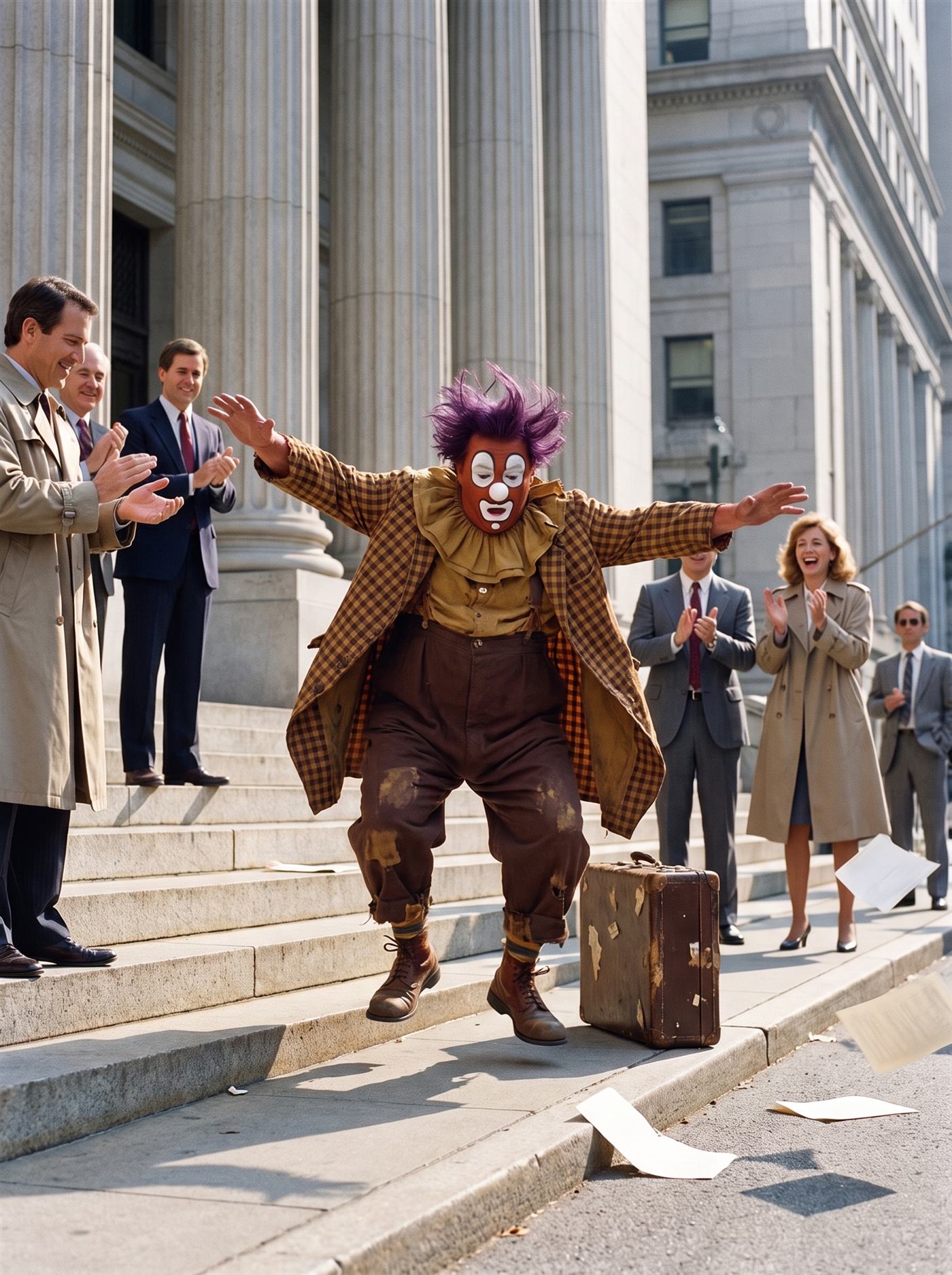
In the photograph of this day he has landed. Knees bent, arms out, hair still airborne, staring at his own feet with the astonishment his face was painted for — the professional fall, ended standing, for once. The suitcase beside him is intact and closed. The crowd applauds because it is watching the only act it wanted to see that week: gravity, negotiated.
The ground is the stone's grey-brown dark; the pigment is the wind-scoured gold of an October afternoon that ended, against the run of the week, in applause.
The artifact
The rescue had two instruments and both were sentences. The Federal Reserve's ran thirty-one words and was proven at the discount window by morning — Corrigan on the phones, Citicorp's street lending up sevenfold, the open-market desk operating early and conspicuously so the tape could watch. The corporations' sentence was shorter still: resolved, to repurchase. Critical mass came partway through Tuesday; by Wednesday some ninety large boards had passed it, and nearly six hundred would within two weeks — against 350 in the whole year before the crash. Between the two sentences the Dow climbed 186.84 points, the biggest single day ever recorded to that date, in a session the wires called orderly with evident relief. The applause was earned. The recovery still took twenty-two months.
Read the card
Printed text is shown plain; the clerk's entries are shown in script.
WEDNESDAY, OCTOBER 21, 1987 — RESOLVED, BY THE BOARD
- that the corporation is authorized to repurchase its own shares in the open market, the board having observed the price.
- the fed, before tuesday's bell, in one sentence: "...its readiness to serve as a source of liquidity..."
- by wednesday: some ninety boards resolved likewise.
- the industrials: up 186.84 · 10.15 percent — the biggest climb ever, on 449 million orderly shares.
- MARGIN CLERK'S HAND: the fed promised the money. the boards answered with one word: ours.
- NEARLY 600 RESOLUTIONS IN TWO WEEKS. THE PEAK STILL TOOK 22 MONTHS.
On Wednesday, October 21, 1987, the Dow rose 186.84 points, 10.15 percent, to 2,027.85 — the largest one-day point gain in its history at the time — completing a two-day recovery of more than half of Black Monday's loss. Thursday fell 3.82 percent, the following Monday retested at 1,793.93, and the August 1987 peak was not closed above again until August 24, 1989.
The ledger — what actually happened
| Measure | Close | Change | Marginalia |
|---|---|---|---|
| Dow Jones | 2,027.85 | +186.84 · +10.15% | "the biggest single-day climb ever" (TIME) — the point record at the time; per the daily record |
| S&P 500 | 258.38 · +9.10% | per the official series | |
| Volume | ≈449 million shares | the SEC chairman's own figure and the daily record agree — twice a normal day, calm by that week's standard | |
| The buybacks | ≈90 companies | by Wednesday, per TIME; nearly 600 within two weeks of the crash, against 350 in the whole year before it | |
| The recovery | Aug 24, 1989 | the first close above the August 1987 peak came 22 months later; Thursday gave back 3.82% and Monday retested at 1,793.93 |
Sources
- MeasuringWorth — Daily Closing Values of the Dow Jones Average (the crash week, the retest, and the Aug 24, 1989 recovery close, queried directly) — https://www.measuringworth.com/datasets/DJA/
- Mark Carlson, "A Brief History of the 1987 Stock Market Crash with a Discussion of the Federal Reserve Response" (Fed FEDS 2007-13) — the statement verbatim, Corrigan and Citicorp, the discount-window spike on the 21st, the Brady Report's buyback timing
- TIME, "The Crash: A Shock Felt Round the World" (Nov 2, 1987) — the superlative, the ninety companies, the prime rollbacks, "from hell to heaven"
- SEC Chairman David Ruder (Feb 18, 1988) — the 449-million-share day; Netter & Mitchell — the post-crash buyback count
- The official S&P daily series — 258.38, +9.10%; the July 26, 1989 S&P recovery date