At least through mid-2013
S&P 500 1,172.53 · +53.07 · +4.74% · the date-stamped zero
At 2:15 the Federal Reserve did a thing it had never done in ninety-eight years: it put a calendar date on easy money — exceptionally low levels, at least through mid-2013 — with three of its own members dissenting in writing. The market's first reading was despair; the promise implied the patient was sicker than anyone had said, and the Dow dropped two hundred points in the half hour after the words. Then the second reading arrived, the one the last forty-five minutes traded: two years of zero is two years of zero. Six hundred and thirty-six points of reversal in under eighty minutes, a close a fraction off the high, the ten-year briefly at a record 2.03 — and the fourth page of a week in which the Dow moved four hundred points or more every single day, the first such run in its history.
The day's protagonist
The date — no symbol.
Move: "at least through mid-2013" — the first calendar ever stapled to zero
Forward guidance had always been weather-talk — an extended period, a considerable time, words a committee could walk away from. At 2:15 on the day after the United States lost its triple-A, the committee stapled a date to it: economic conditions were likely to warrant exceptionally low levels for the federal funds rate at least through mid-2013. The New York Fed's own historians mark it as the first explicit-date guidance ever issued; three members — Fisher, Kocherlakota, Plosser — dissented in favor of the old vagueness, the most public split in years. The market read it twice. The first reading was grim — a two-year promise of zero is a two-year diagnosis, and the Dow fell about 205 points in the half hour after the words, to the session's 10,604 low. The second reading took hold with less than forty-five minutes left and went, in the day-of press's word, parabolic: 636 points of reversal into the bell, a 4.74 percent close a fraction off the high, breadth twelve to one, the ten-year note briefly at 2.03 percent — the lowest yield in the republic's records to that afternoon. BlackRock's strategist named the mechanism without ceremony: backdoor quantitative easing. It was the second act of the berserk week this archive already keeps the first page of — four straight sessions of 400-plus Dow points, never seen before, with the worst and best of them back to back.
The deeper account
Monday's page — the downgrade, the worst day since 2008 — ends with red ink; this one answers it inside twenty-four hours, and Wednesday answers this one, and Thursday answers Wednesday. The week traded like a wire pulled taut and plucked.
The pledge's paradox is the page's spine: the market fell on the promise before rising on it, because a central bank that dates its emergency admits its length. Both readings were correct. The zero lasted well past mid-2013.
The batch's oldest pages rhyme loudly here: 1929 timed its reassurance to the minute, 1931 announced its rescue after the close, 1987 proved its sentence at the discount window — and 2011 date-stamped the promise itself, with the dissent printed right in the document. The archive observes that the reassurances keep getting more precise, and the mornings after keep coming.
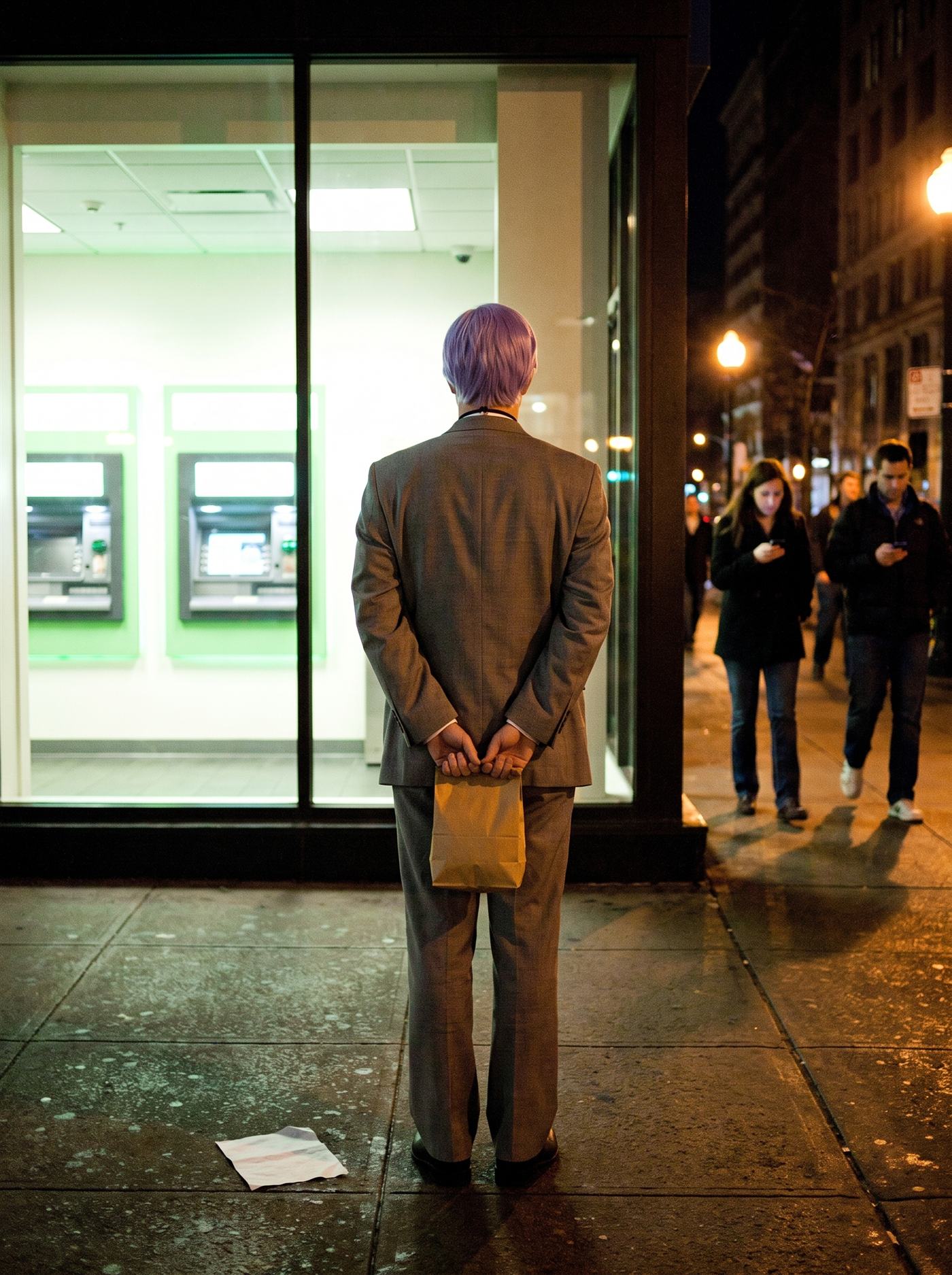
In the photograph of this day he stands at the glass of the lit, empty lobby with his hands behind his back and the bag held closed — the day after the downgrade, come back to look at the institution one more time. The canon stance, the decided trust. The machine glows whether or not it deserves him.
The artifact
The statement was a receipt for two years of zero, the first in the Fed's history to carry a date, with three of the committee's own names withheld from it. The market read it the way any depositor reads bad interest honestly disclosed — as a diagnosis first, down two hundred points in the half hour — and then read it again as a guarantee, six hundred and thirty-six points of reversal in the final eighty minutes, the ten-year note touching 2.03 along the way. The teller's line is the day's quiet half: somebody has to stand at the glass the day after the downgrade, and the archive knows exactly who. The fine print held, incidentally. Zero lasted well past mid-2013.
Read the receipt
Printed text is shown plain; the teller's entries are shown in script.
RECEIPT · 08/09/11 · 2:15 PM
- RATE ON YOUR SAVINGS: EXCEPTIONALLY LOW · TERM: GUARANTEED AT LEAST THROUGH MID-2013 — the first date ever printed on zero — three signatures declined to sign.
- THE FIVE HUNDRED: +4.74 PCT (after falling 200 points on this receipt's own news)
- THE TEN-YEAR: 2.03 PCT — RECORD · 4TH STRAIGHT 400-POINT DAY: FIRST TIME EVER
- TELLER'S HAND: he came back the day after the downgrade and stood at the glass. someone had to keep faith first.
On Tuesday, August 9, 2011, the FOMC's 2:15 statement promised exceptionally low rates "at least through mid-2013" — the first explicit-date forward guidance in Fed history, over dissents from Fisher, Kocherlakota and Plosser. The S&P 500 fell, then rose 4.74 percent to 1,172.53, closing near its high; the Dow's +429.92 made the week the first in its history with four consecutive 400-point days. Wednesday gave the rally back; Thursday restored it.
The ledger — what actually happened
| Measure | Close | Change | Marginalia |
|---|---|---|---|
| S&P 500 | 1,172.53 | +53.07 · +4.74% | closed 0.35 off the session high after a 636-point Dow reversal in the final eighty minutes; per the feed and the record |
| Dow Jones | 11,239.77 · +3.98% | +429.92 across a 640-point session range — the week became the first in Dow history with four straight 400-point days | |
| The statement | 2:15 p.m. — mid-2013 | the first date-stamped forward guidance in Fed history; three dissents (Fisher, Kocherlakota, Plosser). The market fell ~205 points on it before it rose | |
| The 10-year | 2.03% — record | briefly, after the statement — the pledge's first believer was the bond market | |
| The whiplash | −6.66 · +4.74 · −4.42 · +4.63 | four consecutive S&P sessions beyond ±4% — Wednesday took the whole rally back and Thursday restored it |
Sources
- FOMC statement, August 9, 2011 (federalreserve.gov) — "at least through mid-2013," the dissent roster, verbatim
- Federal Reserve Bank of New York, Liberty Street Economics — the first explicit-date forward guidance in Fed history
- AP, Aug 9 and Aug 11, 2011 — the 205-point post-statement drop, the sub-45-minute rally, 9.2B shares and 12:1 breadth, the record 2.03% ten-year, and the four-day 400-point Dow record
- The market-data feed + the official daily record — every close and the session extremes, agreeing with the day's press
- Bob Doll (BlackRock, via AP) — "backdoor quantitative easing"