Read one at a time
S&P 500 7,686.14 · −25.62 · −0.33%
The S&P 500 fell 25.62 points to 7,686.14 on the last session of August, a third of one percent. Read only that and nothing happened all day. Over the weekend the California legislature settled the text of a wildfire bill without the liability relief its utilities had been counting on, and on Monday Edison International opened sixteen dollars below Friday's close and finished down 23.07 percent — its worst session since April 2001. PG&E fell 20.06, its worst since March 2020. Between Thursday's close and Monday's the two of them lost almost exactly the same quarter of themselves: 26.74 percent and 26.07. The utilities sector, which contains them both, printed −1.17. That is the number an average gives you when two of its members are destroyed and the rest of them go home at the usual time.
The day's protagonist
Edison International EIX
Move: −23.07% to 53.98 — its worst session since April 2001, on 24.67 million shares against three and a half million a week earlier
Nothing happened to Edison International on Monday. Everything that happened to it happened over the weekend, five hundred miles from any exchange, in the drafting of a bill. California's legislative leaders and the governor settled on a compromise text for Senate Bill 492 that left out the wildfire-liability relief the utilities and their shareholders had been counting on: the bill does not substantially change how much a utility must pay after a fire it causes, and the people who lose houses keep their right to sue. The market had already begun reading the amendments on Friday, when the stock fell 4.76 percent to 70.17 on 7.40 million shares, twice its recent volume, on an afternoon whose attention was entirely elsewhere. Monday was the rest of it arriving at once. It did not trade down to the number; it opened there. The first print was 55.71, fourteen dollars and forty-six cents below Friday's close, and the whole session afterwards was a twenty-two-hour-old decision being confirmed: a high of 57.23, a low of 53.11, a close at 53.98 on 24.67 million shares against the three and a half million it had traded on each of the two sessions before Friday. The feed's own history is unambiguous about the size of it. In the feed's daily history, which begins in September 1999, Edison has had exactly two worse days — the sixth of April 2001, down 34.73 percent, and the sixth of March 2000, down 30.00 — both of them out of the California power crisis, which is the same subject. Twenty-five years and five months later the same state took another quarter off the same company with a piece of paper, and the index it sits inside moved a third of one percent.
The deeper account
The session itself is almost not worth describing, which is the point of it. The opening print, 7,697.52, was the high of the day, and it was gone inside ten minutes; the first bar closed sixteen points lower. The low, 7,665.06, came at twenty past ten. The Dallas Fed's manufacturing survey landed ten minutes after that, at half past, with its general activity index at 11.6 against 1.3 the month before — a better number, published ten minutes after the market had already stopped falling, and no source connects the two. From there the tape spent five hours inside a narrow band and then climbed, and at ten minutes to four it printed 7,696.33, one and nineteen hundredths of a point below where it had opened six and a half hours earlier. It gave up 10.19 of that in the last ten minutes and settled at 7,686.14. Month-end flows are the obvious explanation for a final-ten-minute drop and no estimate of them exists for this date, so the archive records the sequence and declines the cause. The whole excursion, high to low, was 32.46 points — four tenths of one percent. Two things worth keeping: the Nasdaq 100 rose 0.08 percent while the S&P fell 0.33, so the average was disagreeing with itself; and the VIX rose 3.40 percent to 14.92, which is a shrug wearing the clothes of a warning.
Underneath it the board looked like a rates day and was not one. Two sectors closed green and nine red — energy up 2.04 and technology up 0.44 against communication services down 1.35, utilities down 1.17, industrials down 1.14 — 3.40 percentage points from top to bottom under an index that moved a third of one. The utilities line is the one that lies. Edison International fell 23.07 percent and PG&E 20.06, and Sempra, the third California name, fell 3.10; NextEra rose 0.61, American Electric Power rose 0.10, Duke fell 0.28. The sector did not sell off. Two of its members were taken out and the fund averaged them in with everybody who had an ordinary afternoon, and what came out the other end was a tidy defensive-sector number that a reader could file under rising yields and forget. Yields did rise, modestly and at the long end — the ten-year about four basis points to roughly 4.76 percent, its highest since January 2025, the thirty-year about five, the two-year roughly flat, which is a steepening and not a repricing; the front end had already done its repricing on Friday when Warsh spoke. Futures held the odds of a September hike somewhere between sixty and sixty-six percent depending on the hour you asked and the vendor you asked, and no clean Friday-to-Monday move in them can be isolated. None of that explains a company losing a quarter of itself. A bill did.
Three more companies were wrecked on Monday by news the index never registered, and two rose for reasons unrelated to anything the tape was supposedly about. Aon fell 9.53 percent because it agreed to pay KKR seventeen billion dollars for USI Insurance Services, funded with debt, dilutive in 2027, and its own shareholders declined to applaud. Howmet Aerospace fell 7.51 after a Saturday post about turbine blades. Amazon fell 2.50 as the reporting hardened that the Federal Trade Commission and twenty-two state attorneys general were preparing to sue it over advertising-auction pricing; the complaint was filed in the Western District of Washington the same day, though as late as three in the afternoon the market was still trading the preparation and not the filing. Against them: SLB rose 4.83 percent, the best energy name in the index, on the morning it agreed to buy a data-centre cooling business for about 3.4 billion in cash — so on the day an American strike in the Strait of Hormuz put Brent at 90.49 a barrel, the best-performing oil-services stock in America rose because of air conditioning. And Tesla rose 5.51 percent, the largest move among the big names, for no cause this archive is willing to name: every candidate is either older than the session or arrived hours before the buying did. August closed on all of this at 7,686.14, up 2.62 percent for the month — a month that made its entire gain in its first two sessions, on the third and fourth, and spent the other nineteen giving back fifty points of it. Nine of its twenty-one days were up and it rose anyway. The average is very good at this.
The artifact
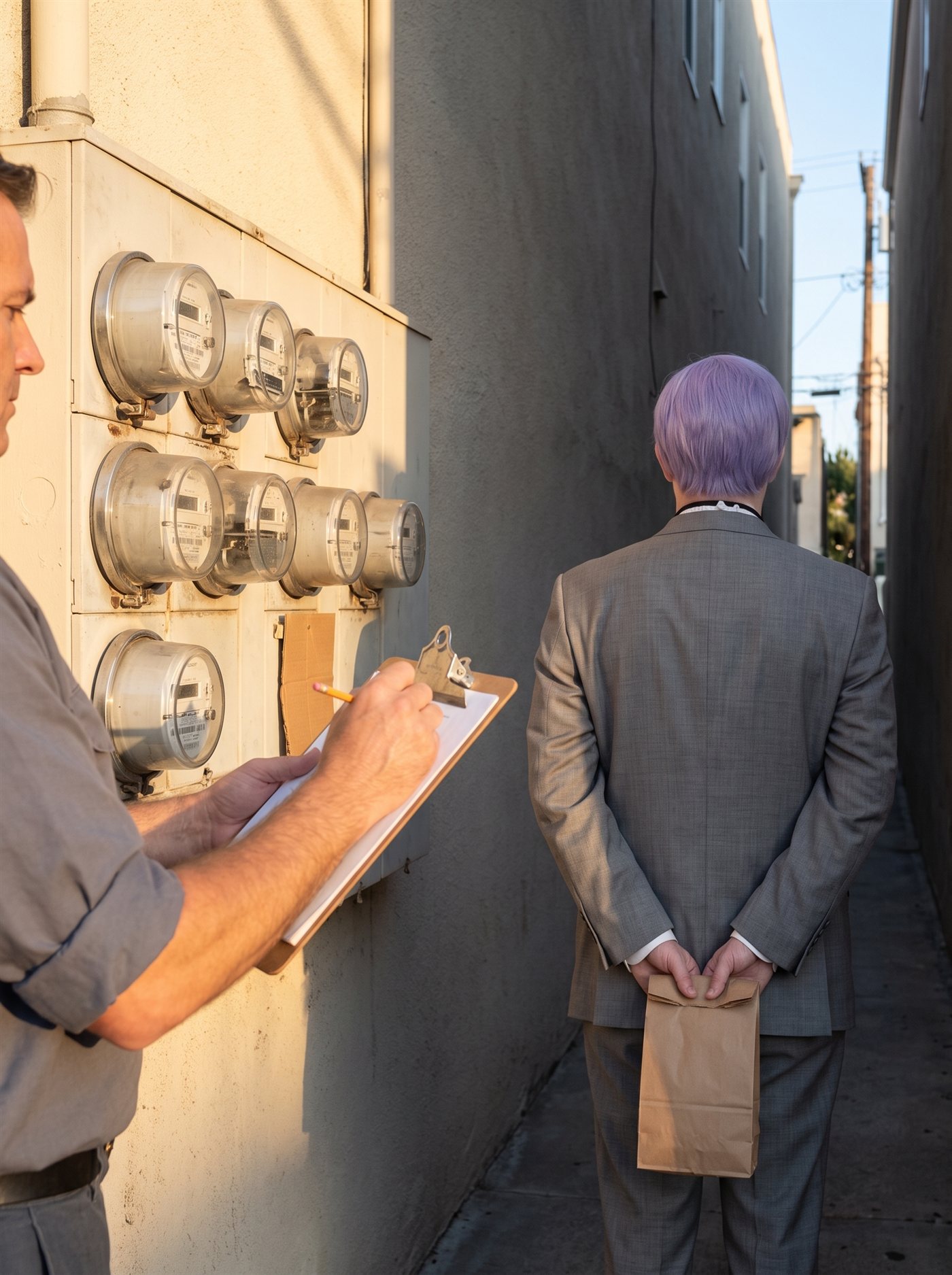
A meter reader walks the route and writes down what each one says. Nobody averages a route; the whole value of the card is that it keeps the readings apart. Monday's utilities fund did the opposite, and the figure it published — one and a sixth of one percent — is arithmetically correct and tells you nothing that happened. Two of the meters on this card had a quarter and a fifth taken off them by a bill drafted over a weekend. Three of them did not move enough to notice. The card is the honest document because it refuses to add them up.
Read the card
Printed text is shown plain; handwritten entries are shown in script.
ROUTE CARD · MONTH END · Nº 08-31
- ROUTE: the utilities route
- DATE: the last of August
- READ ONE AT A TIME: EDISON INTL −23.07 · PG&E −20.06 · SEMPRA −3.10 · DUKE −0.28 · AM ELECTRIC PWR +0.10 · NEXTERA +0.61
- THE SECTOR (AVERAGED): −1.17
- NOTES: two of them were destroyed. the rest went home at the usual time. the fund printed one and a sixth.
- READ A METER RECORDS WHAT WAS USED, NOT WHAT WAS SAID.
An average is not a reading.
The ledger — what actually happened
| Measure | Close | Change | Marginalia |
|---|---|---|---|
| S&P 500 | 7,686.14 | −25.62 · −0.33% | the opening print, 7,697.52, was the day's high and it was gone inside ten minutes · low 7,665.06 at 10:20 · back to 7,696.33 at 3:50, one and nineteen hundredths under the open · and then it gave up 10.19 in the last ten minutes and settled 11.38 below where it started. No source establishes a cause for the late fade; month-end is a plausible explanation nobody has evidenced |
| Edison International | 53.98 | −23.07% | opened at 55.71, fourteen dollars and forty-six cents under Friday, and never traded near it again. Worst session since April 2001; 24.67 million shares against three and a half million a week earlier |
| PG&E | 13.27 | −20.06% | the same weekend, the same bill. Worst session since March 2020, on 152.9 million shares. Between them the two companies traded 177 million shares on a day the market called quiet |
| Sempra | 81.70 | −3.1% | the third California utility, and the size of the gap is the point: a tenth of what the other two took. The bill was read as a judgement on two balance sheets, not on a state |
| The rest of the route | +0.61% / +0.10% / −0.28% | NextEra, American Electric Power and Duke Energy — the same sector, the same session, the same rates. They went home at the usual time | |
| The sector line | −1.17% | what the utilities fund printed, and the most misleading number on the board. Read it and you conclude that rates hurt the bond proxies. Read the meters one at a time and you find two companies destroyed and everybody else unmoved | |
| Aon | 321.52 | −9.53% | punished by its own holders for agreeing to buy USI Insurance Services from KKR for 17.0 billion dollars, debt-funded, dilutive to adjusted earnings in 2027; S&P Global cut its outlook to negative. A second company wrecked by its own news |
| Howmet Aerospace | 244.95 | −7.51% | a third. The move followed a post Elon Musk made on Saturday about turbine blades; the man did not speak on Monday, the stock only answered on Monday |
| Tesla | 367.95 | +5.51% | the largest gain among the big names, and the one the archive cannot explain. The Cybercab event had been public since the twenty-third; the turbine post was Saturday; the Hong Kong price cut crossed at 4:59 in the morning and the tape drifted lower for four and a half hours afterwards. News broke and the tape did not answer it, then answered something else |
| SLB | 60.10 | +4.83% | the best energy name in the index on a day a strike in the Strait of Hormuz put Brent at 90.49 — and it rose on air conditioning. Before the open it agreed to buy Kelvion, a data-centre cooling business, for about 3.4 billion in cash. Nearly double the next-best energy name, for a reason that has nothing to do with oil |
| The fear gauge | 14.92 | up 3.40 percent and still under fifteen. Two companies lost a fifth and a quarter of themselves and the instrument that exists to notice fear closed where it closes on an ordinary Monday |
Sources
- Robinhood market-data feed — SPX 10-minute bars and settle quote; VIX and NDX settle quotes; day bars and official settled closes (sip-list-exchange-close) for EIX, PCG, SRE, DUK, NEE, AEP, AON, HWM, TSLA, SLB and the eleven sector SPDRs; EIX and PCG full daily history from 1999 for the two superlatives. Every percentage on this page, including every sector and both worst-session claims, is computed from the feed. Pulled 2026-08-31 after the close, fully settled
- CalMatters — the SB 492 compromise text and what it left out (published Aug 29, updated Aug 31) — https://calmatters.org/
- Office of the Governor of California — statement on the wildfire legislation agreement, Aug 29 — https://www.gov.ca.gov/
- Reuters — US market close wrap, Aug 31 (the Dow's 53,185.90 / −374.09 / −0.70%, session volume, and the breadth ratio; the Dow is press-only, the feed does not carry it)
- SLB — announcement of the agreement to acquire Kelvion (8-K exhibit, Aug 31) — https://www.slb.com/
- Aon — announcement of the agreement to acquire USI Insurance Services from KKR (Aug 31) — https://www.aon.com/
- Federal Trade Commission and 22 state attorneys general v. Amazon.com — complaint filed in the Western District of Washington, Aug 31
- Federal Reserve Bank of Dallas — Texas Manufacturing Outlook Survey, released 10:30 a.m. ET Aug 31 — https://www.dallasfed.org/research/surveys/tmos