The freeze
S&P 500 103.39 · +0.45 · +0.44%
At 5:45 the phone woke the President: Tehran wanted its money out. Before the banks opened, every Iranian government dollar in America was stopped where it sat — the first freeze. The market wobbled two percent, closed up half of one, and did roughly as it was told. The glass has never quite thawed.
The day's protagonist
The order — no symbol.
Move: twelve billion dollars — or eight, or six; nobody could count it — stopped before breakfast
Ten days after the embassy in Tehran fell, Iran's acting foreign minister announced the follow-through: the country would pull its deposits — some twelve billion dollars, by his count — out of American banks, naming David Rockefeller's Chase Manhattan first. The call reached President Carter at 5:45 in the morning, and the answer was signed before the banks opened: Executive Order 12170, the first great invocation of the two-year-old International Emergency Economic Powers Act, blocking every Iranian government and central-bank asset in American custody, foreign branches included. How much money was that? Tehran said twelve billion; the Treasury counted less than six billion liquid, the largest piece $1.3 billion in notes at the Federal Reserve Bank of New York; the papers wrote eight. The White House statement made the uncertainty official and asked the markets not to mind. They mostly obliged — a two-percent wobble, a 0.44 percent close. The freeze held 433 days, until the hostages flew home. The emergency it declared has been renewed by every president since: the oldest standing national emergency in American law, and the ancestor of every frozen account after it.
The deeper account
Three months earlier this book kept the emptiest page in its century — the obituary, the crowd gone. The crowd was still gone in November, so nobody was in the seat for this either: the first day the thing on the wrong side of the pane was the money itself.
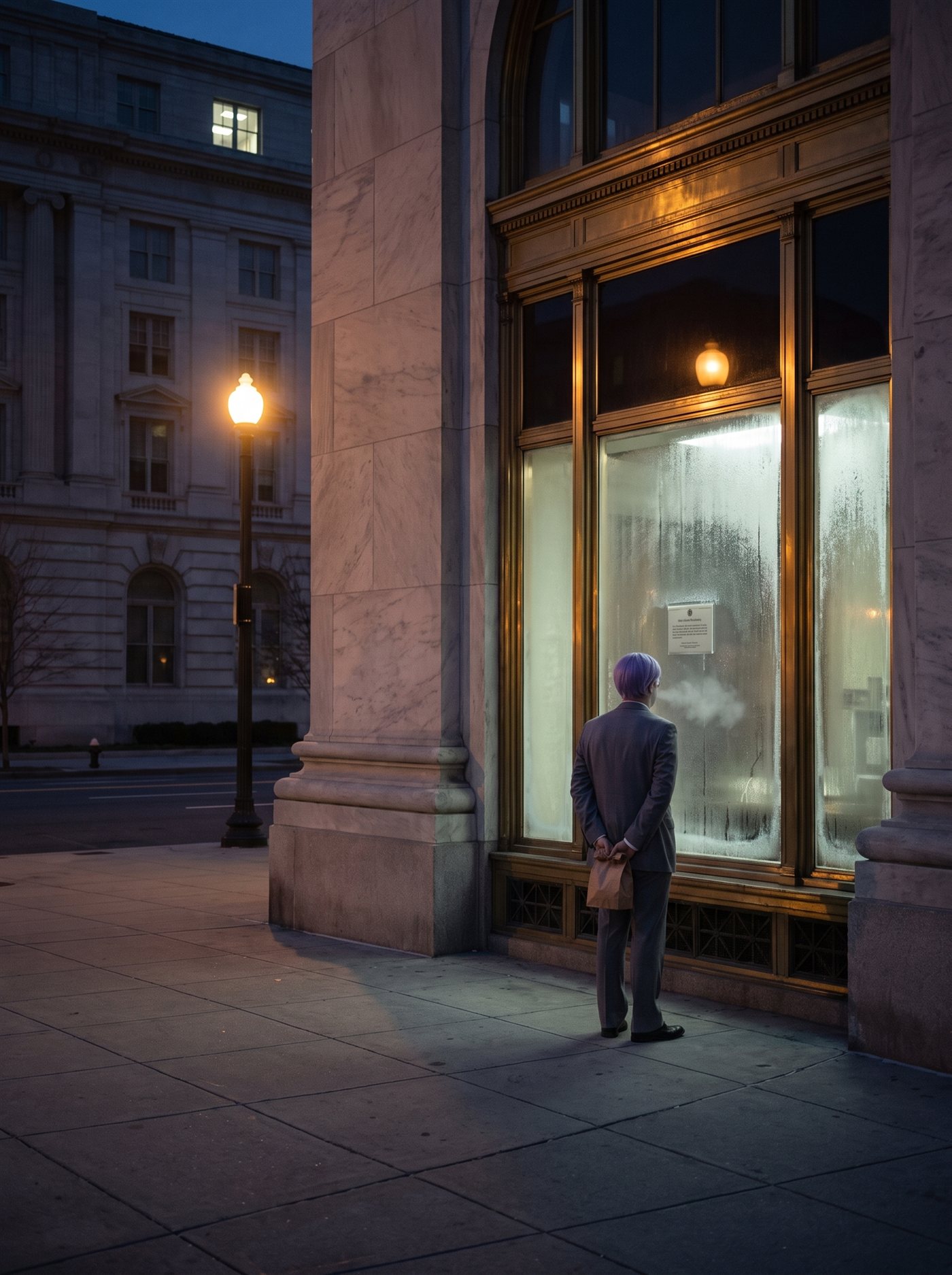
In the photograph of this day he has the sidewalk to himself, the way he had the newsstand's departure to himself in August. He came back to look at a window nobody can withdraw through. The notice is taped on the inside.
The order was the first great use of the International Emergency Economic Powers Act, and it became the template: every sanctions regime, every frozen account, every blocked reserve since is this morning's descendant. The emergency it declared has been renewed by every president since 1979 — the oldest standing national emergency in American law.
Reserve holders drew the quiet lesson: a dollar that can be stopped where it sits is a dollar you hedge. Gold had been climbing all autumn; ten weeks after this morning it printed $850 an ounce — a record that stood for almost three decades.
The ice broke on January 20, 1981 — 433 days on — through the Algiers Accords, in the same hour the hostages left Tehran. The money thawed; the emergency never did.
The artifact
The order was real and the uncertainty was official: the White House conceded the precise amounts could not be ascertained, then asked the markets not to mind — and they mostly obliged, a two-percent wobble tucked inside a half-percent close. The notice is the first of its kind: every sanctions regime, every frozen account, every blocked reserve since is this morning's descendant. The freeze held 433 days; the emergency it declared has outlived its crisis by decades.
Read the notice
Printed text is shown plain; the official's entries are shown in script.
TAPED INSIDE THE GLASS · WEDNESDAY, NOV 14 · BY EXECUTIVE ORDER
- effective before the banks opened: every account of the government of iran, in american custody, blocked where it sits. · BLOCKED
- how much money is that: tehran's count: $12 billion. the treasury's: under $6 billion liquid — $1.3 billion of it in notes at the new york fed. the papers wrote: $8 billion.
- AN OFFICIAL'S HAND: the call came at 5:45. the order was signed before the banks opened. no reason for disturbance.
- HELD 433 DAYS · THE EMERGENCY NEVER LAPSED — THE OLDEST STANDING IN AMERICAN LAW
On Wednesday, November 14, 1979 — ten days after the embassy in Tehran fell — Iran announced it would pull its deposits from American banks, and Executive Order 12170 was signed before the banks opened, blocking every Iranian government asset in American custody. The White House's statement conceded the precise amounts could not be ascertained but saw "no reason for disturbance"; the S&P 500 wobbled two percent and closed up 0.44 at 103.39. The freeze held until January 20, 1981, the hour the hostages left Tehran; the national emergency it declared has been renewed by every president since.
The ledger — what actually happened
| Measure | Close | Change | Marginalia |
|---|---|---|---|
| S&P 500 | 103.39 | +0.45 · +0.44% | the day's range ran 101.91–104.13 — a two-percent wobble tucked inside a half-percent close |
| The call | 5:45 a.m. | Treasury Secretary Miller wakes the President: Iran has ordered its deposits out of American banks | |
| The order | E.O. 12170 | signed before the banks opened — every Iranian government and central-bank dollar in American custody, stopped where it sat | |
| The count | $12B? $8B? $6B? | Tehran said twelve; the Treasury counted under six liquid, $1.3 billion of it in notes at the New York Fed; the papers wrote eight | |
| The statement | 'no reason for disturbance' | the White House, to the foreign exchange and other markets, which wobbled and mostly obliged | |
| Still in force | renewed every year | the national emergency declared this morning has outlived its crisis by decades — the oldest standing emergency in American law |
Sources
- S&P 500 daily closes, public historical record (Nov 1979), retrieved 2026-08-16 — pre-feed dailies lane
- FRUS 1977–1980, vol. XI pt. 1, doc. 30 — Editorial Note (Bani-Sadr's $12B announcement; the Treasury's under-$6B count and the $1.3B at the New York Fed) — https://history.state.gov/historicaldocuments/frus1977-80v11p1/d30
- CAFE — 'No Reason for Disturbance': The Birth of IEEPA and President Carter's Asset Freeze on Iran (the 5:45 a.m. call; the statement text) — https://cafe.com/article/no-reason-for-disturbance-the-birth-of-ieepa-and-president-carters-asset-freeze-on-iran/
- Executive Order 12170 — Blocking Iranian Government Property (American Presidency Project, full text) — https://www.presidency.ucsb.edu/documents/executive-order-12170-blocking-iranian-government-property
- Wikipedia — Executive Order 12170 (the renewals; the oldest standing state of emergency) — https://en.wikipedia.org/wiki/Executive_Order_12170
- Brookings — How the Iran hostage crisis shaped the US approach to sanctions — https://www.brookings.edu/articles/how-the-iran-hostage-crisis-shaped-the-us-approach-to-sanctions/
- The Washington Post — 'The Freeze', Nov 15 1979 (signed early morning, on reports Iran planned withdrawal) — https://www.washingtonpost.com/archive/politics/1979/11/15/the-freeze/a2fbd1b3-d4ae-4931-838f-33dd75a0fe09/
- Gold's $850/oz record, January 21 1980 — public historical record