The one not saved
S&P 500 1,192.70 · −59.00 · −4.71%
Two rescues and one refusal came out of the weekend. The tape fell all day and closed on its exact low — no bounce, no bid, nothing bought back.
The day's protagonist
Lehman Brothers LEH
Move: 158 years, ended by a weekend: $639 billion in assets, the largest bankruptcy in American history
The weekend at the New York Fed produced two rescues and one refusal. Merrill Lynch sold itself to Bank of America overnight for fifty billion. AIG began its public death, rescued the next evening for eighty-five. And Lehman — founded 1850, survivor of the Civil War, the Depression, and every panic between — was allowed to file: four times the record WorldCom set on this wing's first page. Moral hazard was the doctrine of the day. By Wednesday the doctrine was abandoned; by Wednesday the money markets had already broken, and the crisis had stopped being about banks.
The deeper account
The feed's day bar keeps the day's cruelest detail: open 1250.92, low 1192.70, close 1192.70. The market fell all session and finished on the bottom tick.
The refusal was reasoned: Bear's rescue in March (five pages back) had been read as precedent, and the authorities meant to unteach it. The lesson cost more than the tuition.
By Tuesday the Reserve Primary Fund — a money-market fund holding Lehman paper — broke the buck, and the panic moved from Wall Street's banks to everyone's cash.
This page and 2001-09-17 share a register: the house mourns in grey, and both days were measured against each other on the tape.
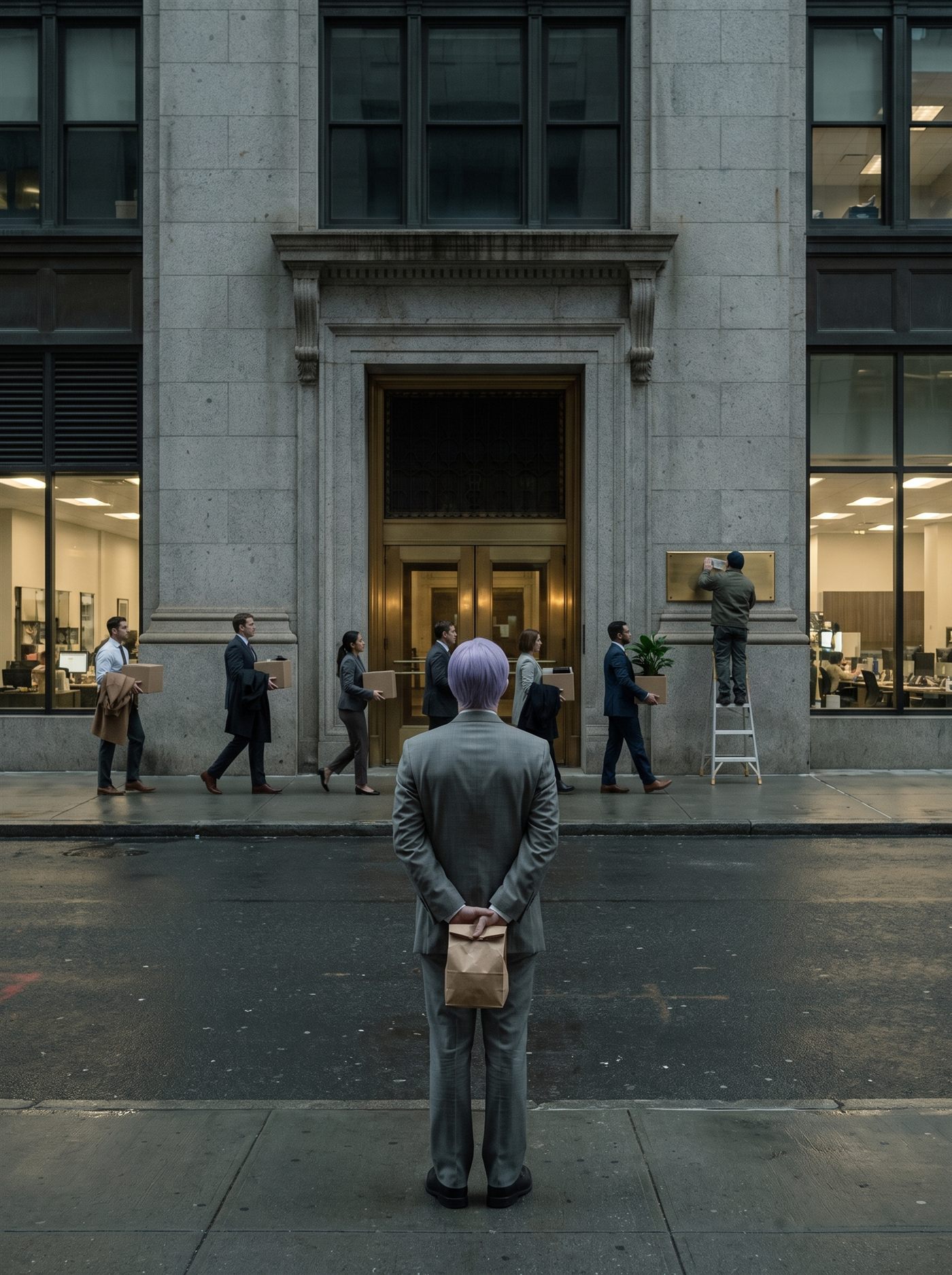
In the photograph of this day the neighbors' windows stay lit while one house goes dark floor by floor. He stood on the far sidewalk while the boxes came out; retail watched, and could not tell the rescued from the lucky.
The record WorldCom set in 2002, this filing took. No filing since has taken it from Lehman.
The artifact
The order carries no stamp — the house does not decorate grief. Its two blank lines, buyer and line, are the whole weekend: of the three houses in trouble, two found a rope, and the one with the animal's own patience — 1850, the Civil War, the Depression, every panic between — was let go on purpose, to prove a doctrine that did not survive the week either.
Read the removal order
Printed text is shown plain; the workman's entry is shown in script.
MONDAY, SEPT 15 · POSTED AT THE DOOR · REMOVAL ORDER
- contents of the house: 158 years.
- value at filing: $639,000,000,000 — THE LARGEST IN AMERICAN HISTORY. STILL.
- buyer: none. line to it: none.
- THE NEIGHBORS, SAME WEEKEND: next door — sold overnight, ≈ $50,000,000,000, agreed before the far markets opened. across the street — one day left; $85,000,000,000 on Tuesday evening.
- WORKMAN'S HAND, AT THE NAMEPLATE: they carried the boxes out themselves.
- THE TAPE FELL ALL DAY AND CLOSED ON ITS EXACT LOW: 1,192.70 · NO BOUNCE, NO BID, NOTHING BOUGHT BACK
On Monday, September 15, 2008, Lehman Brothers filed the largest bankruptcy in American history — $639 billion in assets, four times WorldCom's 2002 record — after a weekend in which Merrill Lynch was sold to Bank of America and AIG moved within a day of its $85 billion rescue. The S&P 500 fell 4.71 percent to 1,192.70, closing on its exact low. By Wednesday the Reserve Primary Fund had broken the buck and the panic had moved to everyone's cash.
The ledger — what actually happened
| Measure | Close | Change | Marginalia |
|---|---|---|---|
| S&P 500 | 1,192.70 | −59.00 · −4.71% | the worst day since the September 2001 reopening — that page is already in this book |
| Dow Jones | 10,917.51 | −504.48 · −4.42% | five hundred points, given up without a single rally that held |
| Lehman Brothers | $639 billion | assets at filing — the largest bankruptcy in American history | |
| Merrill Lynch | sold overnight | about $50 billion to Bank of America, agreed before the Asian open | |
| AIG | one day left | downgraded that evening; rescued the next, at $85 billion |
Sources
- History.com — Lehman Brothers declares bankruptcy, September 15, 2008 — https://www.history.com/this-day-in-history/september-15/lehman-brothers-collapses
- Wikipedia — Bankruptcy of Lehman Brothers — https://en.wikipedia.org/wiki/Bankruptcy_of_Lehman_Brothers
- CNNMoney market report, September 15, 2008 — https://money.cnn.com/2008/09/15/markets/markets_newyork2/index.htm
- Public record — SPX 1,192.70 (−4.71%); Dow 10,917.51 (−504.48); $639B assets at filing