Pelt price
S&P 500 1,276.60 · −11.54 · −0.90%
What an old animal fetches when it must be sold by morning. The tape stayed almost calm; the calm was everyone doing the same arithmetic.
The day's protagonist
Two dollars BSC
Move: An 85-year-old firm priced at $2 a share — about $236 million, less than the value of its headquarters building
On Sunday night JPMorgan agreed to take Bear Stearns for two dollars a share, the Fed absorbing $30 billion of Bear's mortgage book to make the marriage possible. The same weekend the Fed opened its window to investment banks for the first time since the Depression. Bear had survived 1929 without a layoff; it did not survive a week of margin calls. Monday's market barely fell — the Dow finished green — but Bear traded at $4.81 against the $2 offered, the market betting the price was too insulting to stand. It was: JPMorgan paid $10 within the week. The real print of the day was gold, past a thousand dollars for the first time in history.
The deeper account
The week before: Bear's clients pulled their money and its lenders pulled their lines — a wholesale bank run, the old kind, conducted by fax and phone.
The Primary Dealer Credit Facility, announced that Sunday, meant the Fed now stood behind institutions it did not regulate. The rules changed over a weekend, and everyone knew it.
Lehman Brothers fell by roughly a fifth on Monday as the market asked its only question: who is next? The answer took six months to print — it is the next page of this wing.
The Dow closing green is the day's strangest fact. Rescues read as relief for exactly one session; the S&P's March 17 low held only until July.
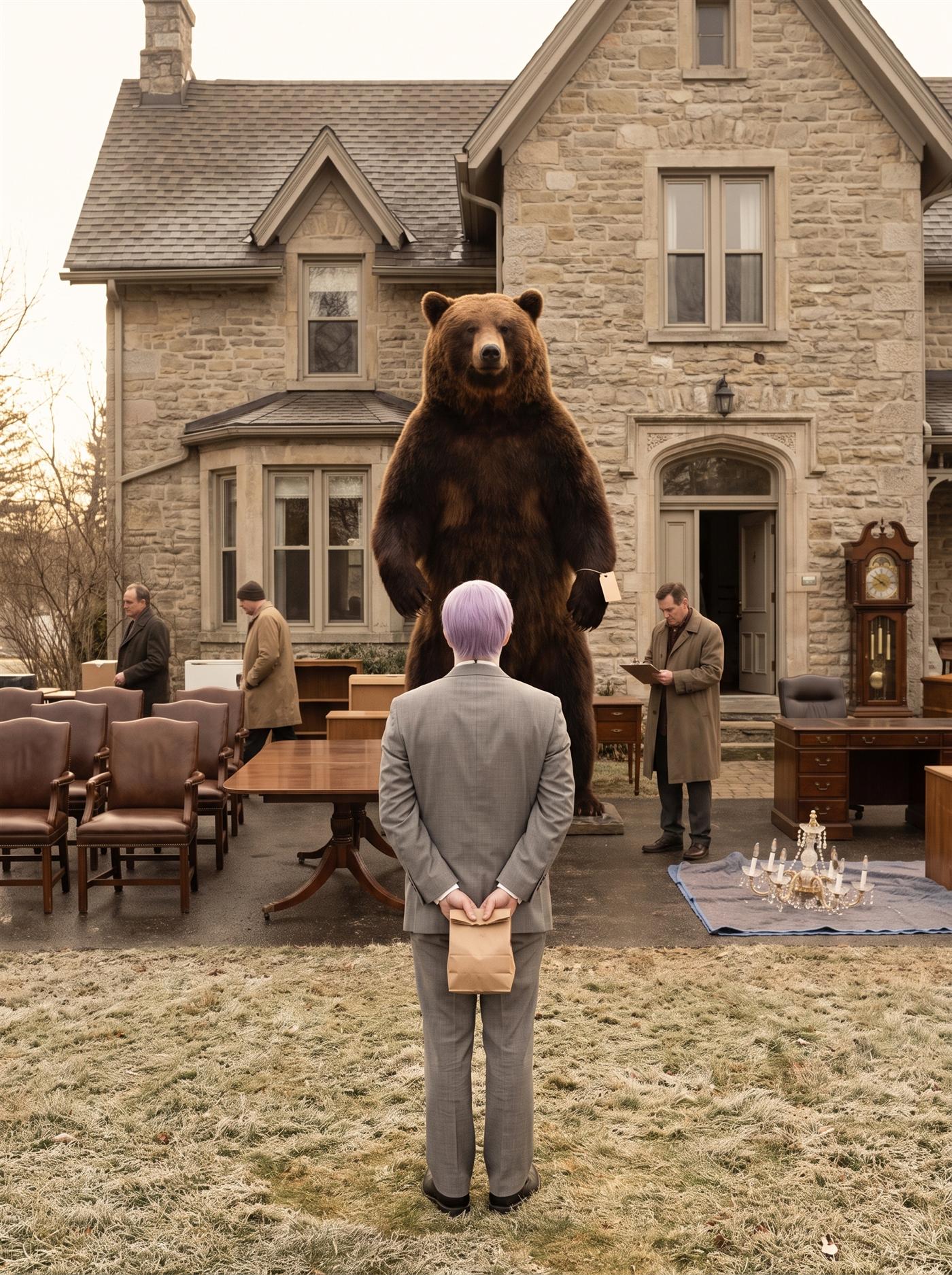
In the photograph of this day the animal stands taller than everything being sold around it, wearing a tag too small to read. He came early with the dealers; retail looked at the tag like everyone else, and made the same arithmetic.
Six days on this book's shelf separate two prices of fear: gold's first thousand here, and Lehman's zero in September.
The artifact
The card's arithmetic is the day's dread in miniature: an 85-year-old house priced below its own headquarters, and a market too polite to fall — the Dow finished green. The tape traded the animal at $4.81 against the two offered, betting the price was too insulting to stand, and won. The fine print holds the honest number: gold's first thousand, printed the same afternoon.
Read the lot card
Printed text is shown plain; the auctioneer's entries are shown in script.
HURRIED SALE · CONTENTS OF THE HOUSE · MONDAY, MAR 17 · LOT Nº 1 — THE GREAT BEAR
- age: 85 years. condition: survived 1929 without a layoff. did not survive one week of margin calls.
- hammer price: $2 — ≈ $236,000,000 · LESS THAN THE VALUE OF ITS OWN BUILDING
- SOLD
- APPENDED, AUCTIONEER'S HAND: buyer raised it to ten within the week. embarrassment, not generosity.
- SAME AFTERNOON: GOLD PAST $1,000 FOR THE FIRST TIME — FEAR'S OWN PIGMENT · AND THE WINDOW OPENED: FIRST TIME SINCE THE DEPRESSION
On Sunday night, March 16, 2008, JPMorgan agreed to buy Bear Stearns for $2 a share — about $236 million — with the Fed absorbing $30 billion of Bear's mortgage book; the offer was raised to $10 within the week. The same weekend the Fed opened direct lending to investment banks for the first time since the Depression. On Monday the S&P 500 slipped 0.90 percent to 1,276.60, the Dow closed green, and COMEX gold crossed $1,000 an ounce for the first time in history.
The ledger — what actually happened
| Measure | Close | Change | Marginalia |
|---|---|---|---|
| S&P 500 | 1,276.60 | −11.54 · −0.90% | a quiet tape over a loud grave; the morning's panic mostly bought back |
| Dow Jones | 11,972.25 | +21.16 · +0.18% | closed green while the fifth-largest investment bank ceased to exist |
| Bear Stearns | $30 → $4.81 | against two dollars offered; JPMorgan raised it to ten within the week | |
| Gold | $1,017.50 | an all-time high, the ounce past a thousand for the first time — fear's own pigment | |
| The Fed | the window opens | direct lending to investment banks, first time since the Depression |
Sources
- CNNMoney, March 17, 2008 — Stocks slump on Bear Stearns deal, Fed action — https://money.cnn.com/2008/03/17/markets/markets_morning/index.htm
- JPMorgan Chase press release, March 16, 2008 — SEC EDGAR — https://www.sec.gov/Archives/edgar/data/19617/000089882208000286/pressrelease.htm
- History.com — Bear Stearns sold to J.P. Morgan Chase — https://www.history.com/this-day-in-history/march-16/bear-stearns-sold-to-j-p-morgan-chase
- Public record — Dow +21.16 to 11,972.25; BSC closed $4.81; COMEX gold record $1,017.50 intraday